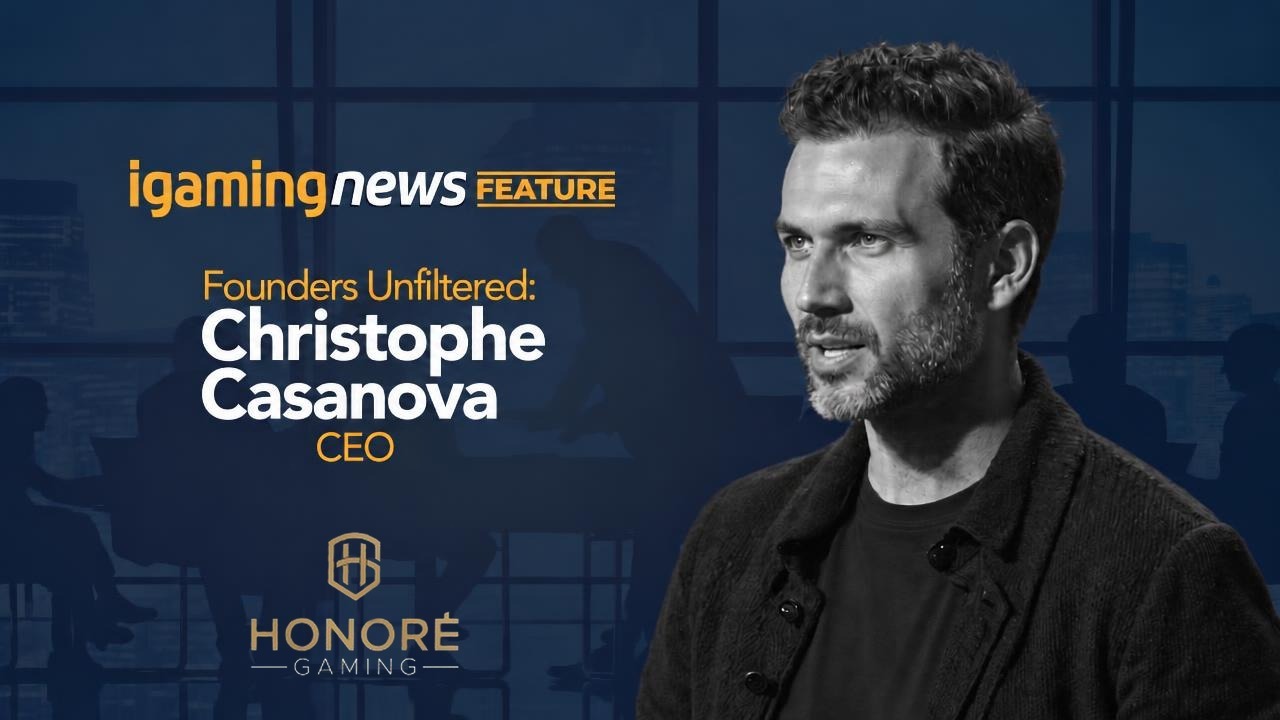
Founders Unfiltered: Honoré Gaming’s Christophe Casanova on Patience, Local Relevance and Betting on Yourself
In this edition of Founders Unfiltered, Christophe Casanova tells iGaming News how Honoré Gaming pioneered sports betting infrastructure for Francophone Africa, why patience is a founder's most tested trait, and why innovation without local relevance is not innovation at all.
Listen to this article
British female voice
When Honoré Gaming set out to build sports betting infrastructure for Francophone Africa, there was no playbook to follow. Most of what existed was either a Western import that did not fit local realities, or nothing at all, leaving the team to design around how these markets actually work, from payments and distribution to the retail agent networks that carry much of the volume.
In this edition of Founders Unfiltered, Christophe Casanova tells iGaming News why patience is the most tested trait of any founder, how pushing products without a local lens taught him that innovation must be relevant to the market, and why the company took a leap with little to no money to build its own platform. He also shares his views on mobile money, overhyped AI personalisation, and what founding a company has cost him personally.
1. What was the original idea behind your company, and what convinced you to take the leap and build it?
We were pioneers in Francophone Africa. When we started, there simply wasn't a platform built for these markets: everything available was either a Western import that didn't fit local realities, or nothing at all. Nobody else was seriously trying to build a sports betting infrastructure designed around how these markets actually worked, from payments to distribution to the retail agent networks that carried most of the volume. Being first meant there was no playbook to copy; we had to write it as we went, which was both the risk and the opportunity.
2. What has been the hardest part of building the business that nobody warned you about?
Patience. Nobody warns you that the hardest part of this business isn't the technology, it's waiting: for licences, for regulatory clarity, for a client to finally sign, for a market to mature enough to justify the investment you already made. You can do everything right and still spend years waiting for the pieces to align. That kind of patience isn't a skill people talk about when they describe what it takes to be a founder, but it's probably the single most tested trait.
3. What has been your biggest mistake as a founder, and what did it teach you?
Not looking at the market enough through a local lens. In the beginning, we sometimes tried to be innovative by pushing products that felt cutting-edge to us but simply weren't adapted to how people in these markets actually bet, pay, or engage with a platform. It taught me that innovation without local relevance isn't innovation at all, it's just a mismatch dressed up as ambition. The real work is understanding the market on its own terms before deciding what to build for it.
4. Was there ever a point when you seriously questioned whether the business would succeed? What happened?
Yes, absolutely. We first used an external platform where we set our own odds, and it didn't take long to realise that it simply wasn't built for Africa; it couldn't handle the realities of the market we were operating in. We had to develop our own, but at that point we had little to no money. We closed our eyes and took the leap. There was no safety net; it was a genuine bet on ourselves at a moment when failure would have meant the end of the company.
5. What is the biggest lesson you have learned about leadership and building the right team?
That competence isn't the same as fit, and fit isn't the same as loyalty. In a company operating across Africa and Central America, spanning product, infrastructure, trading, legal, and support, you need people who genuinely understand that each department has to stay within its scope and trust the others, otherwise you get chaos disguised as collaboration. The biggest shift for me was learning to hire for judgement and trust people to operate within their lane, rather than trying to control every decision myself.
6. What has been your biggest challenge when it comes to growing and scaling the business?
Balancing our open-source, small-footprint philosophy with the reality that scaling across multiple regulatory jurisdictions and different product verticals (sportsbook, horse racing, draw games, virtual and instant games) multiplies complexity fast. Every new market brings its own compliance requirements, payment integrations, and local partnerships. Scaling isn't just "more customers" for us; it's maintaining architectural discipline while the number of moving regulatory and technical parts keeps growing.
7. What do you think the iGaming industry gets wrong about entrepreneurship and innovation?
I think the industry often confuses innovation with feature parity, chasing whatever the latest conference's buzzword was, rather than asking what a specific market genuinely needs. A lot of "innovation" in this space is really just imitation with a new UI. Real innovation, in my experience, has come from taking underserved markets seriously enough to build for their actual constraints, rather than adapting a Western product and hoping it fits.
8. Which current iGaming trend do you believe is genuinely transformative, and which is being overhyped?
Genuinely transformative: mobile money as a payment rail, not as an afterthought bolted onto a card-first platform. It's what actually unlocks these markets. Overhyped: a lot of the AI personalisation narrative, at least as it's currently being sold. Plenty of platforms bolt on generic AI features without solving the more foundational issues of local relevance, trust, and payment friction. AI matters, but it's not a substitute for getting the fundamentals of a market right.
9. What has founding a company cost you personally, beyond money?
No personal life for about four years. It was 24/7 during that build-out period; there was no real separation between the company and everything else. Looking back, that's the part people underestimate most about founding something from nothing: it doesn't just take your savings, it takes your time in a way that's very hard to get back.
10. If you could go back to day one, what would you tell yourself, and what would you do differently?
I would decide earlier to surround myself with motivated, trustworthy people, instead of trying to do five jobs at once at a lower quality. Trying to hold everything together myself felt necessary at the time, but it slowed us down more than it protected us. The right people, brought in sooner, would have made both the product and the pace of growth better.
Stay ahead of iGaming
Get the week's key stories, industry insight and exclusive interviews in your inbox.
One email a week. Unsubscribe any time. More about our newsletter