Founders Unfiltered: Alberto Alfieri on Building Blokotech, Learning to Let Go and the Personal Cost of Leadership
From questioning the industry’s fixation on announcements to speaking candidly about the attention entrepreneurship takes away from family life, this interview offers a frank perspective on building a business—and learning when to step back.
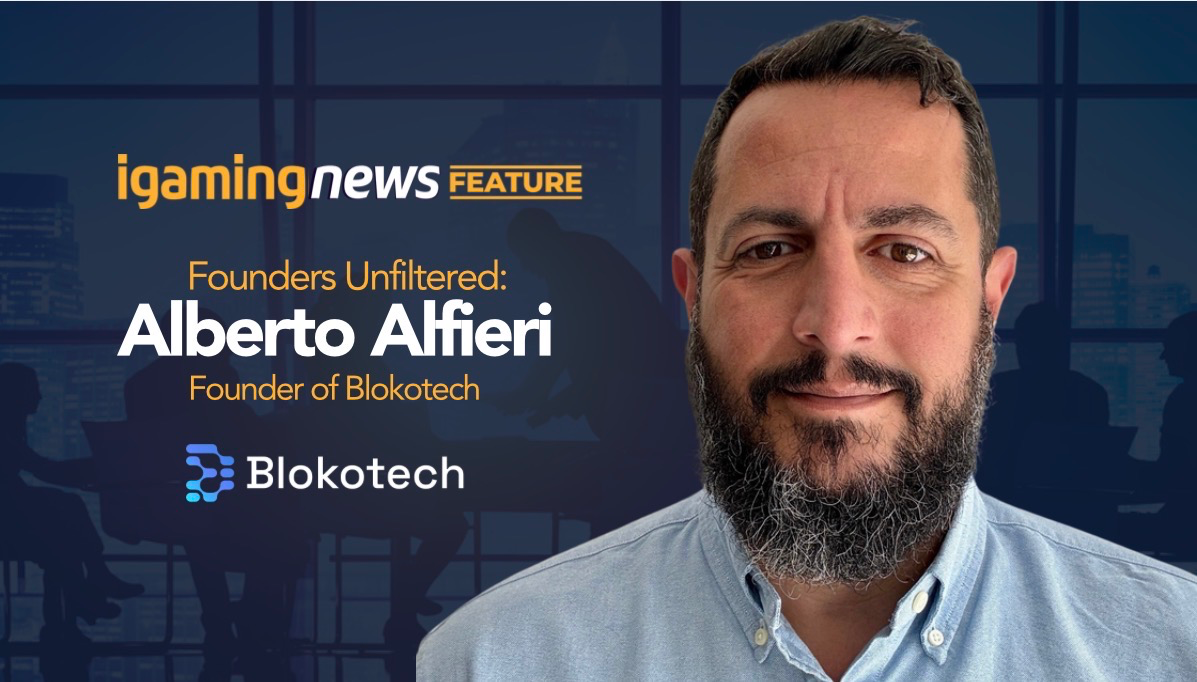
Years spent running B2C operations gave Blokotech’s co-founder a clear understanding of what happens when technology falls short of an operator’s needs. That experience, combined with first-hand insight into LATAM’s markets, became the foundation for a business built to tackle problems its founders had faced themselves.
In this edition of Founders Unfiltered, we explore the realities behind that ambition: the difficult decisions delayed by too much patience, the challenge of growing without losing touch with clients, and the responsibility of giving a team room to lead. From questioning the industry’s fixation on announcements to speaking candidly about the attention entrepreneurship takes away from family life, this interview offers a frank perspective on building a business—and learning when to step back.
1. What was the original idea behind your company, and what convinced you to take the leap and build it?
Blokotech came from years of being on the other side of the table, running B2C operations and depending on technology providers. When a platform cannot do something your business needs, you are the one explaining the consequences to customers, your team or shareholders, and that experience stays with you.
During much of my final years on the operator side, I was focused on M&A and expansion into LATAM, which allowed me to see both the opportunity in the region and how unprepared European operators could be for its realities. Understanding the market commercially was only part of the equation, because you also needed technology and people who could adapt to how those businesses actually operated.
We had the opportunity to build around an existing technical team, and combining that capability with our operational experience gave us the confidence to take the leap. We understood the problems we wanted to solve because we had dealt with them ourselves.
2. What has been the hardest part of building the business that nobody warned you about?
How difficult it is to switch off mentally. I knew there would be long hours, but I was less prepared for how much space the business would occupy in my head outside those hours.
You can achieve a good result and still find yourself thinking about a thousand other things, whether that is a difficult conversation you need to have or wondering whether you’reputting too much or too little into the next opportunity. You appreciate the result, of course, but your mind is already somewhere else.
I also like things to be resolved properly, so accepting that there will always be something unfinished takes effort. As the business grows, the problems change, and part of the job is learning what needs your attention immediately and what can wait without feeling that you are neglecting it.
3. What has been your biggest mistake as a founder, and what did it teach you?
I would say being too patient with some people along the way. Sometimes you give someone more time even though you already have enough information to make a decision, and you have to recognise that the responsibility for that delay is yours. You are allowing the situation to continue, with consequences for your time, other people’s work and the business.
Looking back, I would have made some of those decisions earlier. I do not expect people never to make mistakes, but there is a point where you have to recognise that more patience is unlikely to change the outcome. As for building Blokotech itself, I have no regrets. I would have done it earlier.
4. Was there ever a point when you seriously questioned whether the business would succeed? What happened?
Honestly, no. I know that sounds confident, but a lot of it comes from knowing who I am building the business with.
Salvo, our CEO, and Antonio, our COO, are the best partners I could ask for, and together we have built a great team. I trust them, and when something is difficult, I know I am not carrying it alone, just as they know they can count on me.
Being able to give and receive support when it is most needed makes an enormous difference. You will not always have the answer immediately, but having people beside you who you trust gives you confidence that you can work through it together. That has been fundamental for me.
5. What is the biggest lesson you have learned about leadership and building the right team?
You learn a lot about people when something goes wrong, particularly whether they tell you early, take responsibility and feel comfortable disagreeing with you when they see things differently. Those qualities matter to me alongside experience, because I want to work with people who can think for themselves and make decisions.
Of course, we have to give them the authority to do that. You cannot ask someone to take ownership and then expect them to come back to you for approval at every step.
The part I find more difficult is knowing when to intervene. There are situations where stepping in prevents a bigger problem or saves time and resources, but if you do it too often, people start waiting for you instead of making their own decisions. As a founder, you have to keep questioning whether your involvement is actually helping.
6. What has been your biggest challenge when it comes to growing and scaling the business?
Staying close to operators while making sure we can deliver consistently as we grow. That closeness is an important part of what we offer, so we have to be careful about how we preserve it as the business becomes larger.
Working in LATAM, you quickly learn how much operating requirements differ between markets and individual businesses. That experience forced us to build flexibility into the platform and understand why an operator was asking for something, rather than just taking the request at face value.
The difficulty is that every request takes time, even when there is a good commercial reason behind it. We have to consider whether it will improve the platform more broadly, whether it needs a specific solution for that client, and what other work we would have to postpone to deliver it.
Being responsive is part of why clients choose us, but we also have to be realistic about what we commit to. Managing those expectations while continuing to grow is a constant challenge.
7. What do you think the iGaming industry gets wrong about entrepreneurship and innovation?
The industry gives too much credit to announcements. Perhaps that view comes from how I learned, by doing, learning from the experience and doing again, but I am much more interested in what happens afterwards.
I want to know whether the product works reliably, whether customers actually want it and whether it improves their operation. There is also the question of whether the company can properly support what it has sold, which matters long after the initial excitement has passed.
Having been an operator, I appreciate improvements that might never make a headline. A simpler integration or a better reconciliation process can remove a recurring problem for an entire team, and that has real value for the people using it every day.
That is a meaningful innovation to me. The value should become clearer when people use the product.
8. Which current iGaming trend do you believe is genuinely transformative, and which is being overhyped?
AI is my answer to both, depending on what we are talking about.
I see enormous potential in helping teams make better use of their data, make better decisions and spend less time on repetitive work. Those are practical improvements that can change how an operation functions, which is why I am interested in what the technology can do.
Where I become sceptical is when AI is presented as though it removes the need for good data, proper integration or someone being accountable for the results. Adding it to a product does not automatically make that product better, and you still need to understand how it will behave in practice.
When I evaluate a tool or feature, I want to know what it improves, how we can measure that improvement and what happens when it gets something wrong. Those answers matter much more to me than the label.
9. What has founding a company cost you personally — beyond money?
Attention. You can finish work and be at home with your family while your mind is still occupied by something that happened during the day or a decision you need to make tomorrow.
I have a wife and two young children, and being in the same room as them does not necessarily mean I am giving them my attention. My wife often reminds me of that, and I am very grateful to her because she keeps the family together, including when I am too absorbed in everything else.
I do not see that as something to be proud of or as proof of how committed I am to the business. It is a cost I have to take responsibility for, because although I want to build successful businesses, I also want my family to have more than whatever energy I have left at the end of the day.
Finding time for myself is a struggle too, and that is equally important. Getting the balance right is something I am still working on.
10. If you could go back to day one, what would you tell yourself — and what would you do differently?
I would tell myself to start earlier and to act sooner when I already know a decision needs to be made.
I would also be more selective about commitments, whether that means choosing a partner, hiring someone or taking on a client. Something can look attractive on its own, but you need to consider what it will require from you and the team, and whether it fits the business you are trying to build.
The same applies to features and projects, because whenever you agree to something, you are committing time that will no longer be available for something else. I would be more explicit about those choices from the beginning.
Finally, I would give people clear responsibility earlier and make sure they had enough authority to act on it. We want a company where good decisions can happen without the founders being involved in everything, and creating the conditions for that is our responsibility too.