Founders Unfiltered: Fraser Dunk, CEO and Founder of Jurnii
Dunk opens up about the realities of taking that initial concept and turning it into a scalable, productised business,
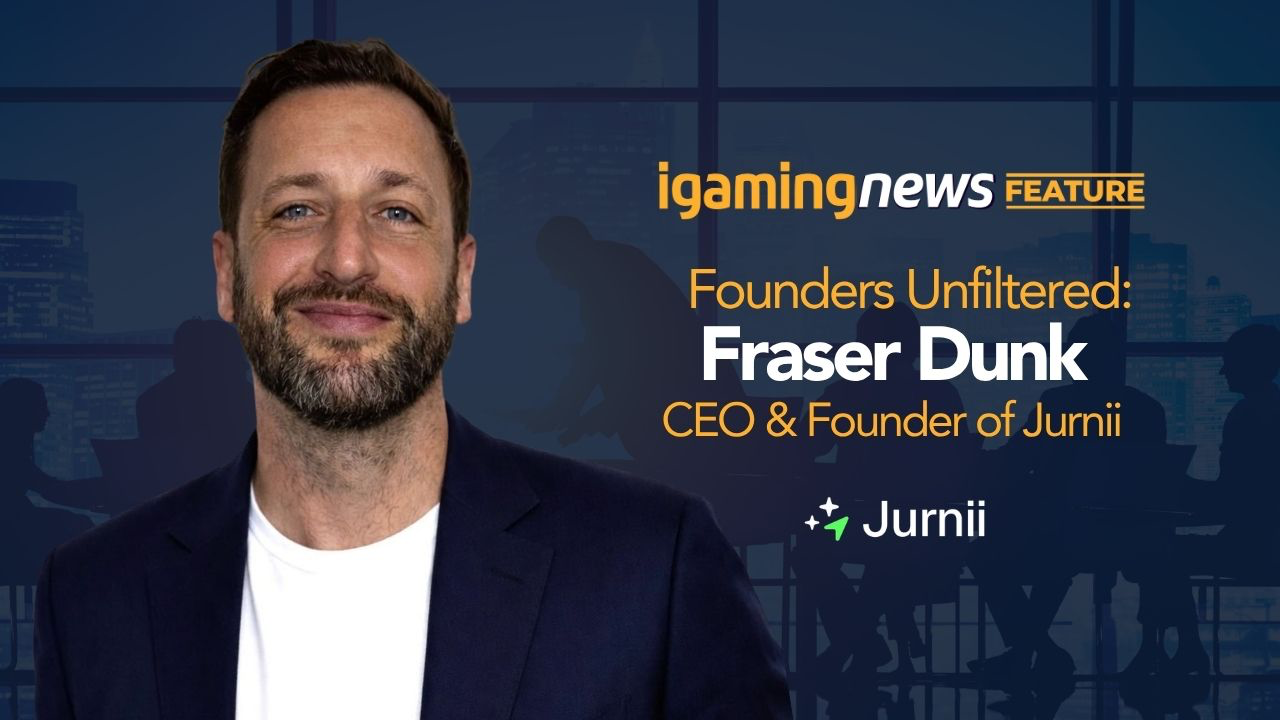
In this edition of Founders Unfiltered, we speak to Fraser Dunk, CEO and founder of Jurnii, about the journey from identifying a gap in the iGaming customer experience landscape to building a technology business designed to address it.
With almost 15 years of experience in the CX space, including senior roles at Betsson Group and DAZN, Dunk saw first-hand how operators and brands were still relying on screenshots, spreadsheets and manual processes to understand competitive and UX intelligence. That experience ultimately led to the idea behind Jurnii and a process of validating the concept through consulting, proof of concepts and early clients before building the full platform.
Dunk opens up about the realities of taking that initial concept and turning it into a scalable, productised business, including the challenges of building a repeatable sales engine, staying focused as AI creates new possibilities, and learning where his own strengths and limitations lie as a founder.
The conversation also looks at the wider iGaming industry, from what Dunk believes businesses get wrong about innovation to the transformative potential of AI and the importance of proprietary data and knowledge. Alongside the business lessons, he discusses the personal cost of entrepreneurship, the constant doubts that come with building a start-up, and what he would tell himself at the beginning of the journey.
What was the original idea behind your company, and what convinced you to take the leap and build it?
I’d spent close to 15 years in the CX space, including senior roles at Betsson Group and DAZN, and I had a very clear view of the vendor landscape — where the tools fell short, and where operators and brands were still solving problems manually that should have been solved years ago.
I stepped away from that world for a while — travelling through Central & South America, Southeast Asia, Southern Africa — and used the time to properly think about my next steps.
What I landed on was less about some inherent desire to be an entrepreneur and more about knowing a problem existed — competitive and UX intelligence in iGaming was still stuck in screenshots and spreadsheets — and having an idea of how to solve both properly and innovatively.
I then went through a process of validating that assumption the boring way: initially as a consultant, then through early proof of concepts, MVP clients, testing whether anyone would actually pay for it before the full build.
So the leap wasn’t really a leap. It was an accumulation of years of experience and process that we set out to automate and encode into a product we knew there was a market for.
2. What has been the hardest part of building the business that nobody warned you about?
Getting an early version in front of users, proving the concept, signing first clients — that part moved quickly, faster than I expected. What I underestimated badly was how much harder it is to take that early build and turn it into something scalable, resilient, and genuinely productised.
My first assumption was that it would be a fairly linear path from idea to MVP to finished platform. It wasn’t. It was iterative, messy, and considerably longer than our early timelines suggested.
My second assumption was that early traction and validation from clients was a sign of things to come. But early reliance on network, partners and word of mouth quickly runs dry and getting a repeatable sales engine in place should have been an earlier focus.
Nobody warns you about that middle phase because it isn’t glamorous enough to talk about. It’s not the founding story or the exit story — it’s the unremarkable, compounding grind of “saassifying” something that already works for one client into something that works reliably for hundreds.
3. What has been your biggest mistake as a founder, and what did it teach you?
Assuming AI would solve more of our development complexity than it actually did — and then compounding that mistake by chasing every new capability it seemed to unlock.
Because we could move fast early on, we started reaching for new features and new ideas, convinced the tooling would let us do everything at once. That came directly at the expense of the core product work that actually needed to happen. We were distracted by what was newly possible, rather than disciplined about what was actually required.
What it taught me is that focus is the only real lesson worth repeating to yourself as a founder. The initial problem you set out to solve doesn’t move just because something shinier appears. Every time we drifted, the fix was the same: go back to the customer, re-anchor on the problem, and let that dictate the roadmap — not the novelty of the tool.
4. Was there ever a point when you seriously questioned whether the business would succeed? What happened?
There is rarely just one moment, they are constant: the first production break, the first client churn, the first investor conversation that goes nowhere, the first target you set with total confidence and then quietly miss. Every one of those is a legitimate moment to sit back and ask "is this working?"
What I've learned is that the intensity of that question depends entirely on how you've defined success in the first place. If success only means a huge exit at unicorn valuation, then you've built a definition that makes failure the default state almost all the time.
I've tried to stay realistic about what success actually means to me, and where Jurnii sits inside that, rather than the other way around. That doesn't remove the doubt, it just changes what the doubt is measured against.
For me, a lot of the fuel has always come from solving problems repeatedly, which is a renewable source of motivation in a way that a single, distant outcome isn't. When one of those doubt-moments hits, I can usually trace it back to a specific, solvable thing rather than a referendum on the whole venture — and that's a much easier problem to sit with at 1am.
5. What is the biggest lesson you have learned about leadership and building the right team?
The first honest lesson was about my own limitations. I'd probably claim, without too much arrogance, to be a decent product and UX leader. But that skill set doesn't automatically translate into being a good founder. Product leadership is about going deep on one discipline. Founding a company is about being competent enough, fast enough, across a dozen disciplines you've never formally worked in.
So my first real move as a leader wasn't to hire people who thought like me; it was to get honest about exactly where my knowledge ran out, and go fill those specific gaps.
In a start-up, everyone ends up wearing multiple hats so technical skill on its own isn't the thing I screen hardest for — motivation is. And motivation, obviously, isn't one thing. You need to know which kind of motivation you're hiring, because it tells you how someone behaves when the work stops being fun.
The team you build is a mirror of you, but with their own individual triggers. I have found success in building teams with the same underlying trait of motivation but understanding those individual triggers is what lets you point people in the same direction without forcing them into the same shape. My job isn't to make everyone motivated the way I am; it's to know what switches each person on, and then give them the freedom to do what they're genuinely best at.
6. What has been your biggest challenge when it comes to growing and scaling the business?
Staying focused instead of chasing the shiny thing.
Early on, the temptation came from inside — us, looking at what AI newly made possible and wanting to build all of it at once. As you scale, that same temptation just gets more voices attached to it. It's a client asking for a feature that would be nice for them but drags the roadmap sideways. It's watching a competitor ship something and feeling the pull to match it just to be seen matching it. It's a new capability in the AI tooling landscape that looks like it could shortcut six months of work, right up until you actually try to use it properly.
None of those pressures existed in quite the same form when it was just an idea and a proof of concept. Growth doesn't remove the discipline problem — it multiplies the number of directions pulling at it. The muscle we built early, of going back to the customer and the core problem before saying yes to anything new, is the exact same muscle that's kept us from drifting as the business has grown. It just needed to get stronger, not different.
7. What do you think the iGaming industry gets wrong about entrepreneurship and innovation?
That innovation is mostly about being first. After nearly 20 years in this space, I've watched the same cycle repeat itself more times than I can count: regulatory shake-up, grey-market surge, a genuinely new idea — and then everyone copies it within a quarter. Once that happens, "innovative" stops being a differentiator, because it's now table stakes.
The industry underrates how much genuine competitive advantage now sits in execution and experience rather than novelty. Games, platforms, and payments are largely commoditised. What's left — UX, pricing mechanics, speed of response, brand trust — gets treated as "operational" rather than strategic, when it's actually the last place real differentiation lives. Chasing "innovative" for its own sake is a young company's mistake; the businesses that last are the ones that got quietly, relentlessly good at the fundamentals everyone else deprioritised.
8. Which current iGaming trend do you believe is genuinely transformative, and which is being overhyped?
This is not an iGaming specific trend obviously, but there is an opportunity for all businesses that I believe is transformative. AI gives every business the ability to encode its own proprietary knowledge, process, and data into an intelligence layer that is unique to them, and can be the foundation of differentiation.
The industry has decades of accumulated knowledge about player behaviour, promotional mechanics, and UX execution. Each operator has unique and proprietary insights into their own players and target markets. The businesses that systematically encode that into an intelligence layer — continuously updated, commercially contextualised — will have a structural advantage that a competitor can't replicate just by buying the same tools.
Generic AI gives you generic competitive advantage; the moat was never the model, it’s the layer you build on top of it.
Overhyped: personalisation. It's on every 2026 trends slide, but most of the industry has borrowed personalisation models from e-commerce and media without accounting for how habitual and intent-driven gambling behaviour actually is. What players call "wanting personalisation" is usually just wanting relevance and less friction — not a smarter recommendation engine sitting on top of a shaky core journey.
9. What has founding a company cost you personally — beyond money?
Ask my girlfriend and she'll tell you that I've aged an unreasonable amount in the last two years. The late nights and weekend work are the visible cost, and they're the ones every founder talks about because they're easy to point to.
The main cost for me is presence. I can be physically in the room — at dinner, on holiday, at something that has nothing to do with work — and still not really be there, because part of my head is still running a problem from three hours earlier or pre-loading one for tomorrow. There isn't an off switch. It's not that I'm working all the time; it's that the capacity for the business is always switched on in the background whether I want it there or not. The cost isn't measured in hours worked, it's measured in how much of your attention is actually available to the people and things in front of you, even when you've technically clocked off.
Of course I don't think that's unique to me, and I don't know whether it's avoidable in year one or two of building something real. But I'm conscious it's a debt, not a one-off cost — and debts need paying down eventually.
10. If you could go back to day one, what would you tell yourself — and what would you do differently?
You don't know what you don't know as a first-time founder, and I went into this genuinely blind to a lot of things. Not the product risk or the market risk — I'd spent years thinking about those — but the intricacies and personal cost of actually running a start-up. That heads-up would have been nice. But the honest answer is that, as a founder, every day is day one. You have a requirement, and an opportunity, to make the changes necessary right now, so it's a hard question to answer succinctly. There isn't really one thing I could point to that I'd have done differently, because the choices accumulate day by day to get you to where you are. Change one and you're not sure what you'd be undoing along with it. Would be nice to know how the whole story ends, though..