Founders Unfiltered: Deborah Conte-Santoro, Managing Director of Swiss Casinos Technology AG
In this edition of Founders Unfiltered, she discusses the challenge of creating a new product category, the uncertainty of securing certification, and what building the business has taught her about leadership and fear.
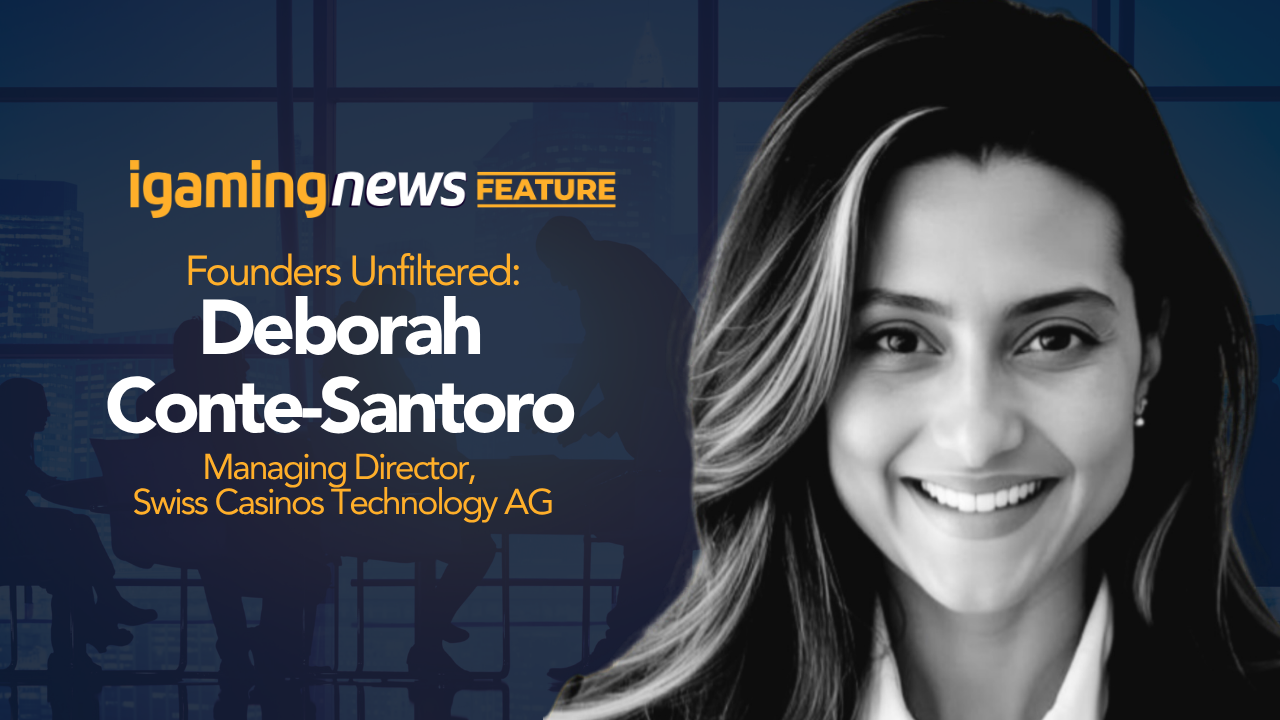
When Swiss Casinos noticed that guests could not find their favourite online games on its casino floors, Deborah Conte-Santoro saw an opportunity to rethink how land-based gaming works. As Managing Director of Swiss Casinos Technology AG, she helped build ReelLink to give operators more flexibility over the games they offer. In this edition of Founders Unfiltered, she discusses the challenge of creating a new product category, the uncertainty of securing certification, and what building the business has taught her about leadership and fear.
1. What was the original idea behind your company, and what convinced you to take the leap and build it?
The idea didn't really start with technology. It started with a question about our own guests.
As a group, we run four land-based casinos and an online platform. When we looked closely, and actually asked our guests, we saw something that stayed with me. Many people who come into our casinos don't play slots the way they do online. The reason was simple: the games they know and love from online, they couldn't find on our floor. There was a real gap between the two worlds.
But closing that content gap was only half of it. We also had a concrete operational need. We wanted the flexibility to change games faster, to run several providers on one cabinet, and to test far more precisely, to keep trying, with the right games, to reach and open up new guest segments. Traditional cabinets simply don't allow that. The content is locked to the machine.
So the real idea behind ReelLink was to separate the game from the cabinet. Unchain the game experience. Give the floor the same pace of innovation that players already expect online.
What convinced me to take the leap was actually simpler than people might expect. I love trying new things. I took on building this because I believe the path is the goal, no matter where it leads. Something new always brings fear, but fear doesn't harm you. Whatever the outcome, you can only learn from it. I had a real conviction about the idea, and at the same time I simply wanted to build something new. Believing in the problem, and being willing to take an uncertain path to solve it, was enough for me to give up a secure role and start.
2. What has been the hardest part of building the business that nobody warned you about?
The hardest part was something nobody warns you about: how much of it is a people business, not a product business.
We weren't just certifying a new technology. We were introducing a completely new product category, something that had never existed before. And with a new category, a lot of fear comes into play, especially here in Switzerland. Every party involved wants maximum certainty before they approve and certify something like this. That is where a product business quietly turns into a people business. It stops being only about meeting laws and regulations. It becomes about reacting early enough, bringing the right people on board, and genuinely investing in a solution that offers security and takes away the fear of the new.
The second part of that same challenge was internal. The biggest hurdle was the uncertainty that builds up in the people involved during the process. Bringing something new to market, without the certainty that it will work, without knowing whether it will even be regulated, demands an incredible amount of vision and willpower. The plans change fast. The whole process is highly dynamic. Some days you have to correct course daily and adapt feedback almost immediately. That can demotivate people on its own, because it creates uncertainty.
I realised quite quickly that you can't give people certainty when it doesn't exist yet. What you can do is keep everyone focused on the goal and remind them why you're doing it in the first place. You set a clear direction, even when you can't quite see the full path yet, and keep working towards it, bringing the people around you with you. That doesn't remove the uncertainty. But the vision, and the why, is what carries everyone through it.
3. What has been your biggest mistake as a founder, and what did it teach you?
I'm relatively young in this industry. Almost three years now. I have a lot of experience building new teams and departments, but always inside media companies, never in gaming. So at the beginning I was convinced I had to catch up, that I had to learn the industry obsessively. You sit next to colleagues who have been in this world for twenty or thirty years, and you feel you have to know everything they know.
And part of that is true. You do have to understand the markets and the real need, otherwise you can't build something customer-centric. But my mistake was that I kept looking for existing patterns. I was trying to fit into how things had always been done.
What I learned is that when you're trying to bring out something genuinely new, it can actually help to look at it from a different angle and bring in experience from other industries. Knowing the industry matters, but not so you can copy its patterns. It matters so you can see where those old patterns no longer fit. In the end, what we are really doing is improving the guest experience and giving casinos more flexibility, and that is not a casino-only question.
Once I let go of the idea that I had to think like everyone else, and started combining my earlier experience with what I was learning from the casino world every day, I found I could reach solutions much faster and make decisions more clearly. And that learning never stops. People themselves don't really change. But the way they consume, and the technology around them, moves on every single day. So that mix of old and new isn't something you ever really finish. It's part of the job.
4. Was there ever a point when you seriously questioned whether the business would succeed? What happened?
Yes. There was a point.
We were in discussions with testing labs, and it simply didn't seem to move forward. They couldn't grasp the vision. They were still caught inside the existing land-based structure, and our product didn't fit any of the boxes they knew.
I still remember hanging up after one call and thinking: if we keep losing months like this, if there is no room here to understand that we are a hybrid, a bridge between two worlds, then we will never get certified. And without certification, there is no product. That thought sat with me. It wasn't an abstract worry about the market. It was the real possibility that the whole thing could stop, not because the idea was wrong, but because there was no framework yet to even judge it.
What changed it was finding the right lab. And that mattered more than I expected. The right partner was extremely demanding and challenging, far from easy, but they came at it with genuine interest in making the product safe and market-ready, instead of blocking it simply because it wasn't regulated yet. That completely changed the dynamic. It helped us work on the product and develop it further, to a point where we didn't just get certified. We got certified for the highly regulated Swiss market.
But I won't pretend the doubt ever disappears completely. When you're building something that has never existed, a version of that uncertainty stays with you. You just learn to keep moving while you carry it.
5. What is the biggest lesson you have learned about leadership and building the right team?
The biggest lesson is that real leadership has very little to do with formal authority.
When we built ReelLink, my team wasn't a classic team sitting under me on an org chart. The people and the critical know-how were spread across different parts of the group and an external partner. For a lot of what needed to happen, I couldn't simply instruct people. I had to bring them with me.
At first that felt like a disadvantage. Looking back, it taught me the most important thing I know about leading. People don't truly follow a title, a reporting line or an instruction. They follow a direction they believe in. If they understand where you're going and why it matters, they give you far more than any org chart could ever require of them. If they don't, no amount of formal authority will get you there, especially when the work is uncertain and changes constantly.
So I stopped trying to lead through structure and focused much more on clarity: being clear about the goal, explaining why it mattered and trusting people to get behind it. That is what held a distributed group of people together through a phase where almost nothing was certain.
And it changed how I think about building a team going forward. I'm not looking for people who simply execute. I'm looking for people who connect with the reason we're doing it, because they're the ones who keep going when the plan changes.
6. What has been your biggest challenge when it comes to growing and scaling the business?
The biggest challenge around growth isn't really demand. It's dependency.
ReelLink only works because a lot of parties work together. Internal teams across the group, and external service providers and partners on the technical, content and distribution side. That is the nature of the product, it sits between several worlds by design. But it also means our pace is never fully our own. Many parties have to move in sync, and every additional partner adds complexity rather than removing it.
And early on there was a human layer to that which was even harder than the logistics. Many of the people I depended on were not mine to instruct. They sat in different parts of the group or worked for external partners, and I had no formal authority over them. So the real task wasn't managing them, it was aligning them. Getting very different people, with different employers and different priorities, to move toward the same goal, and giving that goal enough meaning that they wanted to. You can't simply instruct people into that kind of alignment. You have to build it.
When you want to move forward, that becomes very real. You can be ready to take the next step, but you're only ever as fast as the people and partners you depend on. A single delay in one place ripples through everything else. Keeping internal and external providers aligned on the same goal and the same timeline is constant work that never really stops.
What I've learned is not to treat that as a problem to eliminate, because you can't. You build the dependencies in instead of pretending they aren't there. You reduce single points of failure where you can, you keep critical knowledge close, and you stay honest that some things are simply outside your direct control. The rest comes down to alignment, and doing that work patiently, again and again.
7. What do you think the iGaming industry gets wrong about entrepreneurship and innovation?
I'm deeply convinced that many people confuse innovation with technology.
Technology is an instrument that makes innovation possible. But innovation itself is something else: it's solving a real, existing problem with a new instrument. It's about experimenting, finding the real needs, and closing the gaps with a solution that actually fits. And it doesn't have to be entirely new. It can be an existing idea, adapted so that it meets a need through a different path. For me, what matters is the problem you solve, not whether the technology itself is new.
To be clear, I think iGaming already gets a lot right. The pace online is incredible. The way game providers launch new content every single day, the number of different technologies implemented for online casinos, it's constant real-time learning, and it moves fast, exactly as fast as the technology behind it evolves. Online has understood how to translate technology into real value for the player, continuously.
Where I'd love to see the same is land-based. There, things are still slower and more static, because that online component is missing. And that, to me, is the real opportunity. Not more technology for its own sake, but using it to give casino operators genuine flexibility and to bring the floor closer to the pace players already experience online. There is still a lot of room there, and that gap is exactly the kind of real problem worth solving.
8. Which current iGaming trend do you believe is genuinely transformative, and which is being overhyped?
Let me start with the one I'm genuinely convinced by, and I'll be honest that I'm biased here, because it's the space we work in: the real convergence of online and land-based. Omnichannel.
I believe it's transformative not because it's a nice buzzword, but because it solves a real problem. Players move between worlds. They play online and they visit a casino, and today those two experiences barely talk to each other. Bringing them together, letting the floor move at something closer to online's pace, actually meets a need that exists. That's the test for me, and it passes it.
The one I'd put in the overhyped column is the crypto and blockchain conversation, but I want to be precise about that, because it's not black and white. Parts of it clearly solve real needs. Stablecoins have reduced volatility, and provably fair systems give players a kind of transparency they didn't have before. I don't dismiss that. What I think is overhyped is everything stacked on top: the metaverse casinos, the NFT and token gamification, the idea that blockchain is about to become the foundation of everything. That part is mostly excitement about the instrument, not a real problem being solved better than before.
And from where I sit, in a highly regulated, land-based context, crypto doesn't answer a question I actually have. It sits much more comfortably in the online, less regulated world. So I'd say: useful in specific places, genuinely overhyped in most of the conversation around it.
That's really the lens I use. I ask whether it solves something real, and who it solves it for, rather than whether it's simply new and exciting. Omnichannel does, for us. A lot of the crypto narrative, so far, does not.
9. What has founding a company cost you personally , beyond money?
Beyond money is almost the whole point, because the money was never really mine. It was trusted to me. I gave up a secure position within the group to start this, to build something with a very uncertain outcome. Going from a safe role to an uncertain vision is a real thing to carry, even when you believe in it completely.
And I did believe in it, from the very beginning. But there is always a quiet voice somewhere in the background that says: what if it doesn't work. I think that's deeply human. Whatever we invest, time, money, ourselves, it comes with fear. Fear of not making it. Fear of not living up to the expectations placed in you. We all carry that, and I think it's completely normal. I'd rather say it out loud than pretend it isn't there.
The personal cost can be harder to explain, because it's quieter. It's the constant impossibility of really switching off when you carry something that never stands still. It's a certain loneliness in a role where, in the end, a lot rests on you and some of the weight simply can't be shared. It's the toll on relationships and closeness when building something takes up this much room.
And if I'm honest, the biggest part of it is this: most of my energy through the day, and most of what occupies my mind, is this company. Not something private. A very high percentage of my head is here.
But I want to be clear that this is a conscious choice, not something that just happens. It's a decision you make for yourself once you recognise what actually matters to you. I know what I'm giving room to right now, and I'm choosing to give it that room. That's the real cost, and also the honest part: it isn't dramatic or tragic. For a certain period of your life, you decide that what you're building is going to take up space that might otherwise belong to other parts of life. That's the choice I've made.
10. If you could go back to day one, what would you tell yourself , and what would you do differently?
I'd tell myself two things.
The first is about fear. Don't be so afraid of the fear. In the beginning I thought the quiet worry in the background was a sign that maybe I wasn't ready, or that something was wrong. Now I know it's just part of building something that has never existed. The uncertainty doesn't fully go away, and that's normal, not a warning sign. I'd tell myself to trust my own perspective earlier, and to stop believing I had to think like everyone who'd been in the industry for decades before I was allowed to build something new. Looking back, that outside perspective wasn't a weakness at all. It was actually one of the most useful things I brought to the project.
The second is more concrete, and it's the thing I would actually do differently. I would bring the teams closer together, earlier. We worked across internal units and external partners, and I underestimated how much real, physical exchange matters in a setup like ours. Of course there are countless companies where people work fully remote, never meet, and it works beautifully. But for what we were building, closeness and direct exchange were important. I would have gotten key knowledge in-house sooner, and where that wasn't possible, I would have had internal and external people sit together far more often. Even with partners abroad, that means someone travels there monthly, or the other way around, so that real, physical exchange can actually happen.
So if I could go back to day one, I wouldn't change the vision. I believed in it then and I believe in it now. I'd just carry it with a little less fear, and I'd bring the people around it closer together much earlier.