Founders Unfiltered: Ramiro Atucha on Trusting Your Instincts
For Ramiro Atucha, the founder story cannot be reduced to a single company.
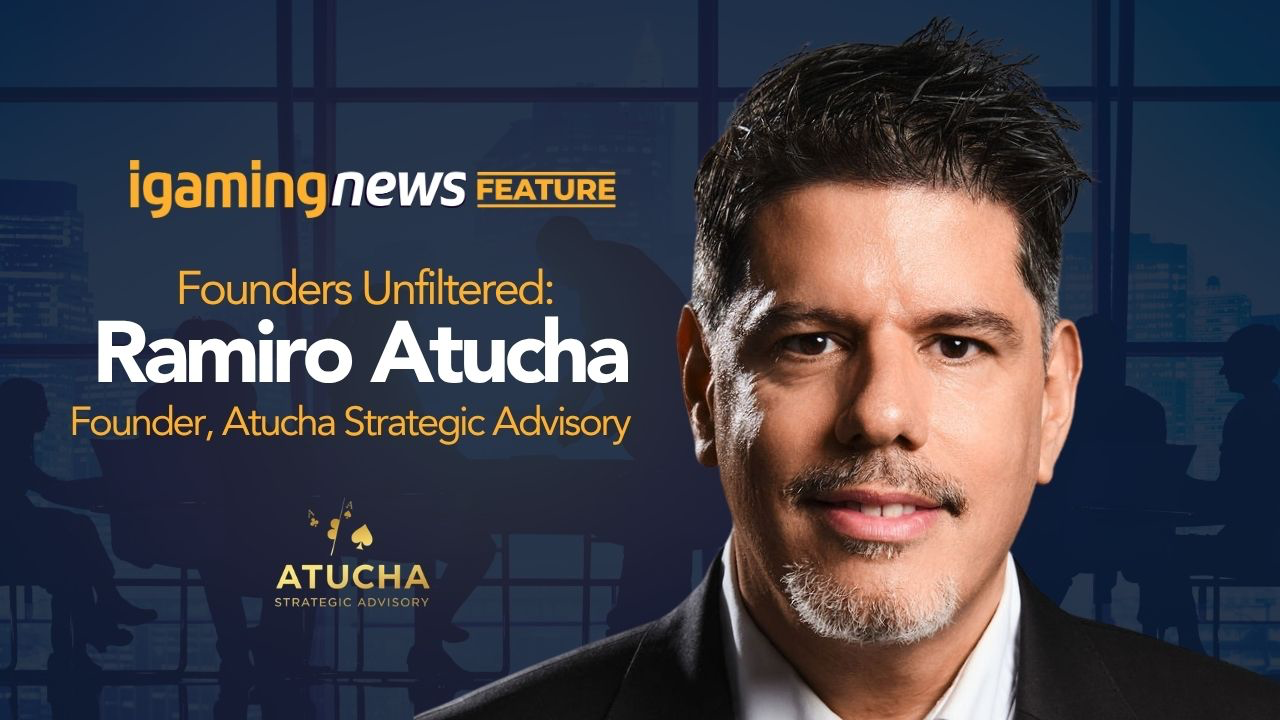
From founding IXONE Studios in Argentina and taking Leander Games onto the global stage to building Vibra Gaming for Latin America, Ramiro Atucha has spent more than 25 years creating, scaling and leading technology businesses. In this edition of Founders Unfiltered, he reflects candidly on the human realities of entrepreneurship, the importance of self-belief and why companies that fail to embrace AI risk being left behind.
For Ramiro Atucha, the founder story cannot be reduced to a single company.
His entrepreneurial journey began in Argentina in 1999 with IXONE Studios, a software business built from his passion for technology, innovation and digital design. That experience ultimately led him into iGaming, where he co-founded Leander Games and helped transform an ambitious games studio into an internationally recognised supplier and distribution platform.
A successful RFP with PokerStars gave Leander Games a level of visibility and scale that Atucha had not anticipated. Years later, he applied the lessons learned across regulated European and American markets to Latin America through Vibra Gaming, expanding its proposition from games and aggregation into sportsbook, casino platform and VLT technology.
Following his departure from Vibra in 2025, Atucha chose a different path. Rather than building another company from the ground up, he decided to share more than two decades of experience with a carefully selected portfolio of businesses and become meaningfully involved in helping other founders and leadership teams succeed.
In this honest conversation with iGaming News, Atucha discusses why people and personalities present a greater threat to companies than technology or financial performance, how failing to trust his instincts became his biggest mistake and why even the “right team” cannot remain right forever.
He also explores the personal reality of scaling a business, the difficulty of delegation, the challenges created by Brazil’s regulated market and the lessons iGaming should learn from companies such as Amazon. Looking to the future, Atucha explains why AI is no longer optional—and why resistance to the technology may be more overhyped than AI itself.
1. What was the original idea behind your company, and what convinced you to take the leap and build it?
In my case I would have to talk about four companies. Leaving one out would be like leaving one of your kids out of the story.
IXONE Studios was a software factory I created in Argentina in 1999. We built websites, intranets and digital design, and I was there until 2007. What convinced me was my passion for technology and innovation, and wanting to be completely dedicated to that.
Then Leander Games, from 2007 until 2019. In 2005 I had been advising a land-based company and I was very curious about why and how they were not getting involved in the online space. Shortly after that I had the opportunity to build a team for online, we started developing games, I started traveling and attending industry shows for the first time in 2009, and that is when I entered this beautiful industry. The idea was to build the best games, which at some point led us to build a platform in order to get distribution. That in turn led to us winning the RFP from PokerStars, and to a visibility and a dimension that we did not expect at the time.
In 2020 I felt we needed a company dedicated to Latam, to apply everything we had learned over the years in the regulated European and American markets. That is why we created Vibra Gaming. With Vibra we grew the offering: we moved from being a game studio and aggregator to having a sportsbook, casino, platform and VLT, and we worked in most of the regulated Latin American markets.
And in 2025, after my exit from Vibra, I decided I did not want to build a fourth company. I was at a point where I preferred to transmit, share and apply my experience to other people’s projects. I decided to choose carefully which companies to collaborate with and to get really involved, which is what I am doing right now. I am blessed to be working with many companies that I appreciate, admire, and whose products I admire
2. What has been the hardest part of building the business that nobody warned you about?
The hardest part is always people. I always say that companies usually do not fail because of technology or financials. They fail because of personalities, egos, people.
When you build a company with people, you become close to those people. Those people change, you change, and relationships change. People that used to be motivated all of a sudden are no longer motivated, and people that were very valuable at some point are no longer that valuable. That may even happen to yourself.
Navigating that is very challenging: being fair to the company, keeping who you have to keep and letting go of who you need to let go of, while at the same time being fair to people who were important at some point and deserve respect, and being true to yourself. Nobody warns you about that, and I think it is the most critical and challenging part.
3. What has been your biggest mistake as a founder, and what did it teach you?
Not believing in myself enough. I found myself in many situations where I would assume someone was right because they were older, more experienced or more successful, even though I felt we should be going in a different direction. I assumed I was wrong because I was younger or less successful at that time.
On many of those occasions I was right, and even when I was not, if I had spoken up and taken a stand, at least it would have generated a very productive dialogue about the direction of the company. Your gut is important. What you feel is important. If your inner voice is telling you that something is not right, you do not have to assume it is right, but you do need to pay attention to it.
4. Was there ever a point when you seriously questioned whether the business would succeed? What happened?
Many times. A big one was during COVID. We had just started Vibra, the team was still being assembled and the relationship with the investors was still being built, and then COVID hit. Navigating those waters was difficult.
Another time, early on, we had differences with our investors and the cash flow was stopped, so we had to navigate that and keep the business going.
And more recently, with the regulation of the Brazilian market. We all felt it was going to be very positive for every B2B that seriously invested in that market. The truth is it was very harsh for any B2B that decided to stay on the regulated side, and we were not the exception.
5. What is the biggest lesson you have learned about leadership and building the right team?
That there is no eternal right team. People who are very valuable today may not be valuable tomorrow, and out of respect for the company you need to make changes, even with people who were very valuable at the beginning. It needs to be done with respect, but it needs to be done. That is a big lesson.
6. What has been your biggest challenge when it comes to growing and scaling the business?
Probably delegation. I love what I do and I put a lot of passion into it. Finding the right people to delegate to is always a challenge. Training them, allowing them to make mistakes, allowing them to find their own way, all of that is a challenge. I think I am getting better at it over time, at accepting ways of solving things that are different from what I would do and understanding that they can still be valid.
The other challenge, of course, is the physical effort of being everywhere, being there for everyone and responding to everyone as the business grows.
7. What do you think the iGaming industry gets wrong about entrepreneurship and innovation?
We do not learn enough from other industries. If you look at any other industry, they work together to make that industry respected in the media and by public opinion. We are not doing that enough, and that is our biggest liability as an industry. Anyone can punch the gambling industry and get away with it. No one is there to defend us because we are not appreciated as an industry.
The other thing is learning from what other companies have done well on technology. We have lived in a market that allowed us to hunt in a zoo, in terms of marketing and in terms of user experience. What Amazon has been doing for the past 30 years, our industry is rarely doing. You enter their website and you find exactly what you want, what you like, because they know what you like and that is what they offer you. Our industry still does not do that. Those are things that would benefit us if we looked outside more often.
8. Which current iGaming trend do you believe is genuinely transformative, and which is being overhyped?
AI is definitely transformative. A company that does not embrace AI and bring it into its processes is being left behind by competitors that do. What is being overhyped is probably the resistance to AI.
This is not about whether AI is good or bad. It is not up to us. It is already here, it is happening. I am very surprised when people say “well, you cannot trust AI with your information.” Brilliant, but you trust WhatsApp, you trust Google with Gmail, you trust Amazon with the cloud, you trust Microsoft with Outlook, you trust Instagram and Facebook. We are already there. We just need to make sure the right filters are in place, and that what you would not share by email you do not share with AI. Beyond that, it does not make any sense.
9. What has founding a company cost you personally — beyond money?
To be honest, I believe it has given me more than it has taken from me. I enjoy what I do. I appreciate the people I have met through my businesses, the partners I have, all the traveling, all the experiences, all the conversations and all the after-hours.
I am really grateful to this industry, to the companies I built and to everything I have learned. To me it was never about money. Money is a consequence of doing what you love, and I really love what I do. I really love this industry and the people in it.
10. If you could go back to day one, what would you tell yourself — and what would you do differently?
I would tell myself it is going to be okay. Trust yourself, do not give up, and keep doing what you are doing. I would not give myself a heads-up on any of the things that went wrong or any of the mistakes I was going to make, because those things, in a way, made me who I am. And I am more than okay with who I am.