End2End Founder Alejandro Revich On Building A Specialist Multiplayer Bingo Business
The End2End CEO discusses two decades of product development, the challenges of scaling bingo networks and why he believes the industry underestimates specialist technology.
Listen to this article
British female voice
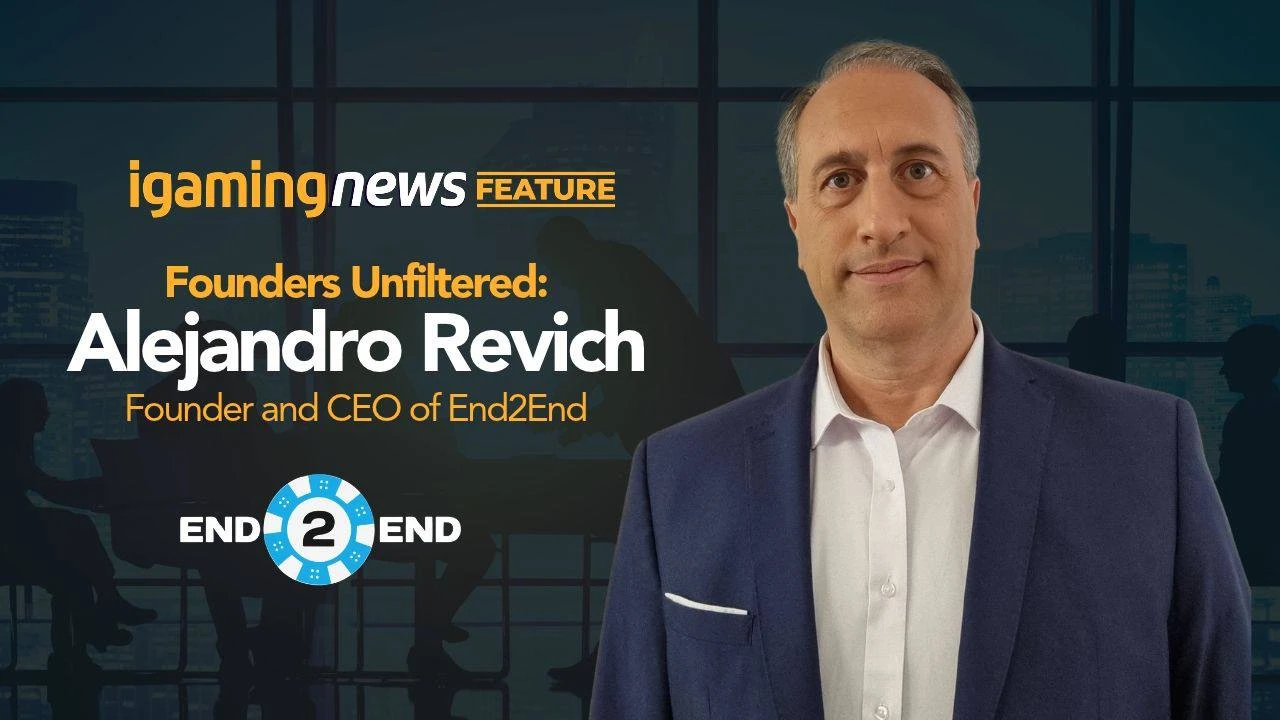
Alejandro Revich, founder and CEO of End2End, has spent more than 20 years focused on one area of the gaming industry: multiplayer bingo.
The business began with a specific idea: to build an online bingo experience that recreated the social interaction of a traditional bingo room, rather than treating the game as an individual experience.
In this interview, Revich reflects on the company's development, the challenges of operating within larger corporate structures, and the opportunities he sees across Latin America and North America.
Building A Business Around Multiplayer Bingo
What was the original idea behind your company, and what convinced you to take the leap and build it?
The idea was never to build a gaming company. It was to build multiplayer bingo properly, because nobody else was doing it. Back in 2005, the team and I started in the UK, and the thing that struck us was how badly the online product treated the part of bingo that actually matters, which is the room. Other people in the room, the same draw, the same pace. Most products at the time were solitary experiences with a bingo card on top.
Over the years that idea took us to Spain with YoBingo, which we built and then sold to The Rank Group in 2018. End2End as a company launched in 2019, but the people and the technology were already on their third major iteration by then. So the leap was less a single moment and more a decision we kept making: to stay in one vertical, a small one by industry standards, and to go deeper into it than anyone else was prepared to.
What convinced me was simple arithmetic. Bingo is a small vertical, so multi-vertical providers allocate resources accordingly, and the product suffers. That leaves room for a specialist. If you are willing to spend twenty years on real-time, concurrency and network liquidity, you end up with something very few companies can replicate.
What has been the hardest part of building the business that nobody warned you about?
How much of your fate sits with other people's calendars. We integrate with the operator's PAM, with platform providers, with aggregators. That is our model and it works, but it means that a launch can be technically ready on our side and still wait months because we are one line in someone else's roadmap. Nobody tells you that a large part of running a B2B technology company is managing priorities you do not control.
The other thing is corporate structure. When Aspire Global took a minority stake in 2021, the plan was to follow the group strategy, and in 2022 and 2023 we had our technology certified across a range of jurisdictions. Then the war in Ukraine, where Aspire had a key office, pushed the integration of bingo into the group down the priority list. Then came the NeoGames acquisition, then Aristocrat. Each of those were outside of our control and each one changed the picture for us. You can plan for competitors. You cannot plan for your partner being acquired twice.
What we learned from that period is to keep our own operations healthy regardless of what happens at group level. Today we have our own operator partners across Latin America and, in parallel, we work with Aristocrat where there is joint interest in growing the vertical.
Navigating Setbacks And Building The Right Team
What has been your biggest mistake as a founder, and what did it teach you?
I am a firm believer that we are the result of what we learn from our mistakes. I like to see the mistakes as part of the path and part of the learning that led me to who I am now and to what I built so far.
I don't know if I would go back and modify anything that I did that didn't end up the way I wanted. Probably if I have to name one difficult period, it was the part where I was away from my family in the U.S. developing the business. It's hard to point to it as a mistake because it was the base of who we are now and what we have built so far but I cannot help feeling that the sacrifice was huge and that now I would probably not do it again.
Was there ever a point when you seriously questioned whether the business would succeed? What happened?
Yes. The early 2020s was a tricky period, and I have said that publicly. We had made a deliberate bet on integrating into a larger group and, for reasons that had nothing to do with our product, that bet stalled. For a period we were a certified, production-ready platform with fewer places to deploy it than we deserved. That is a hard position for a founder, because there is nothing to fix. The technology worked. The market was there. The path was simply blocked.
What happened is that we went back to what we had always done, which is sell bingo directly to operators who wanted it. Latin America carried us through. Points of sale in Peru, integrations in Mexico and Colombia, operators who cared about omnichannel and about the retail bridge. By the end of 2025 we had finished the year well and we walked into 2026 with real expectations again, including the first operator integration using Aristocrat's platform. The lesson I took is that when the strategic route is blocked, the operational route usually is not. You just have to be willing to go back to it.
What is the biggest lesson you have learned about leadership and building the right team?
Most of my management team has been together for around twenty years. That is unusual in this industry and I do not take it for granted. The lesson is that you must build a team for the vertical you are in. Multiplayer bingo is a real-time, high-concurrency problem, and it takes years before an engineer really understands what happens in a room when half a million players are connected across venues. You cannot hire that in. You have to keep the people who learned it.
So my priority as a leader is continuity. Clear focus, so nobody is chasing trends we will not follow through on. Honest conversations when things stall, as they did during the group years, so that people understand why and stay. And enough discipline that the same core principles survive across three generations of technology: fairness, stability, social interaction, scale.
I am technical by background and I know my bias, which is to go straight to the concrete option. The right team is one where the people around you correct your blind spots rather than reinforce them.
Scaling Multiplayer Bingo Across Markets
What has been your biggest challenge when it comes to growing and scaling the business?
Liquidity. In multiplayer bingo the product is the room, and the room is only as good as the number of people in it. Online you can support five hundred, maybe a thousand players per session. Connect land-based venues and you can reach half a million at once. That is the whole difference, and it means growth is not simply a matter of signing more operators. It is a matter of connecting them, sharing player pools across brands and channels while every regulator keeps its control and every operator keeps its commercial terms.
That is a technology problem, which we have solved, and a commercial problem, which is never fully solved. Operators are cautious about shared networks. Regulators differ state by state and country by country. Each market needs its own version of the same conversation. That is why we choose markets carefully rather than opportunistically: Brazil because bingo is in the culture, Argentina because the online segment is still underexploited, the US and Canada because the land-based bingo world of tribes and charities is very, very big and is ready for a technology upgrade.
The other constraint is being a small vertical inside operators' priorities. Bingo earns its place through retention and cross-sell, but it has to keep proving that, every quarter, against verticals with bigger numbers.
What do you think the iGaming industry gets wrong about entrepreneurship and innovation?
It confuses innovation with novelty. Every year there is a new feature that the whole industry has to have, and a year later most of it is gone. In a real-time multiplayer product, the innovation that matters is the boring kind: the engine holding under load, the same room behaving identically on a phone, a desktop and a retail terminal, an operator being able to configure pacing and prizes without calling us. None of that gets a headline. All of it decides whether a player comes back.
The second thing is the assumption that scale requires breadth. The industry tends to reward companies that cover every vertical, and it underrates the ones that pick one and go deep. We have been in one vertical for twenty years. Some people read that as a lack of ambition. I read it as the reason the product works.
And on entrepreneurship, I think the industry underestimates how long things take in regulated markets. Certifications, integrations, licensing, network agreements. A founder who expects a twelve-month cycle in this business will run out of patience before the market does.
Industry Trends And The Personal Cost Of Founding A Company
Which current iGaming trend do you believe is genuinely transformative, and which is being overhyped?
Transformative: the shift towards community. Sportsbook and casino are working hard to add social layers, chat, shared events, because they can see where player behaviour is going. For bingo that has been the product since the start, so we have a twenty year head start on a trend the rest of the industry is only now discovering. What is changing is that operators now understand why it matters for retention and lifetime value, and that changes how they value the vertical. Alongside that, players moving fluidly between retail and digital is real and it is here. Operators who can connect those two worlds inside one network have an advantage that is hard to copy.
Overhyped: I would be careful with any technology sold as a replacement for the fundamentals. Features layered onto a product that cannot hold concurrency or that behaves differently across channels do not fix the product. I am also cautious about the pace of change people promise for newly regulated markets. The opportunity is real. The timelines usually are not.
What has founding a company cost you personally, beyond money?
Time, mostly, and the kind you do not get back. Twenty years in one vertical means twenty years of trade shows, time zones and integration calls at odd hours. Buenos Aires and Miami are far apart, and the markets we serve stretch from Lima to Toronto. My time living away from my family during the beginning of the company, when resources were scarcer, is probably the toughest cost I have to endure during this process.
The other cost is patience, which sounds strange for something that is supposed to be a virtue. The years when the group strategy stalled tested that more than any technical problem ever did. Watching a product you know works wait on someone else's decision is hard on a founder in a way that is difficult to explain to people outside the business.
What I would not describe as a cost is the focus. Choosing one thing and staying with it has been the most personally satisfying part of the whole journey.
If you could go back to day one, what would you tell yourself, and what would you do differently?
I would tell myself that the decision to specialise was right, and to stop second-guessing it every time a larger provider announced a bingo product. Most of them are gone again within a few years. Depth wins in this vertical.
What I would do differently is build the end-to-end offer sooner. We spent years being deliberately platform-agnostic, which remains a core part of who we are, but we could have offered a full solution to bingo-first operators well before we did. I would also have started the North American conversation earlier. The land-based bingo market there, with tribes and charities, has been waiting for modern multiplayer technology for a long time, and we had the product for it before we had the presence.
And I would tell myself to keep the team. That part we got right, and it is the reason
Stay ahead of iGaming
Get the week's key stories, industry insight and exclusive interviews in your inbox.
One email a week. Unsubscribe any time. More about our newsletter