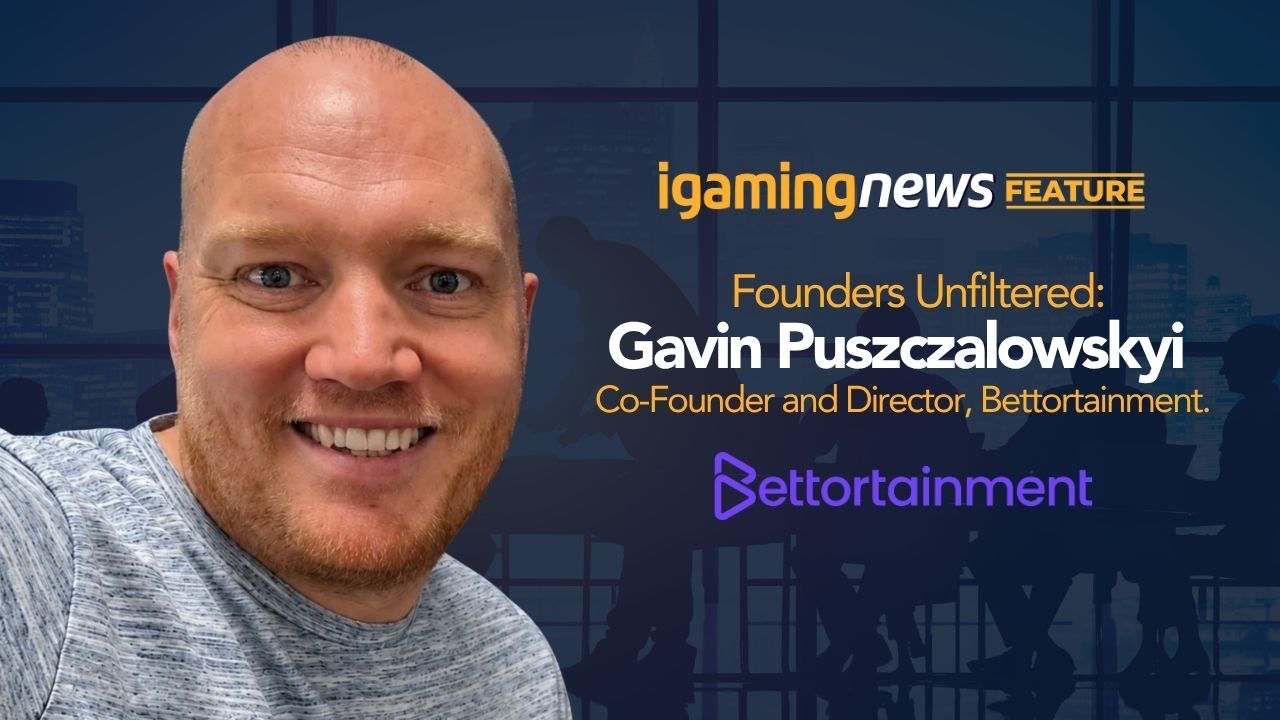
Founders Unfiltered: An Interview with Gavin Puszczalowskyi, Co-Founder and Director at Bettortainment
We sit down with Gavin Puszczalowskyi, Co-Founder and Director at Bettortainment, for a refreshingly honest conversation about the realities of building an iGaming business from the ground up.
In the latest instalment of our Founders Unfiltered series, we bring you one of the most open and candid interviews we’ve conducted at iGaming News.
We sit down with Gavin Puszczalowskyi, Co-Founder and Director at Bettortainment, for a refreshingly honest conversation about the realities of building a business from the ground up.
From the pressures of running a start-up and the personal sacrifices that come with entrepreneurship, to leadership, self-doubt, failure, team building and the challenges of scaling, Gavin offers an unfiltered look at life behind the scenes of a growing iGaming business.
He also shares his thoughts on where the industry is falling short on innovation, the rise of social betting, the future of customer engagement and why real people could be the key to cutting through an increasingly AI-driven industry.
It’s honest, personal and, true to the name, completely unfiltered.
1. What was the original idea behind your company, and what convinced you to take the leap and build it?
The original idea is based around an issue for the betting industry.
How can you really engage customers when sport is live?
Sportsbooks do not do enough to engage, entertain and retain customers when sport is live. And that is a massive, missed opportunity.
Take football as an example. You have 90 minutes of unpredictable action. Goals change games, but they also change betting odds, and no sportsbook is really tapping into the “here and now” when it comes to the best bets. Real-life calls to action, based on what is happening right there and then.
There is very little out there. So, we have created the Bettortainment Hub. It’s a live engagement platform, at the core of which is a live betting service that tips the best bets in real time. It reacts to the drama on the pitch and the changing odds off it.
Then you add in fun and games, quizzes, leaderboards, banter and entertainment, and you have a service that doesn’t just grab customers' attention, it keeps it. And it drives customers back into the sportsbook's ecosystem.
And ultimately, if every single customer placed just one more bet when sport is live, that really moves the needle.
This is not about vanity metrics. This is about performance metrics. Keep people on site. Keep people engaged. Keep them betting.
I’m a former professional radio presenter, and radio is all about grabbing attention and keeping it. As well as playing songs for a living, I also started working for William Hill, presenting betting content over a decade ago, so I have plenty of experience in creating engaging content around betting in real time.
Bettortainment has been built on that experience and the skills I've picked up over the years.
The conviction to act and build something revolves heavily around the idea and the product. Do we have a good idea and/or a good product? Can we build a business around customer engagement when sport is live?
When it comes to what we offer at Bettortainment, the answer is a resounding yes.
We believe we have something niche, different, but also something that the iGaming industry needs. Retention has always been important, but it is more important now than ever before in an ever-competitive world. And when we speak to people in the industry, they quickly understand it, like it, and that gives us the encouragement to keep going, keep building.
If you genuinely believe you have something, there is only one way to prove to yourself, and others, if what you have works, and that is go and build it.
2. What has been the hardest part of building the business that nobody warned you about?
The constant thinking. When you run a business, you must think of absolutely everything. The big stuff normally can look after itself, but you must think of all the small things. Every day, decisions can range from studio hire, filming logistics, budgets and marketing to milk and bin bags.
And it never ever stops. There is never a time when you have answered all the questions, made every decision and can relax, survey the landscape and plot and plan. Every day there is something new to deal with.
A company can be based around one idea, but it takes a million decisions to deliver that idea.
3. What has been your biggest mistake as a founder, and what did it teach you?
As a founder of a previous business, we did not get the right people in the right positions from the very beginning.
Just like a football team, if you play your best players in their best positions, you increase your chances of succeeding. Business is the same.
You must have the right foundation stones on which to build a business, otherwise you will never grow anything substantial. You may succeed and have a few wins, but in the long term, the business may be flawed. You must plan well ahead so you can achieve sustained growth and scalability. Without those foundations, the natural limitations of a business can be your downfall.
A good idea, with a good business plan, with a good team, can do exceptional things. A wonderful idea, with a great business plan, with a poor team, will struggle to achieve long-term success.
Whatever you are building, make sure you are building on firm foundations.
4. Was there ever a point when you seriously questioned whether the business would succeed? What happened?
Yes, and it continues all the time. I think a little doubt is very healthy. It’s good to take stock, check and keep focused. The issue is when you have too much doubt that it stops you believing and the negativity creeps in.
Thankfully, I have never ever done that, and I never will, due to the interest and encouragement I receive from the iGaming industry when talking about the Bettortainment Hub and customer engagement when sport is live, as well as the support and determination to succeed from the team at Bettortainment.
There are days when you feel a million miles away from where you wish to be, but you have two options. Quit, which will answer whether you will succeed or not, or keep going.
I live by the mantra that it will be OK in the end, and if it is not OK, it is not the end.
5. What is the biggest lesson you have learned about leadership and building the right team?
You must have a group of people who understand the ambition, the goal and what you are trying to achieve, who always put the business first and work as a team. You need to create a team and an environment where you can be honest and push each other, with the understanding that it is for the good of the business.
I like to surround myself with people who are better at business than I am, so I can learn and ask questions. It’s a constructive, open environment where we all have one collective goal. To grow the business and make it a success.
It needs to be an ego-free zone. Everyone will make mistakes, we simply do not have the answer to every question, nobody ever has, so it is about tackling the tough decisions as a team. And if mistakes are made, you have a team that is open, honest, supportive, constructive and eager to learn.
If you have one bad egg in the team, it can poison the whole environment.
I will be there to support people when needed, but I also need people to support me. And if you have that, you have a good team.
6. What has been your biggest challenge when it comes to growing and scaling the business?
There is an obvious logistical dilemma when growing and scaling a business like Bettortainment, new studios, new tech, new software, but the biggest challenge for me is expanding the team.
Most start-ups start with a team of generalists. You do a little bit of everything, but as you grow you need to find specialists, people who can come in and deliver what you need to deliver.
That takes time, and you must make sure you bring the right people in, both in skill set and character. And then you sometimes have to bring in new processes and systems to accommodate the new member or members of the team.
And this all happens while the business is still functioning. The dilemma is that you need to bring people on board because you're stretched with work, which is a good thing, but you need to find new members of the team, start the whole recruitment drive, advertisements, assessments, interviews, and then the on-boarding process, while you’re already stretched due to the work load.
So, it actually gets harder before it gets easier.
7. What do you think the iGaming industry gets wrong about entrepreneurship and innovation?
When it comes to innovation, I think the industry plays it safe. Nobody is really doing anything groundbreaking. People talk about innovation, especially when it comes to engaging customers when sport is live, but nobody is really doing anything about it.
It is very risk averse.
And any start-up, or other business for that matter, will tell you that you can suffer death by roadmap. Businesses appreciate and like what you do and are interested in working together, but then there can be an army of stakeholders from different departments who all have to get together and agree. They already have plans in place for the year, they cannot decide whether something sits within a marketing budget or a product budget, and a process that should be quite simple suddenly becomes complicated. The momentum can die.
When it comes to entrepreneurship, I often visit conferences around the world, and it is so difficult to meet, talk to and spend time with key decision-makers. They are extremely busy and their calendars are already full.
It would be great if there was an environment, a platform, where start-ups had access to industry leaders, where conversations can be had, questions can be asked and feedback can be given.
8. Which current iGaming trend do you believe is genuinely transformative, and which is being overhyped?
Social betting is genuinely transformative. It is about creating a customer community and making a sportsbook more than just a place to make a transaction.
There are new sportsbooks whose whole ethos is built around social betting. Dabble and Stakemate are a couple of sportsbooks that firmly believe the best way to engage is to entertain. Have fun around sport and betting, bring people together and build a community.
I think it is important that other sportsbooks follow suit. Customers, especially Gen Z, and soon to be Gen Alpha, will demand more from brands when it comes to content and engagement.
It is vital to grab the attention and custom of the current and next generation of bettors. We live in a highly competitive digital content age, so brands must do more to cut through and grab a share of the betting wallet.
For me personally, I think there is an over-reliance on AI to solve the engagement problem when sport is live.
In a world of WhatsApp, emails, Instagram, Facebook, Snapchat and the countless ways people can communicate, you still cannot beat person-to-person interaction, which is why conferences continue to grow.
I do smile when people travel around the world to converge at a conference centre to network and talk about how important AI is when it comes to engaging bettors.
With so much AI around, using real people in content that engages, entertains and retains customers will become a unique selling point, and one that people will gravitate to.
9. What has founding a company cost you personally — beyond money?
It has cost me a lot. My relationship, for one.
The stresses and strains of running a start-up are only really seen and truly understood by those closest to you, and they can have a negative impact.
There are no office hours. Sometimes there is no office, and you have to pitch up in the kitchen or the living room. You sometimes have to sacrifice bank holidays, weekends and evenings.
Success is how well you can struggle, because when you are running a company, especially a start-up, there are going to be times when you will struggle.
And this is all done with no guarantee of success or a regular income. That puts pressure and stress on personal relationships, which can break as a result.
10. If you could go back to day one, what would you tell yourself — and what would you do differently?
Accept that you do not know everything. Accept that you will feel out of your depth, you will have imposter syndrome, you will feel doubt, you will be scared and accept that you will not have a master plan for instant success.
And that is all good, healthy and perfectly normal.
So, open up. Build a close circle of friends who understand business, ideally people in the same industry, and ask questions, sometimes really stupid questions. Show your vulnerability and learn and grow. Do not do it alone for fear of looking foolish.
I have always said that the biggest growth you will ever experience in business is not moving from one studio to five studios, but the growth in you as a person.
You will grow and learn, but only if you are open to making mistakes and learning from them.
This is why having a great team around you is so important, and that is exactly what I have at Bettortainment