Founders Unfiltered: Cameron Fraser, Co-Founder & CEO of Pineapple Play
In this candid conversation, Fraser discusses the realities of building an independent games studio, from the isolation and financial pressure of entrepreneurship to finding the right distribution partner and building a team where creativity can thrive.
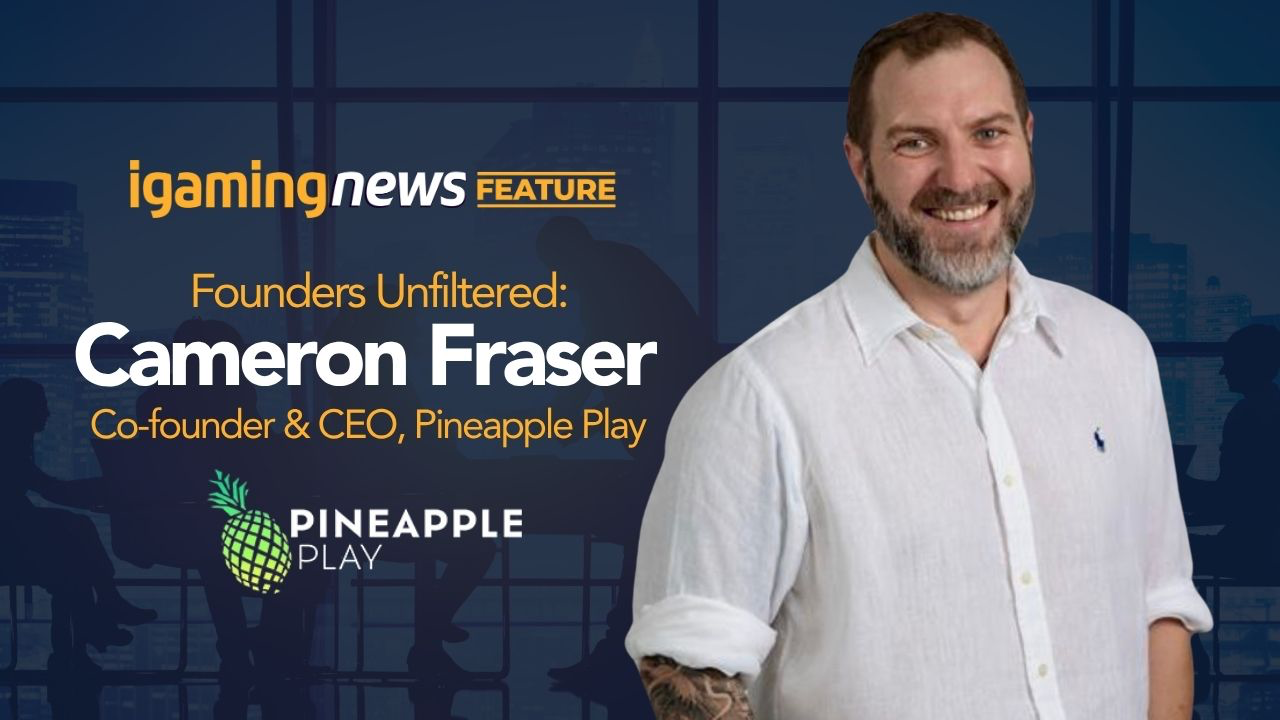
The latest instalment of our Founders Unfiltered series features Cameron Fraser, Co-Founder and CEO of Pineapple Play, a studio built around a simple philosophy: Games that take you somewhere.
With years of experience across land-based casino gaming and online slots, Fraser wanted to create games where creativity, storytelling and artwork lead the development process. That vision led him to launch Pineapple Play alongside his wife and Co-Founder and his brother-in-law and CTO, choosing to bootstrap the studio to maintain creative control.
In this candid conversation, Fraser discusses the realities of building an independent games studio, from the isolation and financial pressure of entrepreneurship to finding the right distribution partner and building a team where creativity can thrive.
He also shares his views on innovation in iGaming, the rise of progression without persistence, the potential pitfalls of AI-generated game art, and what he would do differently if he could start all over again.
1. What was the original idea behind your company, and what convinced you to take the leap and build it?
I have worked in casino gaming for many years, first in land based and then in online slots, and the creative side is what I enjoy the most. Larger organisations often silo the game design process with technical decisions leading the process and the artwork and presentation added at the end, almost as an afterthought. I’ve seen many excellent game design ideas not progressed because they were too novel and taking a release slot with an unproven game idea was too much of a risk.
I wanted to design games with creativity at the forefront, where the artwork and characters really tell a story and bring the player on a journey, and where the gameplay flows from the creative design. I knew that to have that level of creative freedom, I’d need to start my own studio.
Starting a business is a risk and it needs to be at the right time. That moment arrived for me when a company I worked for decided to move into the operator space. It was the clearest signal I could have asked for. I had the experience, and key peoplebeside me (including my wife who is also my co-founder, and my brother-in-law who is also our CTO) who believed in my creative concept and were willing to take the risk to bring it to life.
Pineapple Play is about doing things differently, and our games are about the story and journey. That’s why our slogan is ‘Games that take you somewhere’.
2. What has been the hardest part of building the business that nobody warned you about?
The hardest thing has been the social isolation. One takes for granted going into a busy office and having conversations with colleagues about work and your weekend. I knew that there would be periods without that social interaction around, but it surprised me how much I missed it. I have become quite deliberate about pursuing hobbies and sports for that social interaction now, which has also helped to separate that blurred line between work and personal time.
A very close second, is how the long hours and financial pressure of building a business plays on your mind. We chose to bootstrap Pineapple Play so we could keep creative control of the studio, and that was the right decision. However, when ultimate accountability stops with you and people are relying on you and looking to you for answers, decisions do play on your mind and tend to sit with you at odd hours.
3. What has been your biggest mistake as a founder, and what did it teach you?
My biggest mistake was bringing corporate processes, documentation and approval structures into a small studio. Although this was with the intention of laying solid foundations, I realised I had put in place the red tape I had left larger companies to avoid. We stripped the complex structure back and that was a game changer. The lesson for me was that working in an open and agile way is the most effective way to provide space for creativity to thrive.
4. Was there ever a point when you seriously questioned whether the business would succeed? What happened?
Yes, and it was the first year. We had our core team, our first game built and more planned, but had no path to distribution. We had promising conversations with multiple distributors, but they were progressing slowly, and at the same time people in the industry were telling us the market was saturated and that we could never compete with the larger studios.
We pushed forward anyway, and then met with Hacksaw. It was clear to us immediately that Hacksaw was the right distribution partner for us, and in hindsight none of the earlier distributors we met with would have suited Pineapple Play the way thepartnership with Hacksaw does.
Something that has stuck with me through this journey is how it felt not to receive responses from some distributors when we reached out. We now do our best to reply to people who reach out to us. It costs very little, and it matters more than people think.
5. What is the biggest lesson you have learned about leadership and building the right team?
On leadership, the biggest lesson for me has been that when you have gone to the trouble of hiring talented and trustworthy people, the most beneficial thing you can do is give them the space and support they need to take accountability in their area of competence to do what they do best.
On building the right team, the biggest lesson has been that industry experience matters, but having a core team that get along, have the appetite to learn and grow, and have a shared vision of where the studio is headed, is crucial. It has also been exceptionally important to build a team of people who are respectful of one another’s ideas and views, and who see mistakes as learning opportunities rather than failures. How people respond to each other sets the tone and shapes the culture of a business, and in a creative environment, you want everyone to feel that they can put their ideas forward, however odd they sound, because that is how great game ideas are surfaced.
6. What has been your biggest challenge when it comes to growing and scaling the business?
We have been fortunate that there is no shortage of demand for our games. The challenge has been financing the studio’s growth ahead of the releases. The cycle is that more resources are needed to build more games, and more game releases are needed to fund the resources. For a small self-funded studio, building up to a regular game release cadence is the key challenge.
7. What do you think the iGaming industry gets wrong about entrepreneurship and innovation?
When we started, the message received from industry veterans was consistent, that the market is saturated, every studio claims to be innovative, and that we’d have no chance without a full-time business development team based in Europe.
I understand why people see it that way, but I also think it’s worth challenging, because underneath that advice, there is nervousness about competition and disruption. You see it when successful studios are bought and then quietly wound down. You see it with small studio capital financing options too, where financing is offered only if full creative direction is handed over. That pushes new studios towards the least risky game design options which takes away the ability for disruption and innovation and pulls in the direction of quantity over quality.
8. Which current iGaming trend do you believe is genuinely transformative, and which is being overhyped?
The transformative trend is progression without persistence. Players have learned to expect a sense of journey or achievement from everything else they play and slots have historically given them a single spin and a reset. The studios solving that inside one session, through meters, escalating states, a feature that builds, are the ones players are talking about. It changes the way games are designed, which is a good test for whether the trend is transformative.
An overhyped trend is building slot games entirely on AI generated art. Players have endless choice and can tell the difference in seconds. Our view is that they will increasingly seek out games with hand illustrated art, and choose that quality over AI generated volume.
9. What has founding a company cost you personally, beyond money?
The main things are what you would expect, long working hours and sacrificing time with family and friends. I have many more grey hairs now than I did before, and a LinkedIn inbox that has never once been empty.
I have also been very fortunate to have gone through this journey with the support of an amazing team of people, and I would not trade the experience for anything. Building something of your own is worth a great deal, and I get to spend my days on work I care about.
10. If you could go back to day one, what would you tell yourself, and what would you do differently?
I would tell myself to get on with it sooner. Circling the decision to start a studio cost me more time than any of the mistakes that came after it.
I would also spend less time on game design and ideas (which were never a bottleneck) and spend a good deal moretime on brand building and media relationships, because what actually held us back early on was not the quality of our games, it’s that not enough people knew who we were.