Founders Unfiltered: Steven Spartinos, Co-CEO at Kiron Interactive
In this edition of Founders Unfiltered, he reflects on those difficult first years, the lessons Kiron learned as it expanded into new markets, and why useful innovation starts with understanding what operators and players need.
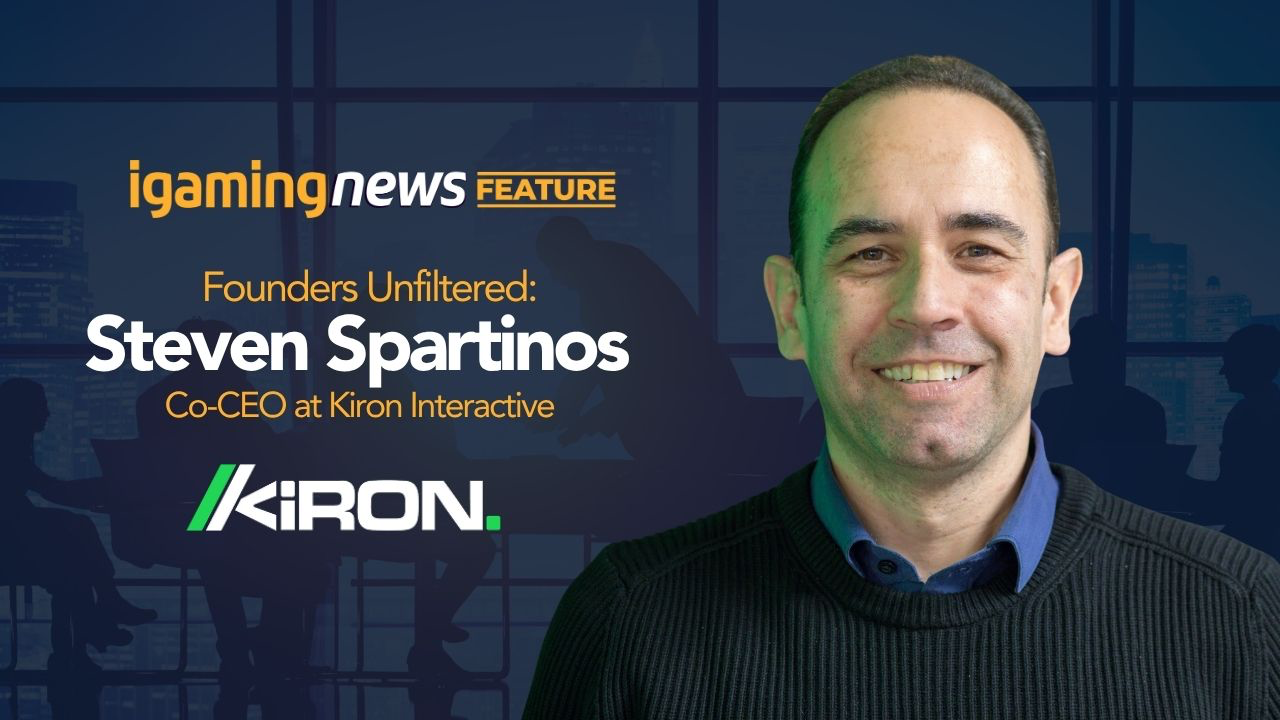
When Steven Spartinos founded Kiron Interactive in 2001, virtual sports were an unfamiliar proposition for betting operators. Twenty-five years later, the company operates across international markets, but getting there took patience: Spartinos says the early breakthrough took closer to seven years than the two he had expected.
In this edition of Founders Unfiltered, he reflects on those difficult first years, the lessons Kiron learned as it expanded into new markets, and why useful innovation starts with understanding what operators and players need.
1. What was the original idea behind your company, and what convinced you to take the leap and build it?
When we started Kiron in 2001, virtual sports did not exist as a product available for betting , so to some extent we were taking a view on where technology and betting were heading.
My background was in banking and finance, which was obviously a very different industry. What got me interested in virtual racing at the time was its uniqueness and a new type of entertainment that made commercial sense. It gave operators complementary content to traditional race betting which was limited to certain times of the day. There were many hours of dead time in shops which was not being monetised by betting operators, so offering them the prospect of betting on racing around the clock made a lot of sense.
At the time, we didn't have a master plan for what Kiron would look like 25 years later. We saw potential with this innovative idea and believed it was worth pursuing.
There was a lot of risk involved, of course, but that's fairly difficult to avoid when you're a start-up introducing a completely new and innovative product to the market.
2. What has been the hardest part of building the business that nobody warned you about?
The early years were a major challenge; travelling the world, trying to convince mostly sceptical operators that this was a product worth investing in. Let’s not forget that these were the early days of iGaming and operators were focused on building their online businesses around mainstream products such as slots, poker, etc.
We lived through the tough initial years, managing cash flows while still strongly believing in our vision and trying to convince others of the eventual success of virtual sports.
What we expected would take us a couple of years to achieve, actually took the best part of seven years to deliver some of the results we had originally anticipated.
This was the hardest part of building this business and is true of most new businesses. Success is not realised overnight and is never guaranteed. I don't think anyone really prepares you for that part of building a business.
3. What has been your biggest mistake as a founder, and what did it teach you?
There have been a number of decisions I may have made differently with the benefit of hindsight.
One of the bigger lessons has been not to assume that success in one market can simply be replicated somewhere else.
We've seen that particularly in Africa. We entered Nigeria in 2011 and subsequently expanded into markets including Uganda and Kenya. That developed into a presence across approximately 30 African markets.
But Africa isn't one market. It's 54 different countries with different requirements, player preferences, infrastructure and ways of doing business.
There were occasions where we could have spent more time understanding those differences before making decisions. Experience teaches you to listen to the people who understand a market properly rather than arriving with a fixed view of what should work.
4. Was there ever a point when you seriously questioned whether the business would succeed? What happened?
There have certainly been difficult periods.
As mentioned earlier, in the initial six or seven years of the businesses existence, we questioned on a couple of occasions whether we would achieve the success we had initially envisioned.
We were however far too determined to succeed and, on each of these occasions, convinced ourselves that having overcome so many obstacles, we would eventually get the breakthrough we required.
In the late 2000’s we finally started seeing the adoption of virtuals in a number of sports betting markets, primarily in Asia, Eastern Europe and CIS. As the success of the products started resonating with operators in these markets, the word spread and more and more markets started opening up.
I would say the biggest breakthrough for virtuals came at the end of 2013 with the regulation of virtual sports in Italy, Europe’s second largest betting market. The products were a runaway success with players from the moment they were made available by operators.
5. What is the biggest lesson you have learned about leadership and building the right team?
In any successful business you need good people around you.
We have been blessed to have built a great team over the years. This has been key to the business’s success and longevity over 25 years.
When you start a business, you become accustomed to solving problems yourself because that's what is required. As the company grows, however, that approach becomes a limitation.
One of the most difficult parts for a founder can be knowing when to step back. Hiring skilled and experienced people doesn't achieve very much if every decision still has to come through you.
We have invested in professionals that have brought the relevant skills and experience to the business and we have given them the freedom to deliver in their respective areas.
Seeing these colleagues grow and deliver results has made my job so much more rewarding and allowed me to be comfortable to take a step back.
6. What has been your biggest challenge when it comes to growing and scaling the business?
Choosing where to focus.
As the business grows, interesting opportunities come from more and more businesses and in more forms. As an entrepreneur, your initial instinct is often to consider many of them. You can't of course pursue all of these, so deciding where to invest your time and resources becomes increasingly important.
We've also learned that scaling internationally doesn't mean applying the same approach everywhere. Italy is a good example. We've been active there for more than a decade and it has a very developed and mature virtual sports market, with established operators, clear regulation and players who have adopted and love the vertical. Growth in this market requires a different approach to entering a new market where virtual sports are still developing.
This principle applies currently when looking at the newer developing markets in Latin America. Brazil, Mexico, Peru and Argentina are all at different stages in terms of regulation, market maturity and player behaviour. You can't really talk about a regional strategy without understanding those differences first.
That's probably one of the biggest lessons we’ve learned when growing Kiron internationally. Growth isn't simply about being present in more countries. You need to understand the market, find the right partners and be prepared to adapt the product and the way you operate.
We've become much more selective about that over the years.
7. What do you think the iGaming industry gets wrong about entrepreneurship and innovation?
We probably use the word innovation too easily.
There is always a new technology attracting attention and that's not necessarily a bad thing. But something being new doesn't automatically make it useful.
For me, innovation should solve a genuine problem or improve the experience.
Sometimes that is quite practical. A product that loads faster, uses less data, makes the betting process simpler or works better on mobile can have a much greater impact than something that sounds more impressive.
We've seen that ourselves. The development of a retail satellite footprint in Africa came from recognising the practical realities around product availability due to bandwidth and data consumption challenges.
There was a clear requirement and we built around it.
I think that's a better measure of innovation than simply being first to use a particular technology.
8. Which current iGaming trend do you believe is genuinely transformative, and which is being overhyped?
Mobile has been genuinely transformative and I think we're still seeing its impact.
It has changed how people access entertainment generally, not only betting and gaming. People expect to be able to access content immediately and for the experience to work properly on the device they're using.
We've seen the impact very clearly in Africa. Retail remains important, but mobile has become a much larger part of the overall betting ecosystem.
As for what is overhyped, I'm reluctant to nominate one particular technology.
Our industry has always gone through periods where something new is expected to change everything. Sometimes it does become important. Sometimes the expectations run ahead of the practical application.
I tend to look at whether something is actually improving the product or solving a problem. If it is, it will probably find its place.
9. What has founding a company cost you personally, beyond money?
Time is probably the simplest answer.
Building a company requires a considerable amount of it, particularly in the earlier years when you're involved in most aspects of the business.
I have always been quite private about my personal life and I think it's important to maintain some separation between that and the business. But inevitably, when you have been involved with a company for 25 years, there are periods when it demands more of your attention than others.
The responsibility changes as the business grows as well. You have people who have been with the company for many years and built careers here. You become conscious that the decisions you're making affect a much wider group of people.
I don't view that negatively. It's simply part of the responsibility that comes with building and leading a company.
10. If you could go back to day one, what would you tell yourself, and what would you do differently?
I'd tell myself to be patient.
When you're building a company, particularly in a relatively new category, it's easy to think everything needs to happen quickly. With experience, you realise that businesses and markets develop at their own pace.
I'd probably delegate earlier and spend more time listening before making certain decisions, particularly when entering new markets.
One of the most useful things we've learned from international expansion is the importance of local knowledge. You can't assume that what works in one country will work in another.
What I wouldn't change is the decision to focus on virtual sports.
We've been in the category since 2001 and have watched it develop from nothing into a well established form of betting.
The industry will continue changing. Mobile behaviour will evolve, regulation will evolve and player expectations will evolve with them. Further, the evolution and adoption of AI is likely to have a significant impact on our industry. Our job is to understand these changes and continue building our business accordingly, in the markets we're operating in.
If you'd asked me in 2001 whether Kiron would still be doing that 25 years later, I certainly wouldn't have predicted everything that happened along the way.
But I'm very pleased that we are still on this exciting journey.