Founders Unfiltered: Opinion Kings’ Harshit Geddam on Prediction Markets and Building Beyond the Product
Opinion Kings founder Harshit Geddam discusses the social potential of prediction markets, why distribution matters as much as technology, and the realities of building a startup.
Listen to this article
British female voice
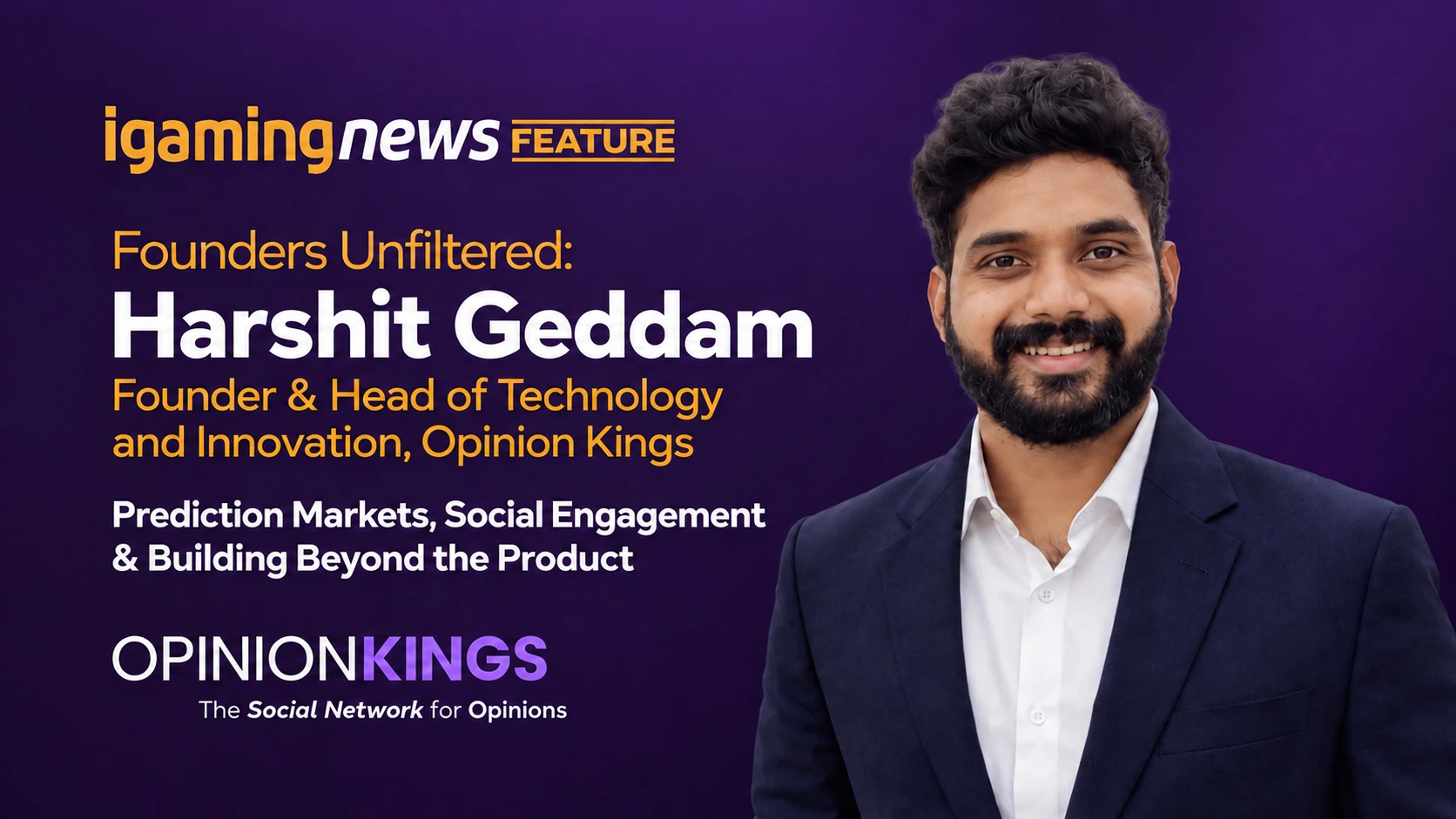
What if the opinions people share online could build credibility through the accuracy of their predictions? That question sits at the heart of Opinion Kings, where founder Harshit Geddam is exploring the relationship between social engagement, prediction markets and real-world outcomes.
In this edition of Founders Unfiltered, Harshit, Founder & Head of Technology and Innovation at Opinion Kings, shares the lessons behind building the business: the limits of a feature-first mindset, the importance of distribution, the uncertainty of an evolving regulatory environment and the personal responsibility of leading a startup. He also explains the company’s play-money starting point and its plans for a path towards regulated real-money trading, rather than presenting that next stage as already achieved.
What was the original idea behind your company, and what convinced you to take the leap and build it?
The original idea came from a simple observation: people spend hours on social media expressing opinions about what they believe will happen next, but those opinions rarely go beyond likes, comments, and shares.
I started asking myself, what if opinions could become something more meaningful? What if people could build credibility based on how accurate their predictions actually were?
That's where OpinionKings began.
We wanted to bring together the engagement of social media, the intelligence of prediction markets, and the transparency of real-world outcomes.
What convinced me to build it was realizing that prediction markets didn't just need more trading platforms. They needed an entirely different way to attract, engage, and retain people.
I saw an opportunity to build that social and technology layer from the ground up.
What has been the hardest part of building the business that nobody warned you about?
The hardest part has been realizing that building a great product is only one part of building a successful company.
As a technology founder, my natural instinct is to solve problems through engineering. But building OpinionKings has required me to think beyond technology—about regulatory frameworks, capital, partnerships, leadership, and market timing.
Prediction markets are evolving rapidly, and sometimes the regulatory environment changes faster than the product roadmap.
Nobody really prepares you for the number of important decisions you have to make with incomplete information.
I've learned that entrepreneurship isn't about having every answer. It's about making informed decisions quickly, taking responsibility for them, and continuing to execute.
What has been your biggest mistake as a founder, and what did it teach you?
One of my biggest early mistakes was believing that building more features automatically meant building a better business.
As engineers, we're naturally excited about innovation. We want to create sophisticated systems, introduce new capabilities, and continuously improve the technology.
But I've learned that users don't necessarily care how complex your technology is. They care about how easily it solves their problems and how much value it creates.
Today, I think much more about user behavior, engagement, retention, and distribution.
My biggest lesson has been that technology creates possibilities, but execution, simplicity, and distribution turn those possibilities into a business.
Was there ever a point when you seriously questioned whether the business would succeed? What happened?
There have certainly been moments when I've questioned the timing and the challenges ahead, particularly given how quickly the prediction market industry is evolving.
When you're building in an emerging, regulated industry, there are variables you simply cannot control.
But I've never believed that uncertainty alone is a reason to stop building.
Instead, those moments have pushed us to strengthen our strategy. We started with a play-money platform, focused on understanding user behavior, and developed a path toward regulated real-money trading.
We've also deliberately built our vision beyond sports, with opportunities across finance, economics, technology, entertainment, and other real-world events.
I've learned to distinguish between questioning a strategy and questioning the entire vision.
Sometimes you need to change the approach without abandoning the destination.
What is the biggest lesson you have learned about leadership and building the right team?
The biggest lesson is that talented people alone don't build successful companies. Talented people who share the same vision, take ownership, and execute together do.
At OpinionKings, we're bringing together people with backgrounds in technology, financial markets, compliance, gaming, and business development.
I've learned that leadership isn't about having the smartest answer in every room.
It's about creating an environment where the best ideas win, decisions happen quickly, and everyone understands what we're trying to achieve.
I strongly believe in giving people ownership and trusting them to deliver.
At the same time, accountability is essential. In a startup, speed matters, but speed without responsibility creates chaos.
My philosophy is simple: build a team that can make decisions, move fast, challenge assumptions, and stay aligned with the mission.
What has been your biggest challenge when it comes to growing and scaling the business?
Our biggest challenge has been balancing growth with the responsibilities that come with operating in a regulated financial market.
Building a consumer social platform requires experimentation, rapid product development, and strong distribution.
Building a prediction market platform also requires compliance, market integrity, trustworthy infrastructure, and carefully structured partnerships.
We're essentially bringing together two very different worlds.
Our approach has been to build the engagement and distribution layer first, understand how people interact with predictions, and develop the regulated infrastructure and relationships needed for the next stage.
I believe the companies that win this market won't necessarily be those that list the most contracts.
They'll be the ones that make participation intuitive, build user trust, and create reasons for people to come back every day.
What do you think the iGaming industry gets wrong about entrepreneurship and innovation?
I think the industry sometimes confuses innovation with introducing another betting product, offering more markets, or improving promotional incentives.
Those things can drive short-term growth, but they don't necessarily change the way consumers engage.
Look at how social media evolved. The biggest transformations didn't come from adding more content. They came from changing how content was discovered, distributed, and experienced.
I believe prediction markets present a similar opportunity.
The next wave of innovation isn't just about what people can trade or predict. It's about how they discover opportunities, form opinions, interact with communities, and build credibility.
At OpinionKings, we believe the social experience surrounding a prediction can become just as important as the market itself.
That is where we see the opportunity to build something fundamentally different.
Which current iGaming trend do you believe is genuinely transformative, and which is being overhyped?
I believe prediction markets are one of the most transformative developments happening at the intersection of gaming, financial technology, and consumer engagement.
They create opportunities for people to express views on real-world outcomes across a much broader range of subjects than traditional sports betting.
But what excites me most isn't just the trading mechanism. It's the potential to combine prediction markets with social networks, creator communities, reputation systems, and AI-driven experiences.
The trend I think is being overhyped is the idea that launching another sports-focused prediction market is, by itself, a revolutionary business model.
Sports will undoubtedly remain a major category, but there's an enormous opportunity beyond sports.
People have opinions about inflation, interest rates, elections, technology, entertainment, and everyday events.
I believe the next generation of platforms will focus on bringing these broader audiences into prediction markets, rather than competing exclusively for the same sports-focused users.
What has founding a company cost you personally — beyond money?
Founding a company changes your relationship with time, responsibility, and uncertainty.
You realize that your decisions don't just affect you anymore. They affect your employees, investors, partners, and everyone who believes in what you're building.
It's difficult to completely switch off because there's always another problem to solve, another decision to make, or another opportunity to pursue.
The biggest personal cost has been the mental responsibility of carrying a vision that is still being built.
But it's also taught me discipline, resilience, and the importance of surrounding myself with people who share that responsibility.
I've come to understand that entrepreneurship isn't simply about taking risks. It's about being accountable for those risks and the people who take them alongside you.
If you could go back to day one, what would you tell yourself — and what would you do differently?
I would tell myself three things.
First, distribution matters just as much as the product. You can build extraordinary technology, but if you don't understand how to reach and retain users, you're only solving half the problem.
Second, surround yourself with experienced people earlier. The right advisors, operators, and industry relationships can save months of mistakes and open doors that technology alone cannot.
Third, don't wait for everything to be perfect.
Launch, learn from real users, improve quickly, and keep moving.
If I could change one thing, I would have focused even earlier on building our distribution engine alongside our technology.
But I wouldn't change the vision.
I still believe we're at the beginning of a fundamental shift in how people consume information, express opinions, establish credibility, and participate in real-world markets.
And that's exactly the future we're building toward at OpinionKings.
Interview: iGaming.News. Responses, portrait and company logo supplied for publication. Company plans and market views are attributed to Harshit Geddam.
Stay ahead of iGaming
Get the week's key stories, industry insight and exclusive interviews in your inbox.
One email a week. Unsubscribe any time. More about our newsletter