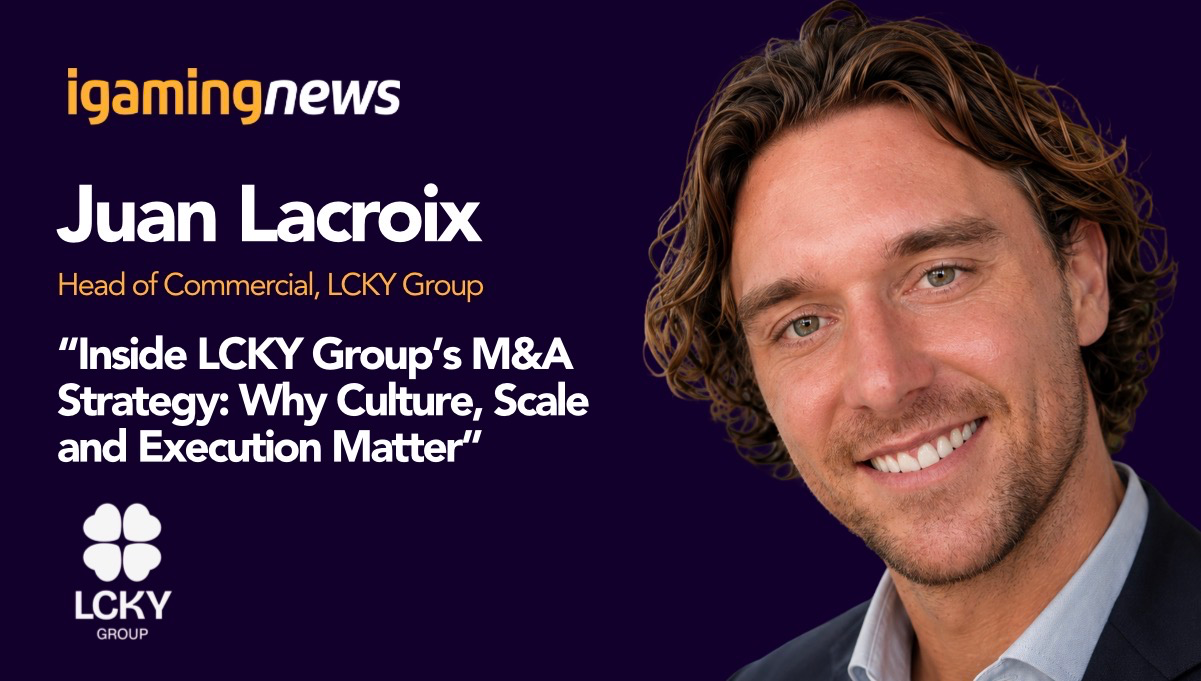
Inside LCKY Group’s M&A Strategy: Why Culture, Scale and Execution Matter
An interview with Juan Lacroix, Head of Commercial, LCKY Group
Having already covered in broad strokes where investors can gain value through M&A activity, this follow-up piece will focus more on LCKY Group and the approach that it takes towards market
expansion. We’ll explore the importance of cultural fit, process alignment and what makes a business stand out as a worthwhile M&A opportunity, as well as what LCKY Group brings to the table as a long-term investment partner. We’ll also discuss the group’s decision to focus exclusively on regulated markets and what this means in commercial terms, before rounding the discussion up with a look at LCKY’s plans for the future and how it will go about achieving them.
Responses by Juan Lacroix, Head of Commercial, LCKY Group:
1) When weighing up the value of any potential M&A activity, how big of a factor does cultural
alignment play in your thinking? Are you a group that places a lot of value in working with brands that share values and ideals that are similar to your own, or do you actively seek out new ideas and perspectives that can be incorporated into your wider corporate strategy?
I have a personal angle on this one, because I joined from the other side of an acquisition. I was at OneCasino when Glitnor acquired it, and I stayed and built my career through the integration into what is now LCKY Group. So I know from experience that cultural fit decides whether the people you acquire are still there two years later. And the people are usually a big part of what you paid for.
That said, alignment doesn’t mean sameness. Some of the best things we do as a group today started as ideas that one brand brought with it. What has to match are the fundamentals: a long term view, respect for regulation, and the way a company treats its partners. You can read a lot of a company’s culture in its commercial relationships. How they negotiate, how they handle a dispute, whether suppliers actually want to keep working with them.
2) When acquiring or merging with a new business, there’s obviously a balance to be struck between maintaining the individuality that attracted you to it in the first place and making sure the brand is consistent with the rest of the group. How hands-on do you like to be during this process and how do you add value without completely overhauling what already works?
This is where my role sits day to day, so I’ll give the practical answer: we centralise the commercial layer and we leave the brand layer alone.The commercial layer is where scale creates value. Supplier agreements, payments, distribution.
When a brand joins the group it moves onto group terms with game providers and payment partners, usually better than anything it could have negotiated on its own. The player never notices any of it, and the local team gets a stronger cost base to work with from day one.
The brand layer is the opposite. Identity, tone, the local team and their knowledge of the market.
That’s what made the brand worth acquiring in the first place, so overhauling it makes no sense.
After the Glitnor and OneCasino deal we brought dozens of provider contracts into group agreements while every brand kept its own identity, and that model still holds today. Hands-on where scale matters, hands-oO where the identity lives.
3) LCKY Group’s Chief Revenue OSicer, David Schwieler, said on recent podcast with G3
Pulse that we’re operating in a highly-saturated industry where genuine ground-breaking innovation is rare. Based on this, what are the other aspects of a business’s product or services that you look at to determine whether or not it’s a viable candidate for M&A activity?
David is right, and from where I sit that’s not a problem. In this industry execution beats novelty more often than people admit.
When I look at a business, I look at the foundations underneath the product. What do the supplier agreements look like, are they on market terms or on legacy pricing that will take years to unwind?
How are the payment acceptance rates, because poor payments quietly kill good products. What is the quality of the aOiliate and partner base, and which licences do they actually hold?
A business with a decent product and clean commercial foundations can be improved quickly. A business with a brilliant product built on messy contracts and weak payment performance costs far more than it looks. So beyond innovation I’d look at distribution, licences and the health of the commercial agreements. Those tell you how much value is really there and how fast you can unlock it.
4) Of course, any M&A activity has to be mutually beneficial for both parties. Given LCKY
Group’s history and experience within the iGaming industry, what would you say are the main competitive advantages you’re able to bring to a business as an investor in terms of technology, market insight or distribution channels that can quickly get products to market?
Speed and infrastructure. We run five brands across six regulated markets, so a business joining the group plugs into things that take years to build alone.
The most immediate one is commercial scale. A big part of my role over the past few years has been consolidating our supplier and payment agreements at group level, so the terms we hold reflect the volume of the whole group. A new brand gets those terms from day one. That changes its cost base overnight, before anyone has touched the product.
The second is market insight. Operating in Sweden, the Netherlands, Spain, Denmark and Ontario means we work daily in some of the most demanding regulated environments in the industry. We know what compliance-first operations look like in practice, and we know thepayment and content preferences of each market. For a business entering those markets, that
knowledge and distribution is worth as much as the capital.
5) As a group you’ve always focused on regulated markets, despite this regulation arguably
putting a cap on what you can achieve from a commercial or product perspective. Does operating in regulated markets allow you to more accurately project whether an investment is likely to be profitable, and how do you deal with sudden shifts like we’ve seen in the UK?
It does, and for me that predictability is the whole point. In a regulated market the biggest cost lines are known before you enter. Gaming tax, payment costs, compliance requirements, licence fees. That means you can model what profitable looks like with real confidence, and you can commit to a market for the long term because you know the rules you’re playing by. The cap on the upside is the price of that certainty, and I think it’s a fair trade.
Sudden shifts are part of the deal though, and you can’t negotiate them away. What you can do is build for them. We’re spread across six markets so no single regulatory decision defines the group. I build review mechanisms into our commercial agreements so terms can move when a market changes. And we keep our central infrastructure flexible enough to adapt quickly. You can’t predict the shift, but you can decide in advance how exposed you are to it.
6) Looking ahead, are there any new markets you’re particularly keeping an eye on and, if so, how will you determine whether it’s better to enter them with one of your existing brands or by identifying a worthwhile M&A opportunity? How important are things like staSing, local knowledge, development costs and speed-to-market when weighing up such key decisions?
Everyone can see where the industry’s attention is heading, and we’re no exception, but market selection sits with group leadership so I’ll leave the names to them. The part of that decision that lands on my desk is the second half of your question: once a market is on the table, do we build our way in or buy our way in? The two routes look similar on a slide and completely different in operation.
Entering with one of our own brands means a licence process, local payment integrations, extending our supplier agreements, hiring, and building a market position from zero. Our platform and group agreements carry part of that load, which is a real advantage, but you’re still looking at a long runway before real traction, and in most new markets the habits form early.
Acquiring flips that. You get a licence, local payments, local knowledge and a player base on day one, and you pay a premium for the speed. What you take on instead is the integration work, and most of that lands on the commercial side: moving contracts to group terms, aligning the payment setup, connecting the partner network. That work decides whether the premium was worth paying.
So my contribution to those decisions is making sure they’re made with a clear picture: what each route costs, how long it takes, and what it asks of the organisation. Staffing, local knowledge, development cost and speed-to-market are exactly the variables that tip the scale, and they tip differently in every market. Whichever way it goes, the licence or the deal is only the start. Most of the value gets made in the execution that follows, and a lot of that lands on the commercial side. That’s the part I know best, and the part I enjoy most.