The Optimisation Divide: When Better Decisions Start to Compound
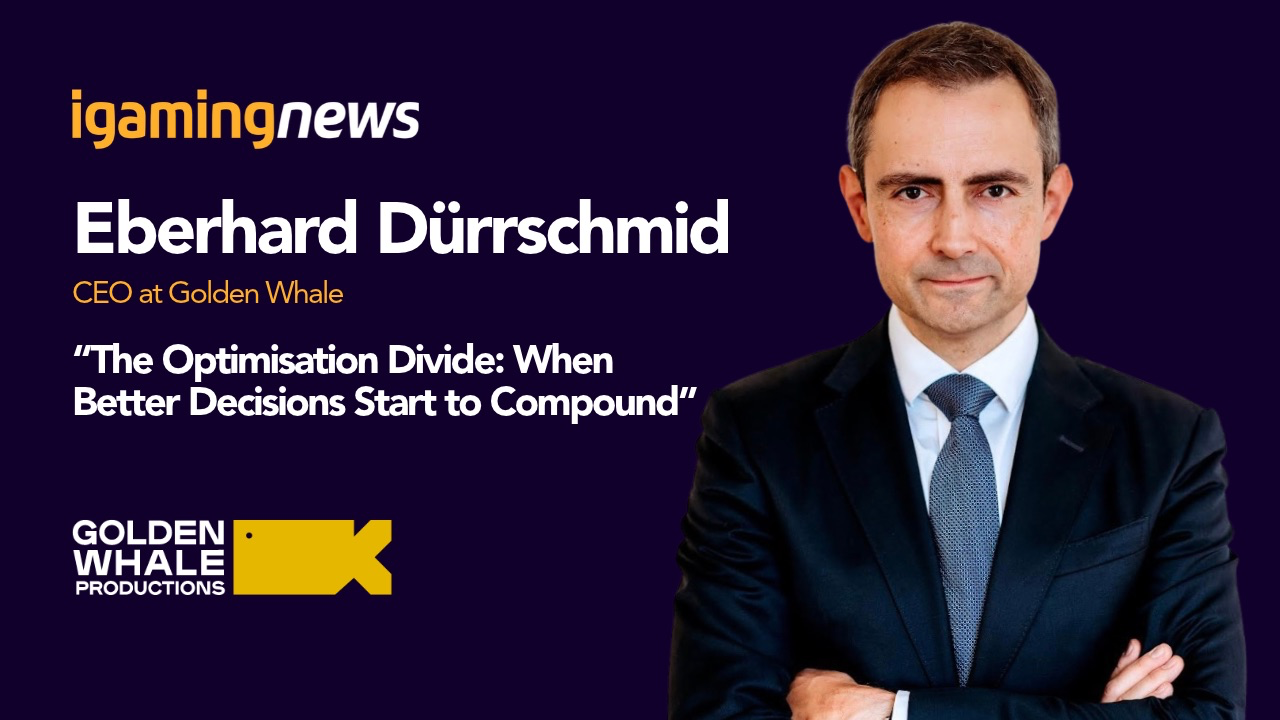
By Eberhard Dürrschmid, CEO at Golden Whale
The question is no longer simply whether an operator has data. It is whether that data can be turned into better decisions quickly enough to change what happens next.
That is where the optimisation divide is emerging: between businesses that can test, learn and act continuously, and those still constrained by slower, more manual decision-making.
The gap matters because optimisation compounds. One better retention decision may have a small effect. Thousands of better decisions across incentives, engagement, personalisation and product journeys can begin to change the trajectory of the business. Faster testing creates faster learning, and each improvement strengthens the next decision.
Democratising optimisation
Advanced optimisation has traditionally been closely tied to specialist data science and engineering teams. But access to data, or even machine learning, is only part of the equation. The bigger constraint is decision quality and capacity: how many good decisions can an organisation make, how quickly can it act on them, and how reliably can it learn from the result?
Most operators are still structurally limited here. They may have dashboards, models and rich behavioural data, but those assets do not automatically translate into action. The optimisation gap sits between insight and execution: the absence of mechanisms that reliably turn automated insight into automated action, and action into learning.
Democratising optimisation means closing that gap. A retention team shouldn’t have to wait weeks for a model to be rebuilt before testing an idea, and a CRM team shouldn’t need to turn every commercial question into a lengthy technical project. Decision intelligence needs to be practical enough to support the operation where decisions are actually made.
The advantage of learning faster
The next competitive advantage will come less from having more data than competitors, and more from being able to act on it better, systematically, measurably and at scale.
That requires feedback loops. A decision is made, the outcome is measured and that information improves what happens next. Importantly, the intervention itself creates new information: how did the player respond, was the incentive necessary, did the journey improve? Those signals then feed the next round of optimisation.
When this happens continuously, relatively small gains can accumulate across a vast number of interactions. The business is not simply making better decisions; it is learning how to make them better again and again.
Making optimisation modular
One way to widen access to advanced optimisation is to stop treating it as one large transformation project.
At Golden Whale, this is the thinking behind our Smart Functions Library: focused optimisation capabilities that can be used as building blocks around specific operational problems. Operators can retain the customer-facing experience, strategy and commercial judgement that make them distinctive, while bringing specialist decision intelligence into areas where complexity and speed make manual optimisation difficult.
This modular approach also lowers the barrier to experimentation. Instead of waiting for an entire internal capability to be built, an operator can start with one high-value decision, measure the result and expand from there.
Closing the divide
Democratising optimisation does not mean handing decision-making over to machines. Human teams still set the goals, define the boundaries and bring the market knowledge. Machine learning can take on the volume, speed and complexity required to optimise continuously within those parameters.
The bigger shift is what that does to competition. As advanced optimisation becomes more accessible, technological scale becomes less decisive. Operators that can shorten feedback loops and reliably turn insight into action can improve faster, regardless of size.
That is ultimately what levelling the optimisation playing field should achieve: not just wider access to data or AI, but wider access to the mechanisms that turn better decisions into continuous learning and sustained improvement.