Has Slot Volatility Hit Its Ceiling? Roundtable: Part One
In this roundtable, we ask whether slot volatility has reached its ceiling, how studios balance risk with entertainment, and what the next phase of high-impact game design might look like if the answer is no longer just “more”.
Volatility has become one of the clearest ways for slot studios to signal scale, ambition and big-win potential. Higher ceilings, sharper maths profiles and more extreme bonus rounds have all helped define a product category where players know that one moment can change the entire session.
But as max-win figures have climbed and high-volatility language has become increasingly familiar, the question now is whether simply going bigger still carries the same impact. Do players still respond to the most extreme profiles, or are they becoming more interested in games that offer clearer progression, stronger base-game engagement and a more rewarding sense of build-up along the way?
In this roundtable, we ask whether slot volatility has reached its ceiling, how studios balance risk with entertainment, and what the next phase of high-impact game design might look like if the answer is no longer just “more”.
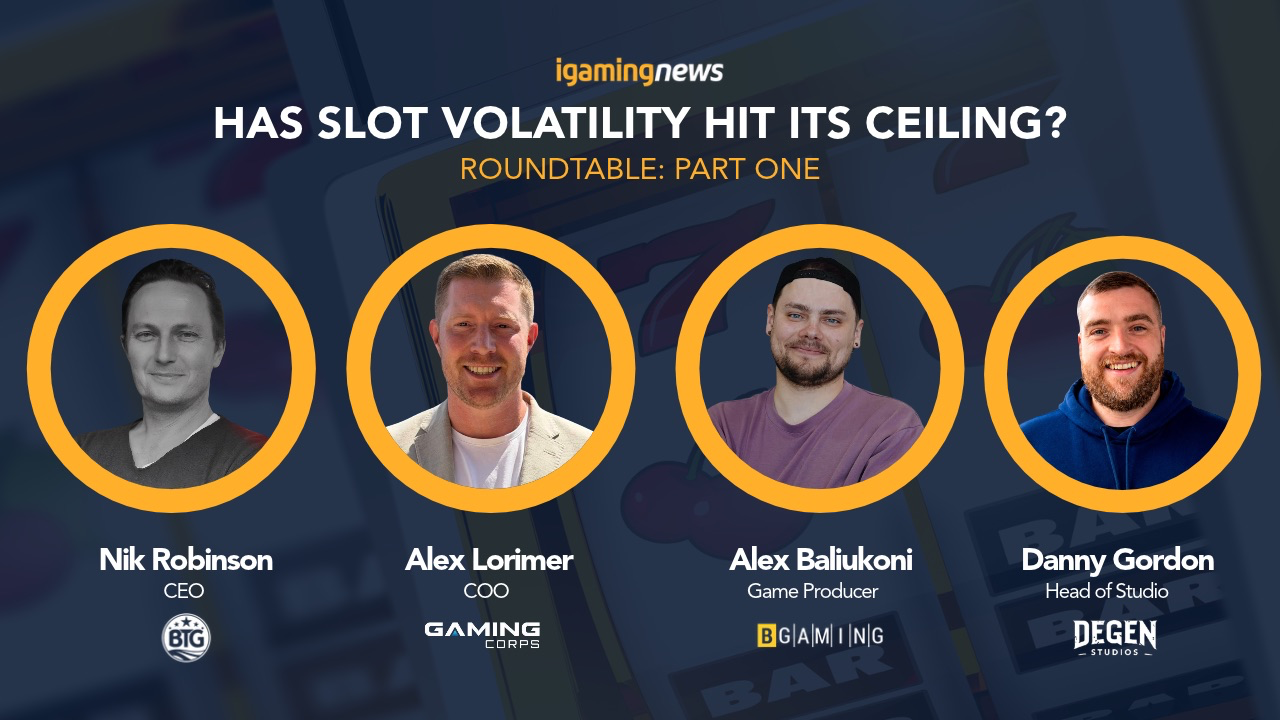
Contributors include:
Nik Robinson, CEO, Big Time Gaming
Alex Lorimer, COO at Gaming Corps
Alex Baliukonis, Game Producer at BGaming
Danny Gordon, Head of Studio, DEGEN Studios
Has the industry reached peak volatility, or is there still room for slots to go bigger, sharper and more extreme?
Nik Robinson: There's still room at the top end. We've made games at the extreme end ourselves this year because there's a real audience for them, and that audience isn't going anywhere. Where I think the industry has hit a ceiling is in what a bigger number can do on its own.
A player who has tried every high-volatility release this month has seen every headline figure going, and one more zero on the paytable won't hold them for long. What keeps someone in a game is how that potential is paced across a session and whether they can feel it building as they play. Studios can keep going bigger, and some will.
Alex Lorimer: There is still room to go further. Some studios will keep pushing max wins and volatility, and there are players who actively seek out those games. But the market is more varied than that one race suggests.
At Gaming Corps, we have chosen to focus on games that perform consistently in regulated markets. That has helped us build strong relationships with operators who know what to expect from us and have confidence in our releases. It doesn’t mean we cannot explore higher volatility. It means the maths profile has to serve the game and its audience, rather than becoming the whole reason for making it.
Alex Baliukonis: Not necessarily, but the industry is approaching a practical ceiling. Volatility is not determined solely by the maximum multiplier, which is where the discussion becomes complicated. We increasingly see games promoting wins of 20,000x or more, even though the mathematical probability of reaching them may be one in billions of spins. Some developers are also experimenting with highly polarised models in which almost every spin returns nothing, and the entire theoretical value is concentrated in an exceptionally rare event.
Without fundamentally new payout systems, there is a limit to how much further this can go before the experience becomes either technically constrained or commercially unviable. The next step should therefore not be about raising the headline number. It should be about designing risk more intelligently and giving players a compelling journey towards those high-impact moments.
Danny Gordon: I think extreme volatility may already be close to its peak. There will always be players who want the biggest number, the sharpest profile and the most aggressive max-win chase, but I don’t think going bigger is where the most interesting design work is happening now.
The better question is what the game gives players between the bigger moments. A huge ceiling means very little if the session has no shape, tension or anything meaningful to follow. For me, the next phase is less about pushing volatility further and more about making the overall product stronger.
At what point does a game become too volatile, and what are the warning signs?
Nik Robinson: For me a game is too volatile when the base game turns into something the player sits through. If the only reason to spin is the hope of reaching the bonus, the design has given up on most of the session. Players stop watching the reels and start watching their balance, and at that point you've lost them.
The other warning sign is a player running out of money before the game has shown them what it can do. Monopoly Rush Hour has a 28,600x max win, but Tokens are moving and landing on Prize spaces all through the base game, and reaching Hotel status gives people a goal they can realistically hit within a session. I'd put the same question to any high-volatility game. Is there anything worth watching between the big moments?
Alex Lorimer: It depends on the players you are making it for. A studio with an established audience can push into more volatile territory, but it needs to understand what those players enjoy about its games in the first place.
That matters even more with a familiar series. Players bring expectations with them, and a change in the maths can alter the feel of a game substantially. I would look at whether the experience still gives those players enough to enjoy between the bigger conclusions. There will always be an audience willing to pursue a more extreme profile, so I don’t think there is one point where the industry as a whole has gone too far. The question is whether your game has gone too far for your audience.
Alex Baliukonis: There is no universal point at which a game becomes too volatile, because the answer depends heavily on its intended audience. For a mainstream player, a base-game hit frequency of less than one win in ten spins, combined with a bonus that triggers only once every 400 spins or more, may already feel highly volatile.
The warning signs are long stretches without meaningful returns, sessions that end before the core features appear, and a growing gap between the promoted potential and the experience most players actually have. Streamers represent a very different cohort: they actively seek rare events, dramatic bonus rounds, and very large multipliers. Even within that segment, however, there is a limit. Titles by BGaming, such as Snoop Dogg Dollars, sit at the extreme end of the spectrum, including for streamer-focused audiences. Ultimately, volatility becomes excessive when anticipation turns into frustration.
Danny Gordon: I don’t think there is one point on a volatility scale where a game suddenly becomes too extreme. Two games can both be labelled high volatility and still feel completely different in the hands of a player.
The warning signs come when too much value is placed into one remote outcome. If the base game gives very little back and the feature feels miles away, the whole session starts to lean too heavily on that one payoff, and the appeal naturally narrows.
That profile will still appeal to some players, and there is nothing wrong with designing for them. But the volatility needs to have a purpose. Even a very aggressive game should create tension, tease potential and give the player enough to follow so they understand why they are still in the chase.
Are max win and volatility becoming too closely linked in slot design?
Nik Robinson: In a lot of marketing they've become the same sentence, and I understand why. A max win is the easiest number to put on a banner. The trouble is it describes one outcome that very few players will ever see, and it says almost nothing about every other spin.
When we built Fruit Merge MegapotsTM, we wanted the 88,000x ceiling to sit at the top of a ladder the player can actually see. Three matching fruits merge into a better one, and even the lowest fruit is only four merges away from a Megapot symbol. That gives the max win a route. Players can watch themselves climbing, so the bigger prizes feel connected to what's happening on screen.
Alex Lorimer: A large max win signals volatility, but it does not tell you how the whole game will feel. We saw that with 3 Pigs of Xmas Bonus Pot 20000. One UK bingo-focused operator told us, around 15 days after launch, that the game was tracking to be its eighth-best release of the year on a 30-day comparison. That showed us a 20,000x game could connect with a broader audience than we might have expected.
Now, with the 30,000x 3 Pigs of Olympus 30000 Extreme, some major regulated operators are open to releasing it, even though that level of win potential would usually sit outside their comfort zone. The strength of its predecessor has helped but so has the care taken to balance the gameplay around that headline figure.
Alex Baliukonis: No, because max win and volatility have always been closely connected in both game design and marketing. For many mainstream players, the maximum-win figure is still the most visible shorthand for understanding risk, and providers and aggregators commonly use it when categorizing games.
However, the two concepts are not interchangeable. A game with a 5,000x or 7,000x maximum win can have a relatively low-volatility profile, while a game capped at 1,000x may still be highly volatile because of how frequently and unevenly wins are distributed. The real issue is that the industry continues to add more parameters to its definition of volatility without agreeing on a standard way to communicate them. Simply labeling a slot “high volatility” tells players very little about how it will actually behave. Greater standardization and transparency would make these labels far more useful.
Danny Gordon: I think they can be. A huge max-win figure has become an easy way to communicate excitement, and naturally that often comes with a more extreme maths profile. But the biggest number on the game sheet should not dictate every other decision.
There are players who actively want that max-win chase and giving them specific modes or ways to access it makes sense. We have done that ourselves. But that does not mean every player needs to experience the entire game through the same level of risk.
There is room to separate those things more intelligently. You can create serious win potential while still giving the wider game enough range to entertain different player types. Max win can be the summit without making everything below it feel like a cliff face.