Channelisation in Canada is Not Finished; it's a Race iGaming Regulators Risk Losing
Ontario's impressive 91% channelisation rate is often touted as an example of the success of Canada's iGaming market. However, outside the province, offshore operators continue to dominate among bettors. In this research
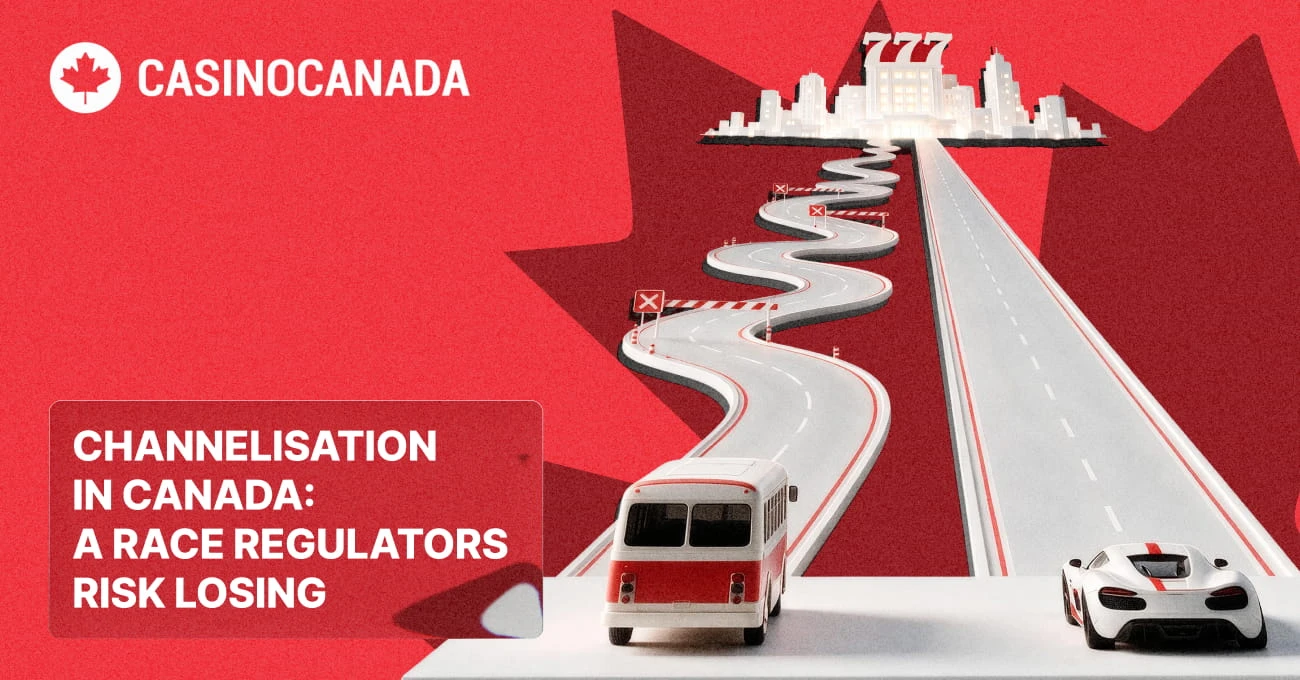
Ontario's impressive 91% channelisation rate is often touted as an example of the success of Canada's iGaming market. However, outside the province, offshore operators continue to dominate among bettors. In this research article, CasinoCanada.com breaks down the alarming numbers surrounding offshore gambling across Canada and attempts to identify who is gambling offshore, why they are doing it, and how Canada can combat it.
Canada likes to champion Ontario's channelisation rates. After four years, an AGCO/iGaming Ontario-commissioned Ipsos survey put the figure at 91% in May 2026 – a headline-grabbing figure that regulators across North America now point to as proof the model works.
However, if you step back from Ontario, the story changes. Most of Canada isn't looking at a 91.1% success rate; in fact, it's often looking at the opposite. Offshore leakage rates in nearly all provinces outside Ontario sit at or above 80%, with a body of academic research showing offshore play is concentrated disproportionately among higher-risk gamblers.
With new product categories like prediction markets emerging, and continued interest in cryptocurrencies and alternative payment methods, offshore operators are growing faster than the regulated market in several of the areas that matter most.
Ontario paints a promising picture for the future of Canadian gambling, but mirroring this nationally is a difficult task. If Canada is going to replicate this success in other provinces, it needs to first identify exactly what is driving customers to offshore betting, and what licensed operators can do to combat this.
Research highlights
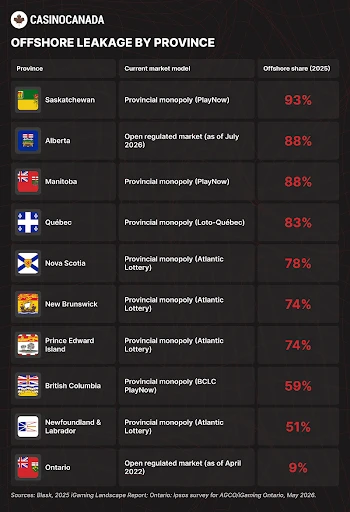
Offshore leakage outside Ontario: 49% in BC, up to 93% in Saskatchewan, 88% in Alberta and Manitoba, 83% in Quebec (Blask, 2025).
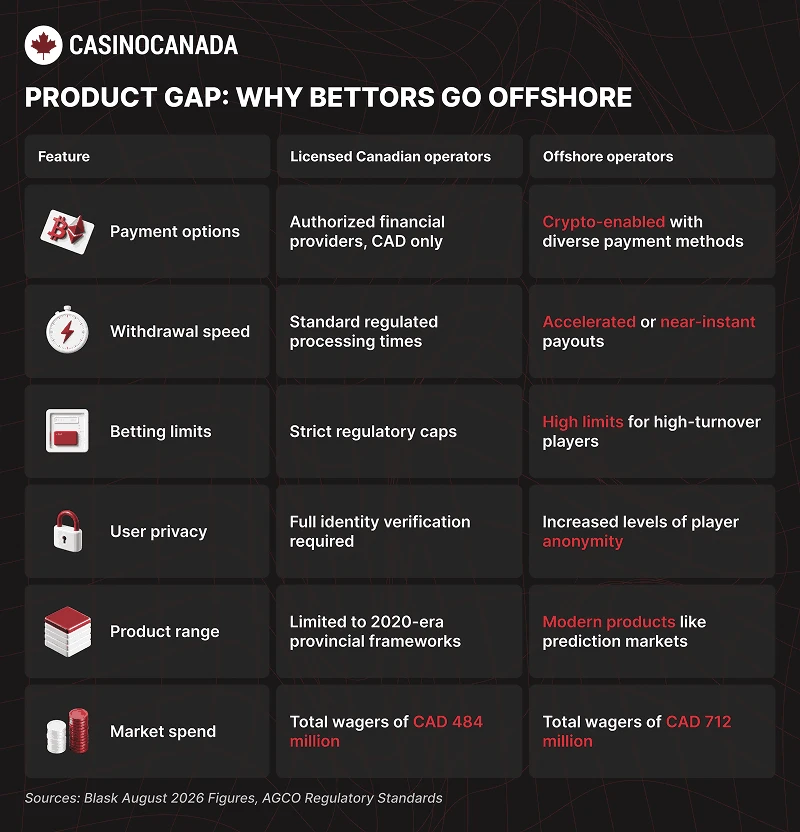
Nationally, 66.47% of gamblers use licensed sites vs 33.53% offshore – but offshore wins on spend: CAD 712 million ($512m) wagered offshore vs CAD 484 million ($348m) licensed (Blask, July 2026).
4 of Canada's top 10 most popular gambling brands are offshore operators (Blask, 301-brand ranking).
Stake: highest-valued brand in the Canadian market at CAD 2.50 billion, offshore and crypto-enabled.
Rainbet: 621% YoY growth in Canada; offshore prediction market activity up 161% YoY
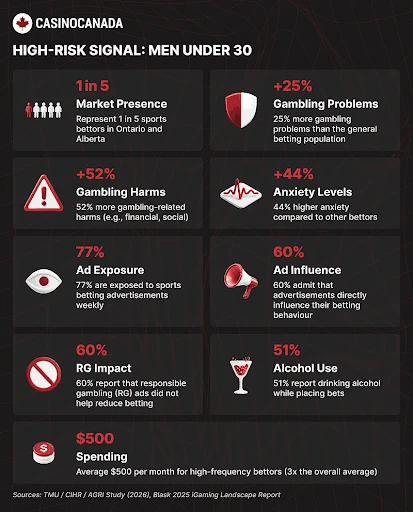
Men under 30 report 50% greater gambling harm, 44% higher anxiety than the wider betting population.
77% of Canadian male bettors under 30 see betting ads weekly.
60% of Canadian general say responsible gambling messaging does not connect.
7 in 10 Canadians say they're concerned about problem gambling rising alongside online sports betting.
Ontario as an outlier
Ontario's regulated market has been a huge success. As we reported in a recent CasinoCanada article, the province generated CAD 82.7 billion in wagers and roughly CAD 2.9 to 3.2 billion in gaming revenue in FY2024-25, and its 91% self-reported channelisation rate is genuinely one of the strongest in the world for a market this young.
But treating that as Canada's national performance hides what's happening everywhere else.
Blask's 2025 iGaming Landscape Report puts offshore leakage at 93% in Saskatchewan, 88% in both Alberta and Manitoba, and an estimated 83% in Quebec, where Loto-Québec has operated since 2010 without meaningfully dislodging offshore competition. Even British Columbia, despite years of BCLC's PlayNow platform being live, sits at roughly 49 to 51%.
More importantly, the national picture Blask's more recent figures show isn't standing still. According to Blask's figures on Canadian betting brands (subscription required) in August 2026, 66.47% of Canadian gamblers now use licensed sites against 33.53% offshore – a licensed-side majority that is slightly skewed by Ontario's success.
A country where two-thirds of bettors are using licensed sites might not appear too alarming, but it is when users are compared in terms of spending that the real picture becomes clearer. Blask's figures show that offshore operators took CAD 712 million ($512m) in wagers, compared with CAD 484 million ($348m) on licensed platforms, meaning the smaller offshore-using population is significantly outspending the larger licensed one.
Fewer people may be betting offshore, but the ones who do are betting far more. Of the 301 Canadian gambling brands Blask tracks in Canada, four of the top ten performers are offshore. Stake alone carries an estimated market worth of CAD 2.50 billion ($1.8bn), the highest of any brand in the ranking, regulated or not.
High-risk players offshore
One of the key questions that needs addressing in Canada is who is actually playing offshore, and, unfortunately, Canadian research on these matters remains alarmingly thin.
Other countries and institutes have completed studies into the nature of offshore gambling, and who and why it attracts players, with Norway perhaps offering one of the clearer comparisons.
Like most Canadian provinces, it runs a government gambling monopoly, Norsk Tipping, competing against openly accessible offshore operators, a structure close to what BC, Quebec, and most other provinces use today.
A 2022 study by Norwegian researcher J. H. Kristensen and colleagues at the University of Bergen's gambling research group, using national gambling account records, found that problem gamblers, a clinically defined category, made up just 2.1% of the gambling population studied, but accounted for 46% of turnover at offshore operators, compared with 17% of turnover at licensed operators.
That's a clear asymmetry, and while it's Norwegian data rather than Canadian, the structural parallel – a monopoly domestic market against unrestricted offshore access – makes it a reasonable comparison point for what's likely happening in Canada's own monopoly provinces.
Canadian research
Closer to home, a study led by Toronto Metropolitan University (TMU) in 2026, in partnership with the University of Bristol, Brock University, the University of Calgary, and the University of Massachusetts Amherst, and funded by the Canadian Institutes of Health Research and the Alberta Gambling Research Institute, surveyed more than 1,800 sports bettors across Ontario and Alberta.
The findings are hard to read as anything other than a public health signal. Men under 30 make up roughly one in five sports bettors in the two provinces, and that group reports 50% greater gambling-related harm and 44% higher anxiety than the broader betting population. More than half said they drink alcohol while betting.
The advertising data also raises alarm bells. 77% of young male bettors are exposed to sports betting ads weekly, and 60% say those ads directly influence how they bet. Responsible gambling messaging, the tool regulators lean on hardest to offset that exposure, was rated as having little or no impact by 60% of the same group.
A national Angus Reid Institute poll in 2026 found the concern isn't confined to researchers either. Seven in ten Canadians say they're worried about problem gambling rising, and more than a third of men aged 18 to 34 say they're personally worried someone close to them is developing a gambling problem.
None of this data is specific to offshore operators, but it describes the exact population most likely to be drawn there. Young, heavily marketed to, and largely unmoved by the responsible gambling messaging regulated operators are required to display.
Payment options
It is not just marketing that makes offshore gambling attractive. AGCO standards require Ontario deposits to run through an authorised financial services provider, with balances denominated in Canadian dollars, a rule that excludes cryptocurrency from the regulated market by design.
The results are already visible in the rankings. As we have already seen, crypto-operators like Stake and Rainbet aren't niche players with small market numbers; they are dominating large parts of the market.
There are plenty of reasons for this. Crypto sites typically offer faster withdrawals, higher limits, and a degree of anonymity no regulated Canadian operator is permitted to match, and for a certain type of bettor, those three things matter more than any brand or bonus.
Crucially, a study from the United Kingdom Gambling Commission in 2023 highlighted the link between cryptocurrencies and gambling addiction, suggesting that those using these sites are at a higher risk.
Licensed operators struggle to match these services and, due to the complex nature of regulation, often struggle to keep up with shifting player preferences. It might provide a robust regulatory system in one respect, but it also leaves huge gaps for offshore operators.
The rise of prediction markets
If crypto exclusion were the only product gap, it might be manageable. But Blask's most recent figures suggest offshore operators are pulling ahead on more than one front. Rainbet, for example, has grown its Canadian business by 621% year-on-year from 2025 to 2026, ahead of every licensed operator in the country.
Alongside that, prediction markets, a category regulated Canadian operators are largely unable to offer under existing provincial frameworks, have seen offshore activity grow 161% year-on-year from 2025 to 2026. It's a new product line that didn't exist in the same form when most provincial frameworks were designed, and offshore operators have moved into it quickly as regulators discuss how to manage it.
These problems are about emerging product categories the regulated market structurally cannot offer yet, at exactly the moment demand is accelerating.
Change is needed
Ontario proves regulation can work at scale. It doesn't prove Canada's approach to regulation works, because Ontario's success was never designed to be replicable by nine provinces independently rebuilding the same infrastructure with none of it connected.
The research base built around Ontario and Alberta's betting population, the TMU study in particular, suggests the country's offshore problem is concentrated in exactly the demographic least served by province-by-province tools: young, heavily advertised to, and, if the Norwegian pattern holds here, disproportionately represented in the turnover of operators no Canadian regulator can reach.
This should be a signal to operating regimes outside of Ontario that they need to reconsider their responsible gambling messaging and support. With such a high number of bettors unmoved by responsible gambling advertising, the case for stronger messaging and education is clear.
What the Blask figures add to this picture is urgency. Offshore leakage isn't a static baseline regulators can gradually chip away at with better messaging. It is a moving target, and right now it's moving faster than the regulated market in the categories, crypto and prediction markets, that matter most to where bettors are actually going next.
A framework built around a 2020 product set will continue to lose ground to operators building around 2026 products. Regulators who treat channelisation as a finished project, rather than a race against a market that keeps innovating around their rules, risk finding that a major offshore operator is already the market leader before regulation has caught up.