Personalisation Without the Pushiness: Where AI Can Genuinely Help Player Engagement
Operators expect their first measurable return from AI in player engagement and personalisation. The harder question is how much of that personalisation players actually want.
Listen to this article
British female voice
AI & Innovation Hub
Engagement and personalisation is where most iGaming operators say they expect the first measurable return from artificial intelligence. It is also the area where the gap between what a model can do and what a player will tolerate is widest.
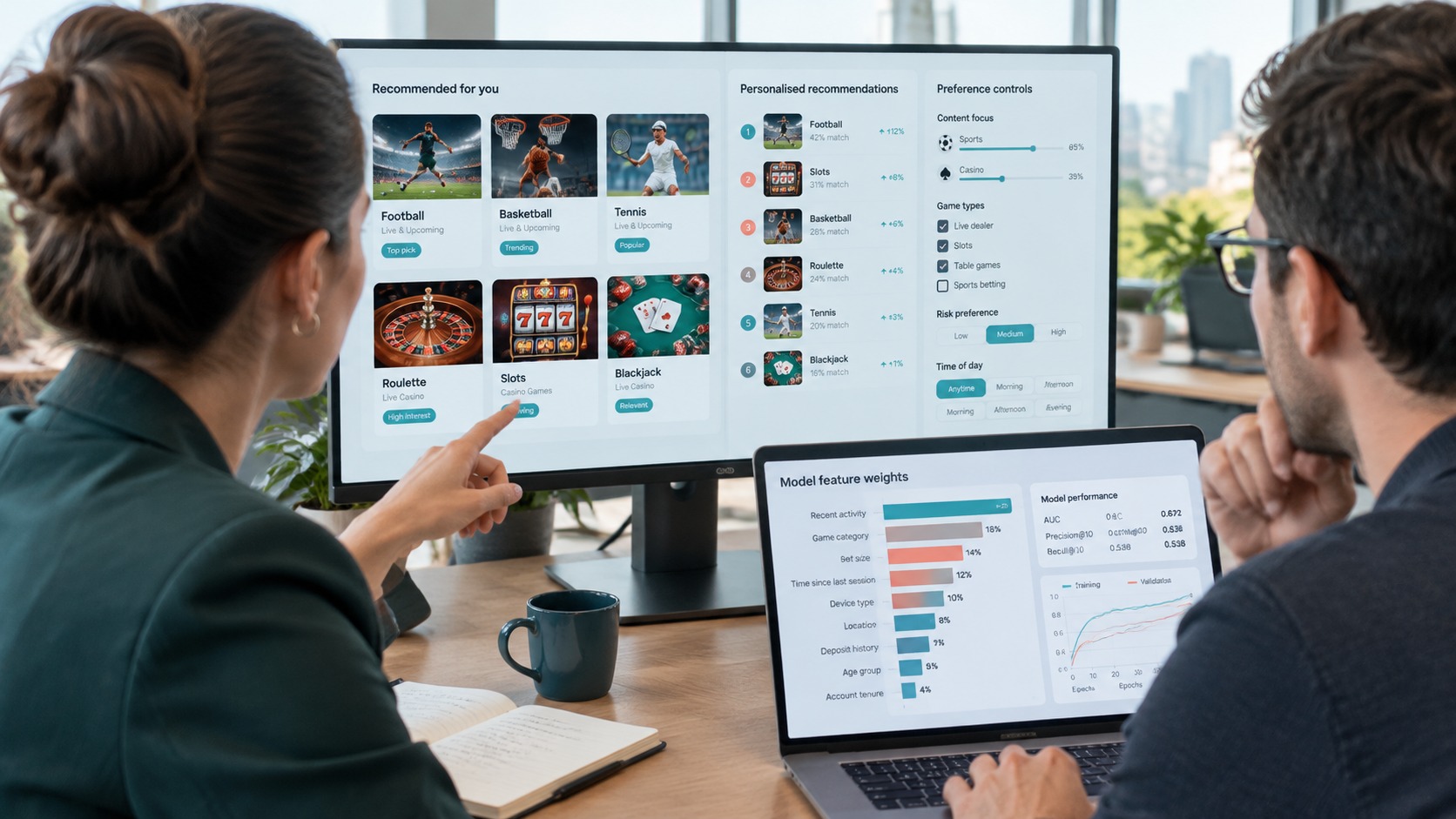
The pitch is straightforward. Operators sit on years of session, deposit, game, offer and support data. Modern models are good at spotting patterns in that data and at generating the content, offers and messages that match it. In principle, that means fewer generic promotions and more relevant experiences.
Relevance is the pitch, intrusiveness is the risk
The difficulty is that relevance and intrusiveness are separated by a thin line. A message that arrives at the right moment reads as attentive; the same message a day later reads as surveillance. Personalisation that reflects a player's stated preferences feels useful. Personalisation that infers things a player never told the operator can feel uncomfortable, even when the inference is accurate.
Teams that approach this seriously tend to treat personalisation as a constraint problem rather than an optimisation problem: what can we do that a player would recognise as helpful if they saw exactly how it worked? That test is a useful filter, because plenty of technically possible campaigns fail it.
The data question comes before the model question
Most personalisation projects stall long before the modelling stage. Customer records are split across brands, platforms and markets; identity resolution is incomplete; consent and preference states are inconsistent; and the events that would show whether something worked were never instrumented. A model trained on fragmented data will produce fragmented results, and it will do so confidently.
Operators that get value first usually spend the earlier months on the unglamorous work: joining up identity, making consent states machine-readable, agreeing what a session or an active customer means across the business, and putting measurement in place before the campaign runs.
Personalisation inside a duty of care
iGaming personalisation is not a pure marketing exercise. Operators carry a regulatory responsibility to customers, and optimising engagement for its own sake can conflict with that responsibility. The most obvious version of the tension: a model that learns which customers are most responsive to prompts is, by definition, good at finding the customers least able to resist them.
That does not make personalisation inappropriate. It means the objective function matters. Teams that handle this well write down what the model is for, what it must never do, and how vulnerable or at-risk segments are treated, before any campaign is approved. Personalisation is then used to improve the experience - clearer game discovery, better support routing, more useful account information - not only to increase spend.
What good looks like in practice
Three things separate the mature implementations from the demos.
The first is transparency. Players can see why they are being shown something, and can turn personalisation off without losing access to the product.
The second is restraint. Frequency caps, quiet hours and channel limits are treated as product requirements rather than afterthoughts.
The third is honest measurement. Teams compare like with like, hold back control groups, and look at what happens over months rather than the weekend after launch.
The measurement problem
Engagement work is easy to claim credit for and hard to prove. A lift in clicks after a personalised campaign says very little about whether the operator created value or simply moved revenue forward in time. Without a control group and a longer window, most personalisation results are unfalsifiable.
That is worth stating plainly, because the industry's AI conversation is often conducted in the language of certainty. Personalisation is one of the most promising applications of AI in iGaming. It is also one where the evidence for success is most often thinner than the presentation suggests.
The operators who benefit will not be the ones with the most sophisticated models. They will be the ones who know which decisions they should not automate.
More from the AI & Innovation Hub: Predictive analytics and the limits of customer intelligence · How the hub came about
CreateFuture is the AI Sector sponsor of iGaming News and its AI & Innovation Hub. iGaming News decides what it publishes; the sponsor does not choose stories or approve copy. More detail is in our Sponsored Content Policy.
Advertisement
Stay ahead of iGaming
Get the week's key stories, industry insight and exclusive interviews in your inbox.
One email a week. Unsubscribe any time. More about our newsletter