FEATURE: Women of iGaming Payments
Through their insights, Viktoriia Degtiarova, Co-founder of Paysecure and Yasmin Nagi, Head of Growth at Yaspa, explore the trends shaping the future of payments, the challenges the industry must overcome and the opportunities available for the next generation of female leaders.
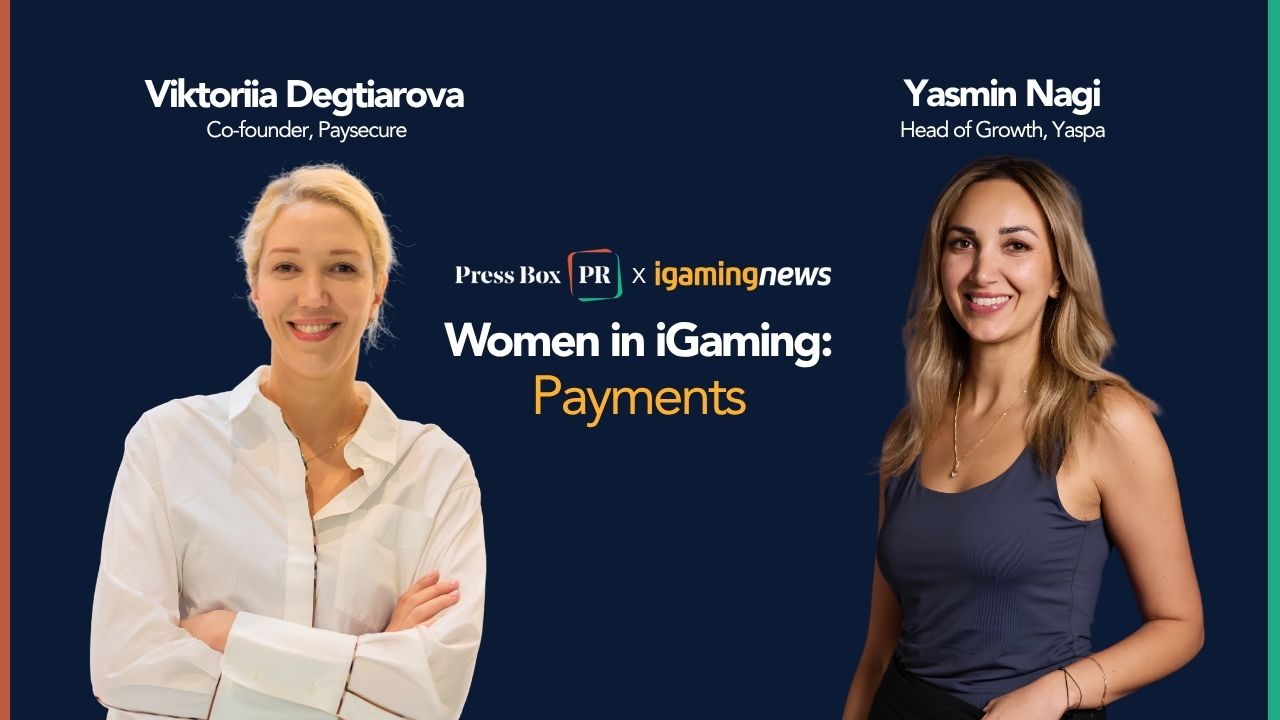
Contributors:
- Viktoriia Degtiarova, co-founder of Paysecure
- Yasmin Nagi, Head of Growth at Yaspa
Payments are the backbone of the global iGaming industry. Every successful operator relies on secure, seamless and compliant payment infrastructure to deliver a frictionless player experience, enter new markets and meet evolving regulatory requirements. From payment processing and open banking to fraud prevention, KYC, compliance and financial technology, the sector continues to evolve at pace.
While innovation in payments is often associated with technology, it is driven by the expertise of the people behind it. This edition of our Women of iGaming series, in association with Press Box PR, shines a spotlight on the women leading innovation, strategy and growth across the payments and banking ecosystem. Through their insights, Viktoriia Degtiarova, co-founder of Paysecure and Yasmin Nagi, Head of Growth at Yaspa, explore the trends shaping the future of payments, the challenges the industry must overcome and the opportunities available for the next generation of female leaders.
1. Payments are at the heart of every successful iGaming operation. What do you believe are the biggest priorities for operators when building a payment strategy in today's market?
Viktoriia Degtiarova: When operators are looking to scale, they hit a crossroads. The payments infrastructure that served them well in one market rarely stretches neatly to the next. New markets bring new regulators, new local payment methods, new currencies and a step change in transaction volume. So the first priority is flexibility. Whatever an operator implements today has to adapt to conditions nobody can fully predict; new PSPs coming to market, evolving regulation, and player preferences. Operators need infrastructure built for agility, interoperability and stability, that is able to keep every option open rather than locking the business into a single provider or a single build.
The second priority is data, because data has become the most valuable asset in payments. Every interaction at the cashier generates valuable insights that go far beyond transaction processing. The operators that can leverage this data for risk management, personalisation, marketing, gamification and commercial decision-making will have a significant competitive advantage.
Thirdly, conversion optimisation has become a continuous strategic priority rather than a one-off project. At enterprise scale, even a 1% improvement in approval rates or a small reduction in payment errors can translate into millions in additional revenue. Technologies such as network tokens, intelligent routing and proactive risk management are becoming essential tools for maximising conversion while maintaining a seamless customer experience.
Payments are no longer just an operational function; they have become a strategic business capability. A strong payment strategy now directly influences revenue growth, profitability, customer experience and a company's ability to scale efficiently across multiple markets.
Yasmin Nagi: Payments are the front door to the player experience, so low friction, trust, and speed on both deposits and withdrawals are non-negotiable starting points. But at Yaspa we’d push operators to think bigger than the transaction itself. The real opportunity is treating payments as a source of insight, not just a mechanism for moving money - done well, that data can be transformational for both players and operators.
2. The payments landscape continues to evolve rapidly through new technologies, regulation and changing player expectations. Which developments do you believe will have the greatest impact on the industry over the next three to five years?
VD: I’m not sure if it’ll take three to five years to realise this, but AI is the new, exciting, disruptive, and potentially challenging technology for the industry. In payments, agentic AI is the next big technology that is proving to be powerful for the igaming industry.
Agentic AI is autonomous software systems that can plan, reason, and independently initiate, execute, and optimise actions without needing a human to approve every step. These systems operate strictly within human-set rules, spending caps, and security limits, and with agentic commerce developments, they can process transactions instantly and continuously (24/7/365) to handle modern digital commerce demands.
For payment orchestration, agentic AI is incredibly powerful when partnered with smart routing engines. This is because the AI can dynamically select the best payment rail, gateway, or currency path to reduce fees and bypass network failures in a fraction of a second. It can also handle treasury and liquidity management functions, monitoring FX rate, balance account, and match invoices.
For the payments industry, agentic AI is the most exciting technology for the last few years. However, agentic payments will take longer to implement to overcome the trust barrier and achieve widespread adoption. In the shorter term, this technology will be more important for operators who can adopt AI and agents within their own operations to power smart routing, fraud detection, spot patterns, and report based on insights and intelligence. Watch this space.
YN: It’d be somewhat disingenuous if I didn’t point to what we're doing at Yaspa with Intelligent Payments - using consented, open banking-powered data to give operators a live view of player affordability and financial health. For operators, that means reduced churn and far more tailored, timely responses to a player's actual financial position, rather than reacting after the fact. For players, it means a more personalised and relevant experience - the right reaction from the operator, at the right moment - and I think we’re only just scraping the surface on the benefits that this blend of payments and insights can provide both operators and players alike.
3. From compliance and fraud prevention to localisation and player experience, payments teams are balancing multiple priorities. What do you see as the biggest challenge facing the sector today, and how can the industry address it?
VD: Compliance, fraud prevention, player experience and payment performance are each in their own right challenges facing the sector, but the biggest across the board is the pace of change happening at once. Regulatory requirements, such as from the Malta Gaming Authority through to local licensing authorities, continue to evolve and become more demanding, and operators must continuously adapt their payment processes to remain compliant whilst avoiding significant financial and reputational risks. Fraud attempts are becoming more sophisticated, and as fraud directly affects approval rates and player experience, payments teams need to work more closely than ever with the broader compliance and risk teams to mitigate these challenges. It is less about one key focus or challenge for operators and more about building a payment infrastructure that can adapt and evolve fast enough to stay competitive within all these moving parts.
The encouraging news is that some of the most significant shifts happening in payments right now are exactly the tools operators need to keep pace. The transition to network tokens is a prime example. It is one of the biggest shifts under way in the industry, and we are only beginning to see how much it will reshape payment infrastructure. Traditionally, PSP tokens tie a player's payment credentials to a single provider, which limits how freely an operator can move. Network tokens remove that dependency entirely, so the same credentials work across multiple providers. The impact we are seeing is substantial for operators; fraud is reduced, credentials stay current reducing churn and approval rates are up to 7% higher. Advancements such as these are a brilliant opportunity for iGaming businesses, because they hand operators far stronger control of their own position in the payment process.
This control and flexibility further opens the door to tools such as payment orchestration. With greater portability of tokens, operators can look to build more resilient, multi-acquirer payment workflows. This enables operators to map payment journeys for specific customer segments, markets, peak trading periods and more. Over the last decade, the payment ecosystem has become increasingly complex and fragmented and large operators often work with multiple PSPS across markets, with different reporting tools and back office systems. This further fragments data and reporting and makes it difficult to optimise approval rates and routing decisions. Orchestration resolves this by providing a single control layer, unified reporting and centralised decision-making, and it is the natural home for the AI-driven capabilities payment teams are now adopting, such as smart routing and automated decisioning.
The pace of change is not slowing down, but the tools available to operators are evolving just as quickly. The operators who embrace advancements like network tokens and orchestration are the ones turning that pace into an advantage.
YN: The area I'm particularly interested in is the potential that financial transaction data has to reveal insights - whether it’s about individual consumer financial health and risk signals, to macro industry indicators (what we term financial spectroscopy) that can allow us to better understand grey market adoption. The challenge is ensuring that consumers feel comfortable sharing their data, and they also benefit from the trust they place in payment providers, whether from personalised experiences or a faster route towards safer play. It’s a super exciting area, and Yaspa is pioneering some really innovative applications.
4. As a woman working within the payments and financial technology sector, what has your career journey been like, and what advice would you offer to other women looking to build a successful career in this part of the iGaming industry?
VD: When co-founding Paysecure, I realised that being a woman in the payments industry, especially within complex sectors and emerging markets, is not just about navigating a male-dominated space. It is about building solutions for clients who have historically been underserved.
Early in my career, the primary challenge was the credibility tax. Despite my technical expertise, I felt I had to work twice as hard to manage perceptions and prove my capabilities when discussing smart routing, cascading logic, or cross-border nuances.
Yet, these challenges sharpen us. At Paysecure, we turned market complexity into our greatest strength, closing the innovation gap between online businesses and emerging markets. While the industry is demanding, the opportunities for women are unprecedented. Complex environments simply require a deeper understanding of market contexts, risk mitigation, and diverse perspectives.
We are also at a crossroads where AI usage is rising while human involvement declines. I believe technology and human insight must work together. At Paysecure, features like our User Trust Score and Dynamic Cashier pair advanced technology with human behavioural analysis to help clients truly understand their users.
This human insight stems directly from our team's diversity. Complex payments thrive in emerging markets, from LATAM to Africa, which require cultural intelligence rather than just tweaked code. Women, who often excel in collaborative networking and holistic problem solving, are uniquely positioned to lead expansion in these regions.
While knowledge should always be the primary currency, mentorship accelerates success. By valuing people over protocols, Paysecure’s team has grown 131% over the past year, with women leading key departments from Marketing to Account Management.
To women eyeing the payments sector: do not be intimidated by complexity. Complex infrastructure is where the most significant innovation happens, enabling solutions that connect underbanked regions to the global economy. My journey has taught me that persistence is the ultimate equaliser. Do not wait for the industry to change; build the technology that makes the old industry obsolete, cultivate your network, and empower the next generation. The future of payments is not just secure and intelligent, it is diverse.
YN: I've spent around a decade in payments, starting in sales at Paymentsense, then moving into account management at Dojo, before joining Yaspa to lead growth. What's kept me in this space is how genuinely innovative payments has become, and how much value it can unlock for an industry like iGaming when you get it right. My advice to other women coming into this part of the industry is to leverage connections and allies, continue to give back where you can (for example through women in iGaming networks), building relationships as deliberately as you build technical knowledge.
5. Looking ahead, what excites you most about the future of payments in iGaming, and what role do you hope women will continue to play in driving innovation and shaping the industry's next chapter?
VD: What excites me most is how much further the industry can take its data. We are only scratching the surface of what payment intelligence can do. Over the next few years it will increasingly drive commercial decision-making, marketing, personalisation, gamification, cashier optimisation and conversion improvement, and the companies that succeed will be the ones that transform that data into real-time business intelligence.
That shift is why I believe payment orchestration will become the industry standard rather than a competitive advantage. It will evolve into a central platform for managing PSPs, FX, currencies, routing, approval rates, cost optimisation, reporting and financial visibility. As payment ecosystems become more complex, operators need a single source of truth and one control layer across their entire payment infrastructure, and orchestration is where that lives.
The market itself will keep evolving too. Regulation is becoming more demanding, marketing investment requirements are significant, and operating globally is increasingly complex, so I expect the industry to continue consolidating, with businesses relying on sophisticated payment infrastructure to scale efficiently. At the same time, payment strategies will become more localised. In many markets, local payment methods will overtake international card schemes as the primary driver of conversion and customer experience.
In order to scale effectively in iGaming in 2026 and beyond, it is not just about competing, but building flexible and interoperable infrastructure that enables you to remain agile for the constant stream of change impacting the business. At Paysecure, we are excited to be at centre of this evolution, providing the agility operators need to futureproof their business growth.
On the role of women, I hope we will continue to see more women in CEO, founder, commercial and product leadership roles. Business is ultimately about people, and understanding customers, partners and employees is just as important as understanding technology. In my experience, women at senior and C-level positions bring outstanding expertise, strategic thinking and strong intuition to decision-making, alongside qualities like emotional intelligence, resilience and the ability to build strong teams. If there is one thing that holds women back, it is more often confidence than capability. So my hope for the next chapter is that the coming generation of women step into leadership positions not because the industry needs more diversity, but because they are simply the best people for the job.
YN: What excites me most is how fast this sector moves — payments in iGaming is never static, and there's always a new problem worth solving. I also love how relationship-driven this industry still is, even as the technology gets smarter; the best partnerships come from real trust between people, not just good tech. I'd love to see more women coming through and shaping that next chapter, because diversity of thought is exactly what pushes an industry like this forward.
For more female leadership and iGaming content, head over to our dedicated Women in iGaming section, sponsored by Press Box PR.