Beyond the Pitch: How Betby is Using Prediction Markets to Rewrite the Sportsbook Calendar
Unlike traditional exchange-based models that rely heavily on liquidity and demanding user interfaces, Betby’s new product offers a fully managed, fixed-odds experience tailored for sportsbook operators.
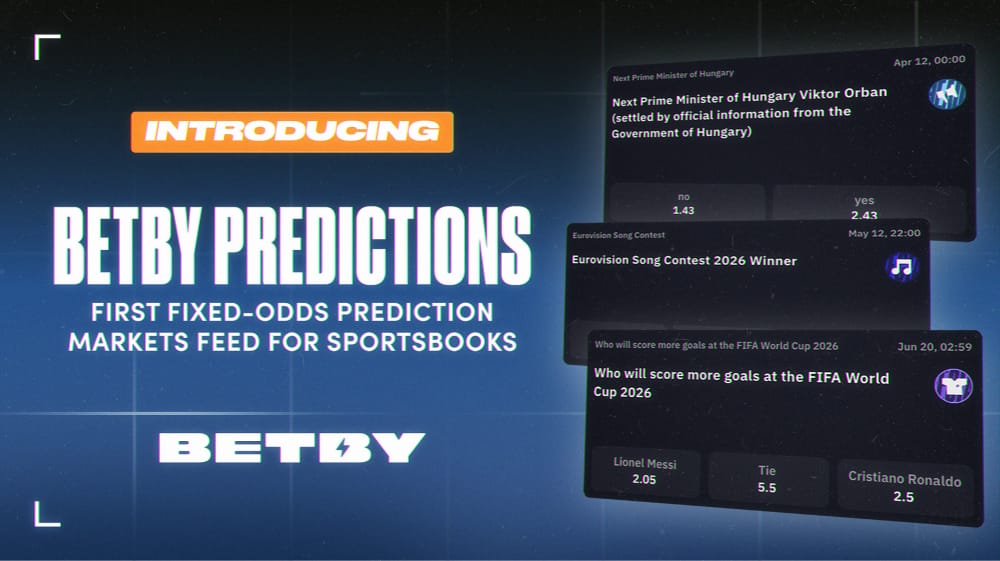
The rapid ascent of prediction markets has taken the betting industry by storm. While regulatory battles continue to make headlines across the Atlantic, forward-thinking suppliers are quietly seizing the momentum. Leading the charge is Betby, which has unveiled its own tailored take on the trend: Betby Predictions.
Unlike traditional exchange-based models that rely heavily on liquidity and demanding user interfaces, Betby’s new product offers a fully managed, fixed-odds experience tailored for sportsbook operators. Crucially, the supplier has drawn a firm ethical line: markets tied to geopolitics, warfare, or human suffering are strictly off the table. Instead, the focus is on curated, human-vetted markets spanning cryptocurrency, finance, technology, and entertainment—all seamlessly integrated into Betby’s core sportsbook infrastructure.According to Kirill Nekrasov, Betby’s Head of Innovation and R&D,
The solution turns “global moments into interactive opportunities for players.”
Tapping into New Demographics
For sportsbooks, the dependency on live fixtures has always been an operational hurdle. Prediction markets offer a way to smooth out those natural peaks and troughs.
“Sportsbooks are, by definition, dependent on the sports calendar,” explains Nekrasov.
“Even with a strong in-play offering and alternative verticals, there are always moments where activity drops. Prediction markets allow operators to reduce the ups and downs, but more importantly, they open the door to something much broader.”
Nekrasov points out that mainstream cultural sectors like tech and entertainment have historically had “little presence” within traditional sportsbooks, “despite already generating significant engagement on platforms like Kalshi or Polymarket.”
By launching a standalone vertical, Betby aims to capture this pre-existing audience.
“These users already have clear opinions. Prediction markets simply give them a way to act on those opinions within a structured environment. This is a space built around your interests, where you can find what you care about without having to search for it.
“You’re effectively creating a new entry point into your platform... One that exists as its own vertical and attracts users who may never have engaged with a sportsbook otherwise.”
The Power of Local Exclusivity
In a crowded market, content differentiation is vital. Nekrasov believes the most successful markets are those that feel intensely relevant to the local punter, such as a Chilean operator offering odds on domestic reality television.
“These are the kinds of markets that players don’t expect to find but immediately connect with,” says Nekrasov. “They resonate strongly with the local audience and, at the same time, they’re not available elsewhere, which makes them feel exclusive.
“This exclusivity creates a clear competitive advantage. If users know they can only find certain markets on one platform, that platform becomes the go-to place for them.”
To achieve this, agility is key. Backed by an AI-driven system and a dedicated trading team, Betby allows operators to request and deploy bespoke markets rapidly rather than relying on a rigid, one-size-fits-all catalogue.
“The result is a stronger connection with users, both in terms of retention and acquisition,” Nekrasov adds.
Bridging the Halftime Gap
Even during massive sporting events like the World Cup, player engagement can be fleeting. Traffic spikes dramatically around the 90 minutes of play, only to plummet as soon as the final whistle blows. Prediction markets offer a natural bridge for those quiet intervals.
“Take a typical scenario: a player logs in to place a bet on a World Cup match, but once the bet is placed there is often little else to engage with, which shortens the session,” Nekrasov notes. “By introducing alternative markets such as ‘Who will be Manchester United’s next coach?’ or ‘Will Bernardo Silva join Benfica this summer?’ operators create a reason for that user to stay.
“By keeping users engaged during off-peak hours, operators not only retain their audience but also drive additional revenue, creating a more consistent flow of income per user.”
Ultimately, this strategy shifts the user experience from a series of disconnected wagers into something much more cohesive.
“What this creates is continuity,” Nekrasov concludes. “Instead of isolated betting moments, you have a more fluid experience where users move between different types of content.
“Because they are tied to real-world events — from politics to technology and entertainment — they provide a constant stream of betting opportunities. You’re giving players something to follow continuously. That naturally leads to longer sessions, more frequent interactions and an increase in ARPU [average revenue per user].
“What makes prediction markets so interesting is not just the volume they can generate. It’s the fact that they allow operators to rethink how they structure content, who they attract and how they keep users engaged over time.”
Related News:
BC.GAME Brings BETBY into BC Engine as Staker Rewards Surpass $2.5 Million
Betby Launches Predictions Vertical to Bring Fixed-odds Markets to Global Events