Betting Without the Book: The Case for P2P Prediction Markets
An Op/Ed by Maksym Shtun

For decades, online betting has run on one formula: the operator sets the odds, takes the bets, manages exposure, and pays the winners. It works, but it ties revenue to risk. P2P prediction markets offer a different arrangement, in which players trade against each other and the operator earns from volume rather than from the result of an event.
How P2P works
In a P2P model, the platform acts as a neutral intermediary. It connects participants, enables transactions, clears markets and ensures fair settlement. The result of a wager is decided between users, not between a player and the operator.
Prices are not issued by an in-house trading team; they emerge from supply and demand, so users can take a position, challenge another participant, or adjust their exposure as an event develops.
For operators, the difference is structural. There is no trading exposure to hedge, no liability to balance across outcomes, and no direct financial opposition to winning customers. Revenue comes from transaction volume through commissions, spreads, or fees, so income does not hinge on whether the favourite wins, the underdog surprises, or a high-value customer finds an edge.
The idea is not new: poker, betting exchanges, fantasy sports and parimutuel pools have used P2P mechanics for years.
Why prediction markets matter
Prediction markets are the most commercially interesting form of P2P betting for iGaming operators. Instead of placing a fixed bet, participants buy and sell shares in binary or graded outcomes.
Take a market asking, “Will Candidate A win the election?” A YES share might trade at $0.62, reflecting an implied probability of 62%. Someone who thinks the real figure is higher can buy; someone who thinks it is lower can sell. When the event resolves, shares in the correct outcome pay $1.00, and the rest expire at zero.
Crucially, positions can be traded before the event ends. A player can exit early, lock in profit or reduce risk as new information arrives, which makes the experience closer to trading than to a fixed-odds bet.
Automated market makers (AMMs) remove one of P2P’s historical barriers: the need for a matched counterparty. The algorithm prices outcome shares continuously based on the distribution of positions in the pool, absorbs trades, and adjusts prices accordingly, helping sustain liquidity in early-stage or specialised markets.
P2P versus the sportsbook
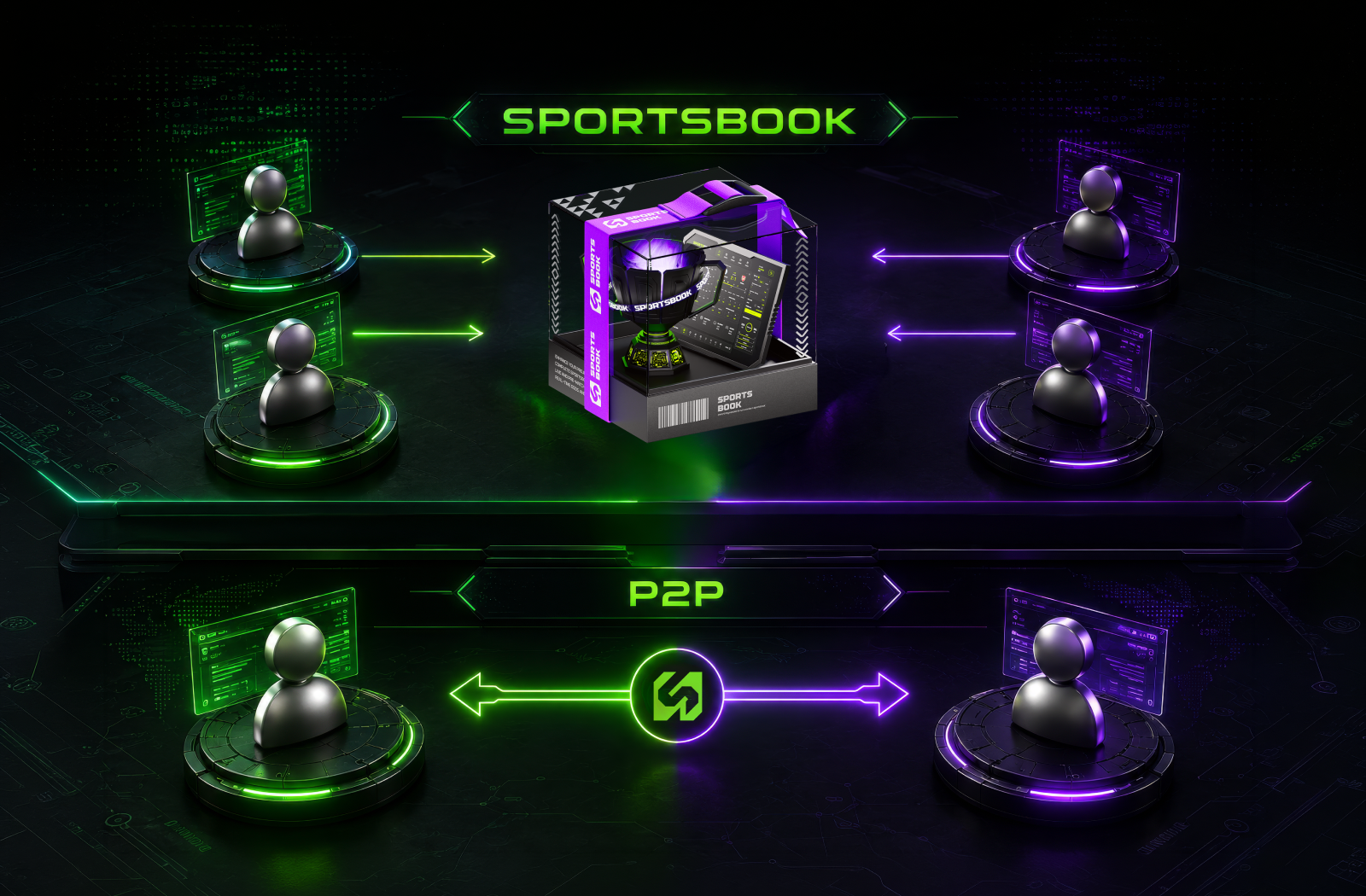
Traditional sportsbook | P2P / prediction market | |
|---|---|---|
Opposing side | The operator | Another player |
Odds formation | In-house trading team | Market consensus |
Revenue source | Margin built into odds | Commission, spread or fee |
Operator risk | High exposure to outcomes | Minimal; revenue tied to volume |
Winning players | Often limited or banned | Can improve liquidity |
Neither model is inherently superior: fixed-odds betting remains essential for many audiences. P2P offers a different framework, one where operator revenue is decoupled from event outcomes.
The operator case
Lower trading risk. There is no book to balance and no skewed market to hedge, and revenue tied to turnover is easier to forecast.
Better use of high-value players. Knowledgeable participants stop being a cost centre: they add liquidity, improve price discovery, and make markets more attractive to others.
New verticals beyond sport. Elections, macro events, crypto, entertainment, and more widen the catalogue without a new sportsbook operation.
Engagement. Rankings, tournaments and social features make betting feel like joining a live community.
Common objections
“Licensing is too complicated.” Rules are still developing but becoming clearer. Jurisdictions treat prediction markets differently, so operators need local advice and a provider that supports a market-by-market approach.
“There won’t be enough liquidity.” Early success does not require covering every global event. Start with markets that spark genuine interest and disagreement in the existing audience: depth beats breadth.
“Launching P2P is harder than a sportsbook.” That was true when it required custom matching engines and complex order books. Modular engines with configurable commissions, APIs and ready-made infrastructure make it comparable to adding another content vertical.
Where Predictor by Slotegrator fits

This is the space Predictor by Slotegrator is designed to fill. It is a prediction market engine that lets operators add peer-to-peer, event-based products to an existing platform without becoming the house. According to Slotegrator, the module carries zero P&L risk for the operator, which earns from commissions it configures on every transaction.
Players trade binary “yes” or “no” contracts on real-world outcomes against one another, not against a bookmaker. Prices are automated and self-adjusting: as activity around an outcome grows, its implied probability and value change in real time, so the operator needs no trading desk or risk book.
Launch follows three steps:
Integrate. The module is added through a single iFrame, and connection to an existing wallet system takes up to a day.
Create an event. Any event with a binary outcome, such as a sports result, election, crypto price move or entertainment award, can be set up in 30 seconds.
Set commission. The operator defines its fee on each transaction and earns from activity rather than from players’ losses.
Predictor works for casino operators, sportsbook operators or as standalone prediction software, and events can span politics, sport, entertainment, climate, lifestyle and other categories. For operators, the pitch is a new engagement and monetisation layer on top of existing infrastructure, with no platform rebuild.
Outlook
P2P is not a replacement for the sportsbook but an additional product layer with its own risk profile and unit economics. If AMMs keep improving liquidity and regulation clarifies, prediction markets may move from experiment to core category.