Part 1: Moving Beyond AI Pilots – Building the AI-Native iGaming Operator
An Interview with Hassan Peymani, CreateFuture
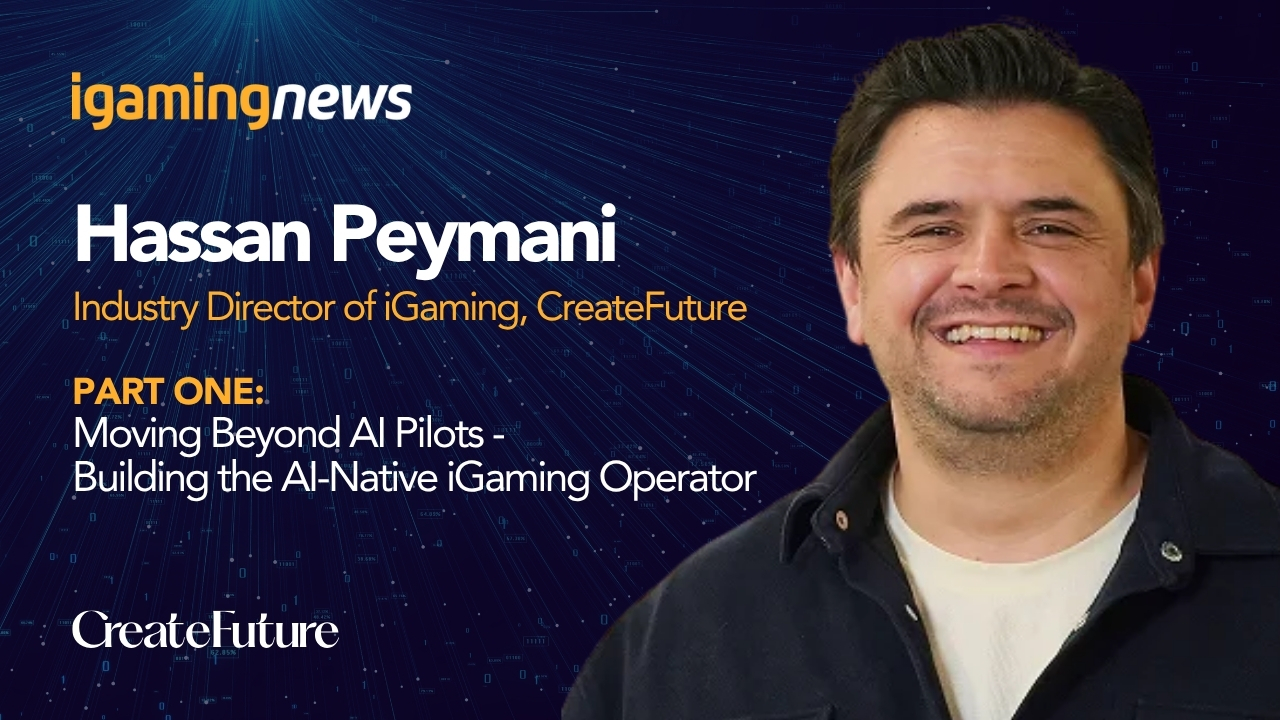
Artificial intelligence has moved from an emerging technology to a boardroom priority for the iGaming industry. Operators have spent the past two years experimenting with generative AI, automation and increasingly sophisticated models, but the next challenge is proving that these technologies can deliver meaningful, measurable value in the complexity of a live, highly regulated gaming environment.
For Hassan Peymani, Industry Director of iGaming at CreateFuture, the answer lies in moving beyond simply adding AI to existing operations. The industry needs to rethink how its people, processes, platforms and products work together if it is to unlock the full potential of the technology.
That shift is what Peymani describes as “AI-native enablement”, an approach that moves away from isolated pilots and towards a fundamental redesign of how an operator operates. From trading and player operations to compliance, engineering and product development, the opportunity is not simply to make existing tasks faster, but to rethink where work should be automated, augmented, orchestrated or remain firmly in human hands.
The emergence of agentic AI could accelerate that transformation further, giving AI systems the ability to move beyond generating answers and instead retrieve information, reason across systems and take action. Yet in an industry handling real money, sensitive player data and significant regulatory responsibilities, the difference between an impressive demonstration and a production-ready solution is substantial.
In the first part of this two-part interview, Peymani explores why so many AI initiatives struggle to make the transition from pilot to production, what an AI-native operator could look like, where agentic AI can create genuine operational impact and why accountability, governance and measurable commercial outcomes will ultimately matter more than the technology itself.
Peymani also discusses how operators can begin their AI journey pragmatically, focusing on individual workflows, measurable P&L outcomes and 90-day value cycles rather than attempting to transform the entire organisation overnight.
You use the phrase “AI-native enablement”. What does that actually mean for an iGaming operator, and how is it different from simply adopting AI tools?
Adopting AI tools is the easy part. You buy a licence and tokens, switch it on, and a few teams get faster at what they already do. AI-native enablement is a different order of change. It means redesigning how the operator works before you decide which tool to use, and judging success by business outcomes rather than activity.
No operator changes all at once. The ecosystem is too big for that. So you work function by function: how trading prices a market, how player operations handles a query, how compliance watches risk, how engineering ships. You redesign each deliberately, deciding what to automate, augment, orchestrate or keep human, prove it there, then connect them so they reinforce one another. Do that across enough of the business and the whole operator shifts, steadily rather than in one leap. Adoption bolts AI onto yesterday's operating model and hopes for a lift. Native rewires the model, so value compounds rather than leaking away in isolated pilots.
iGaming has spent the last two years experimenting with AI. Why do you think so many initiatives have struggled to move from pilots into production?
Because a pilot and a production system are different propositions, and the industry underestimated the gap. A pilot lives in a controlled setting, with clean data and a forgiving audience.
Production means live players, real money, regulatory exposure and a cost attached to every transaction. The research is sobering: BCG puts the share of companies across all industries creating value from AI at scale at around five per cent, and McKinsey finds most report no meaningful impact on earnings. iGaming is no exception.
What stops the jump is rarely the model. It is everything around it, across all four Ps: people whose roles never changed, processes still built for humans, platforms and data never readied for AI, and products left as they were, with governance bolted on at the end. Too many operators answered a stalled pilot by launching another one, when the real work was rewiring all four together to let a single pilot run for real.
You talk about AI-native transformation requiring a redesign of people, processes, platforms and products. Why is this different from the approach many operators have taken so far?
Most operators treated AI as a technology decision. They bought a platform, dropped it into the business, and left everything else largely as it was. At best, that gets you a faster version of the old operation. At worst, you automate its flaws, so the same broken processes now run faster, cost more to feed in tokens and compute, and fail in ways that are harder to explain to a regulator.
AI-native means redesigning all four Ps together: people, process, platform and product. People, because roles change once work is automated or augmented. Process, because a workflow built for humans wastes a capable model. Platform, because agents and models are only as good as the data and controls beneath them. Product, because the real prize is rethinking what you offer players, not simply running the back office faster. Value leaks at the joins. Redesign one and ignore the other three, and the gains stall. Change all four deliberately, so they reinforce each other, and the numbers follow.
Agentic AI is now one of the biggest industry buzzwords. Where do you believe it can genuinely transform an iGaming operation, and where is the hype exceeding reality?
Genuinely, wherever work moves across systems and currently waits on a person, a human being, to move it along. Trading and pricing, large parts of player operations, compliance monitoring that never sleeps, and the software lifecycle itself. An agent that can retrieve, reason and act across those systems takes out real cost and latency. That is not hype.
Where the hype runs ahead is the leap from a slick demo to something you can trust on a live platform. In a regulated multi-jurisdictional jurisdiction. A demo answers a question. A production agent takes an action that touches a player, a payment or a regulator, and it needs permissions, memory, evaluation, audit and hard limits around it. Without that harness, agents stay as party tricks. My honest view: the destination is real, and closer than the sceptics think. The distance you have to cover safely is longer than the buzzwords suggest.
What is the biggest difference between an impressive AI demo and an AI solution that can safely operate within a live regulated environment?
Great question. It has to be Accountability. A demo only has to be convincing. A live solution in a regulated market has to be answerable, and that is the whole difference.
A demo produces an impressive output once, on data you chose, with nobody downstream. A production system takes an action, repeatedly, on real players and real money, and someone has to stand behind every one of those actions to a regulator.
The demo is perhaps ten per cent of the work. The rest is the unglamorous part. The significant data work to get information trusted, permissioned and fit to use. The foundational infrastructure the whole thing stands on. Permissions that limit what the agent can touch, evaluation that catches when it drifts, an audit trail that shows exactly why it did what it did, and a human in the loop where the stakes demand one. If you cannot explain a decision after the fact, you cannot run it in this industry.
CreateFuture has recently strengthened its relationships with both OpenAI and Anthropic. Why should operators focus on capability and outcomes rather than simply the technology partnerships behind them?
Because a logo on a slide has never improved a single operator's margin. The partnerships matter to us for one practical reason. They give us deep, early access to the best models from more than one frontier lab, and the certified people to use them well. But an operator should judge us, and anyone else, on what that access produces.
Our relationships with OpenAI and Anthropic run deep, and we value both. Between them we have access to the best of two frontier labs, and the certified people to apply it well. For a client, that turns into the thing that matters most: choice. We can advise on which model fits which job, combine their strengths, and manage the cost behind each decision, rather than defaulting to one answer for every problem. It is an advisory relationship, not a reseller one. The partnerships open the door; the outcome we then deliver, on what timeline and at what cost to serve, is what earns a client's trust. We are proud of both recognitions, and just as clear that they are the start of the value, not the whole of it.
When operators are looking to start or accelerate their AI journey, what is the first practical step they should take to create measurable value?
You should pick one workflow that genuinely matters to the P&L, and define the number you expect to move before you build anything. Then work in what we call 90-day value slices. Rather than commit to an eighteen-month programme and hope, you align on the target in days, define the approach in weeks, and deliver a measurable business outcome within a quarter. No two-year black boxes.
Each slice has the ROI built in from the start, so the board sees a real number every ninety days, not another status update. You redesign that first workflow deliberately, deciding what to automate, augment, orchestrate or keep human, prove the value, then scale what works and start the next slice. It keeps the risk small and the learning fast. Start narrow, measure honestly, and let the wins compound quarter by quarter.
Related News:
- Live from ICE Barcelona: Exclusive Interview with Hassan Peymani of CreateFuture
- iGaming News Podcast: Interview with Luke Campbell, Head of Technology (iGaming), CreateFuture
- FEATURE: AI in iGaming - How iGaming Leaders are ACTUALLY Using AI