Novig And Crypto.com Take Missouri Prediction Markets Dispute To Federal Court
The two prediction market operators are challenging Missouri's attempts to apply state sports betting laws to federally regulated event contracts.
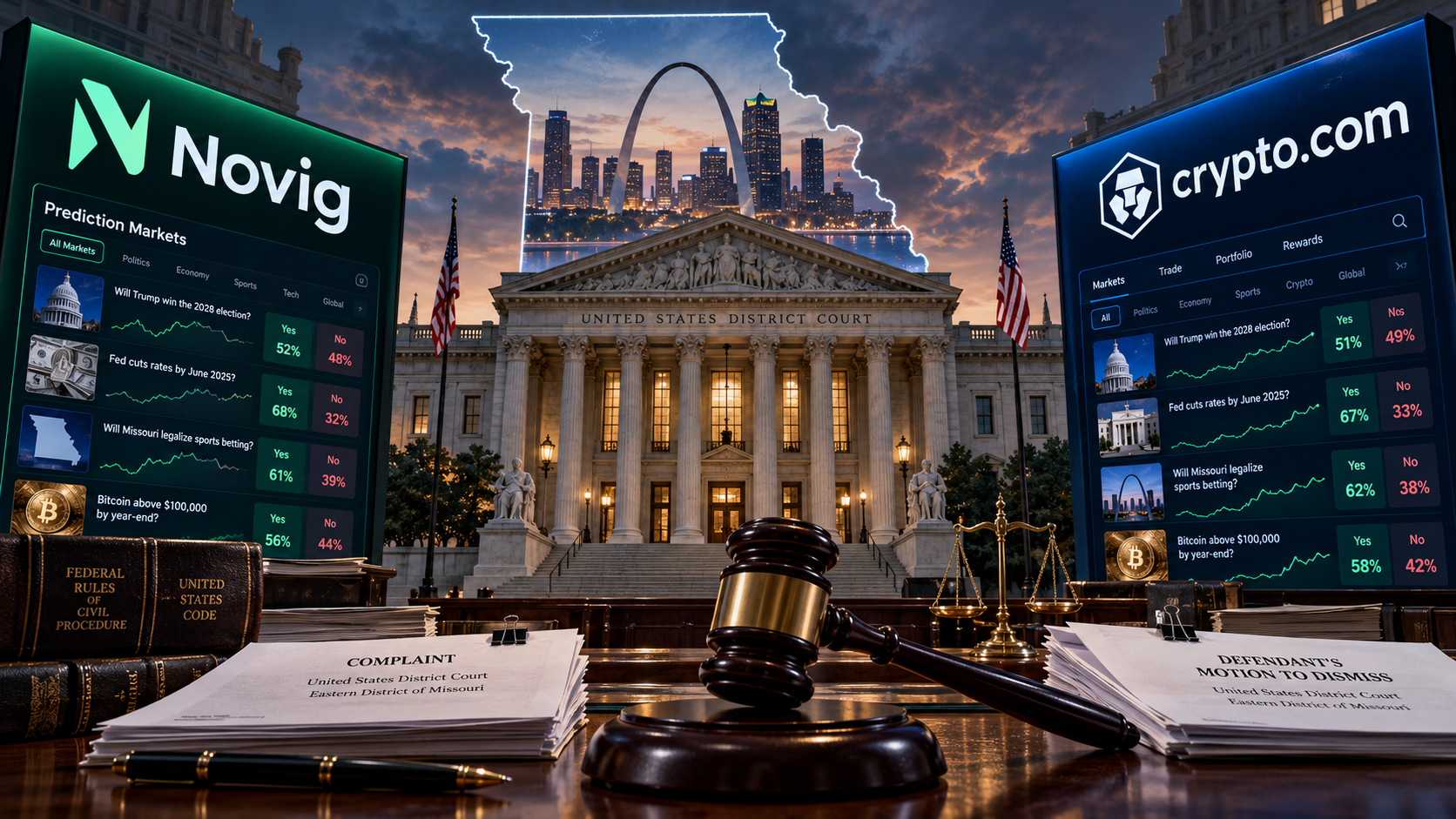
Novig and Crypto.com have launched separate federal lawsuits against Missouri regulators, seeking to prevent the state from enforcing sports betting legislation against their prediction market operations.
The legal challenges follow cease-and-desist letters issued by Missouri Attorney General Catherine Hanaway in September, which accused six prediction market operators of offering unlicensed sports wagering products.
Both companies filed their lawsuits as the 30-day compliance deadline expired, arguing that their event contracts fall under federal derivatives legislation rather than Missouri's gambling laws.
The proceedings add to a growing legal dispute across the United States over whether sports-related prediction markets should be regulated by individual states or the Commodity Futures Trading Commission (CFTC).
Novig Challenges Missouri's Sports Betting Requirements
Novig filed its lawsuit through Ludlow Exchange LLC in the US District Court for the Eastern District of Missouri, naming Hanaway and Missouri Gaming Commission officials Michael Lear and Jan Zimmerman as defendants.
The operator is seeking preliminary and permanent injunctions preventing enforcement action, alongside a declaration that federal law takes precedence over Missouri's gambling legislation when applied to its exchange.
Novig argues that its event contracts qualify as swaps under the Commodity Exchange Act, placing them within the CFTC's jurisdiction. The company also referenced an October 9 proposal from the federal regulator addressing event contracts involving sports, politics, culture and weather.
According to Novig, Missouri's sports betting licensing framework is incompatible with its peer-to-peer exchange model, which matches participants rather than acting as a traditional bookmaker.
“A licensing regime calibrated to the economics of the house does not readily accommodate a market with no house,” the complaint states.
The company also argued that obtaining a Missouri licence would require geographical restrictions and payment of the state's 10% sports wagering tax, potentially disrupting the national liquidity underpinning its exchange.
Crypto.com Argues Missouri Licensing Is Unavailable
Crypto.com's legal challenge was filed by North American Derivatives Exchange in the Western District of Missouri, advancing similar arguments concerning federal regulatory authority.
The company additionally claimed that Missouri's licensing arrangements effectively prevent it from obtaining the authorisation demanded by state officials.
Missouri permits two untethered mobile sports betting licences, both of which have already been allocated. Six additional online licences are available through partnerships involving professional sports teams and casinos.
Crypto.com argues that requiring an exchange to obtain a licence it cannot realistically secure amounts to prohibiting its operations within the state.
The company also disputed the recipient of Missouri's original enforcement notice, claiming it was incorrectly addressed to Foris DAX rather than the exchange responsible for the prediction market contracts.
Other operators targeted by Missouri's cease-and-desist campaign include Kalshi, Polymarket, Robinhood and Underdog. None of those four had filed equivalent Missouri lawsuits at the time of the latest proceedings.
Federal Appeals Could Determine Wider Regulatory Dispute
The Missouri cases arrive as federal appeals courts continue reaching different conclusions over the relationship between state gambling legislation and federally regulated prediction markets.
The Eighth Circuit Court of Appeals, which has jurisdiction over Missouri, is currently considering Kalshi's appeal against a September ruling in Iowa that rejected its request for preliminary protection from state enforcement.
Kalshi's opening appeal brief is due on November 6, with further submissions expected to conclude in December. The eventual ruling could establish an important precedent for federal courts throughout the circuit.
Elsewhere, the Third Circuit has supported Kalshi's position in New Jersey, while rulings involving Nevada, Ohio and Tennessee have favoured state regulatory authority.
The disagreement has also reached the US Supreme Court, with New Jersey requesting intervention to resolve conflicting interpretations of federal and state jurisdiction.
Missouri has joined other states supporting Supreme Court consideration of the issue, alongside wider opposition to federally regulated sports prediction markets from gambling industry organisations and tribal representatives.
For Novig and Crypto.com, the immediate objective remains preventing Missouri from restricting their operations while the broader legal questions are resolved.