Beyond the Demo: How Product Teams Turn Emerging Technology Into Something Players Use
AI has made product demos better without making the distance shorter. A neutral editorial view of how emerging technology becomes something iGaming players actually use.
Listen to this article
British female voice

AI & Innovation Hub
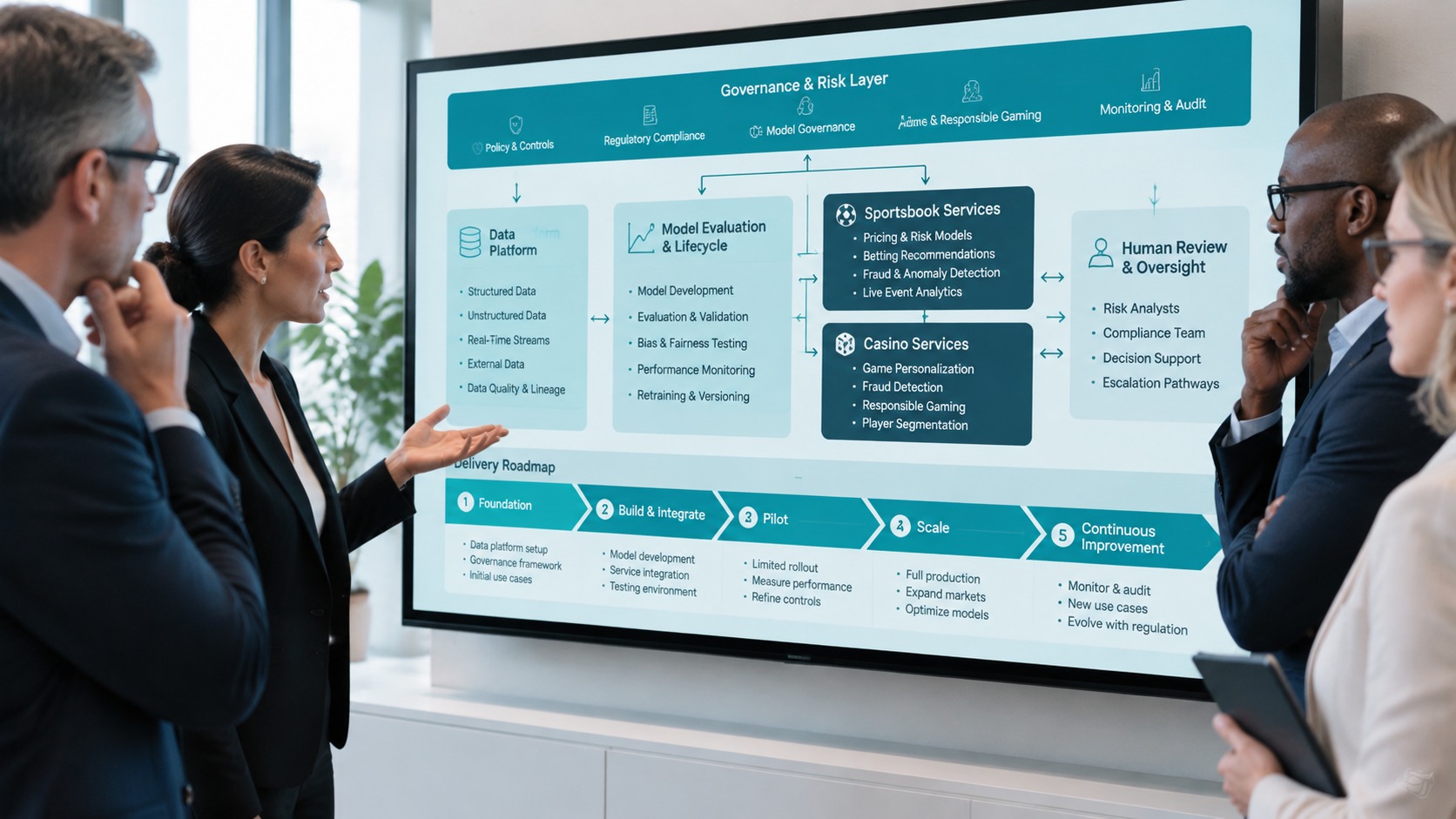
Almost every iGaming product team now has a pile of experiments: a generative feature, a new interaction model, a personalised surface, a prototype that impressed in a review and never shipped. The distance between a convincing demo and a product players actually use is the most reliable filter in this industry, and AI has made the demos better without making the distance shorter.
Why demos are easy and products are hard
A demo is judged on what it could be. A product is judged on what it does at scale, under load, in a regulated market, on a phone with a bad connection, on a Sunday evening. Latency, reliability, accessibility, localisation, responsible-gambling constraints and payment behaviour all have to be solved, and none of them appear in the prototype.
There is also a quieter cost: every experimental surface that ships becomes something the team must maintain, monitor and explain, whether or not anyone uses it.
Novelty is not a value proposition
The most common mistake in emerging-technology product work is assuming that newness is a reason to build something. Players are not generally seeking new technology; they are seeking a fast, familiar, trustworthy experience. A feature that adds a step, however interesting, is usually a feature that gets skipped.
The technologies that stick in iGaming tend to be invisible: faster deposits, better search, fewer dead ends, smoother verification. They are adopted because they remove friction, not because they are novel.
What a disciplined innovation process looks like
Teams that ship successfully run experiments with an agreed question, a defined measure, a control group and a date at which the experiment ends either in a release or in a written decision to stop. The written stop is the important part: without it, prototypes drift into production and stay there.
They also separate the two kinds of risk. Market risk asks whether anyone wants this. Technical and regulatory risk asks whether it can be built and operated lawfully. Running the cheap test first - the one that answers the market question - saves the expensive work of building something nobody needs.
Where AI changes the maths
AI's genuine contribution to product innovation is the falling cost of iteration. Building a first version is quicker and cheaper, so more ideas can be tested. That is a real advantage, but it also creates a new bottleneck: the ability to decide what to kill. Organisations that cannot say no end up with more experiments than they can run.
The honest position
Some of what is being attempted today will not work, and the industry would benefit from saying so. Product innovation in iGaming is constrained by regulation, by legacy platforms and by the fact that the core behaviour - placing a bet or spinning a reel - is already well served. That is not a reason to stop experimenting. It is a reason to be precise about what each experiment is meant to prove.
The teams that get this right are not the ones with the most ideas. They are the ones with the shortest honest path from an idea to a decision.
More from the AI & Innovation Hub: What AI across betting and gaming might look like · Moving beyond AI pilots
CreateFuture is the AI Sector sponsor of iGaming News and its AI & Innovation Hub. iGaming News decides what it publishes; the sponsor does not choose stories or approve copy. More detail is in our Sponsored Content Policy.
Advertisement
Stay ahead of iGaming
Get the week's key stories, industry insight and exclusive interviews in your inbox.
One email a week. Unsubscribe any time. More about our newsletter