Michael Jordan, DraftKings And Sportradar Discuss The Changing Relationship Between Sport, Betting And Fans
Michael Jordan joined DraftKings CEO Jason Robins and Sportradar CEO Carsten Koerl at SBC Summit Lisbon to discuss how betting, data, AI and changing fan behaviour are reshaping the relationship between supporters and live sport.
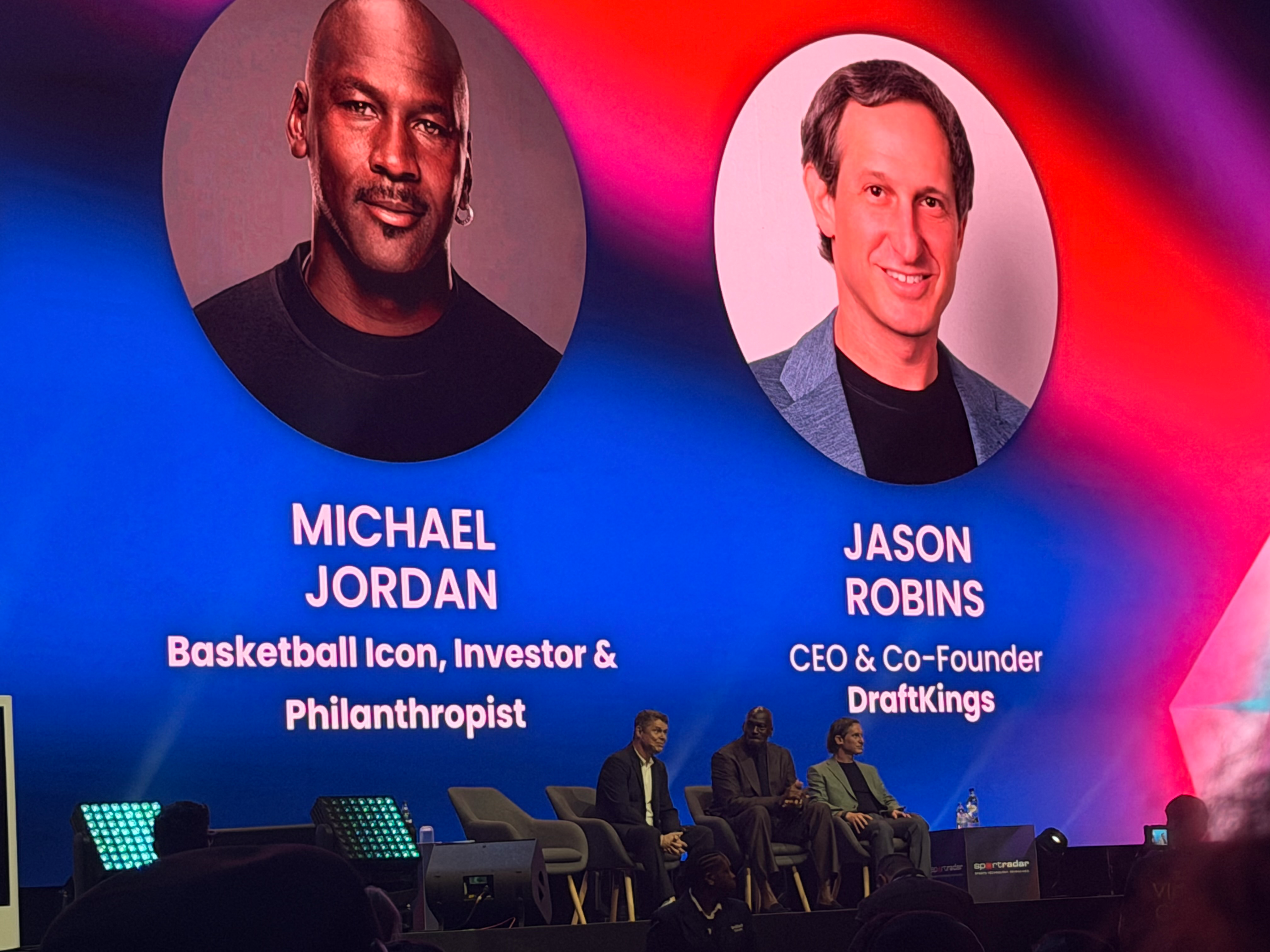
The growth of sports betting has fundamentally changed how fans interact with live sport, with supporters increasingly becoming active participants rather than simply spectators.
That was one of the central themes of a wide-ranging discussion at SBC Summit Lisbon featuring basketball legend Michael Jordan alongside DraftKings CEO and Co-Founder Jason Robins and Sportradar CEO and Founder Carsten Koerl.
Moderated by broadcaster Kirsty Gallacher, the panel covered everything from in-play betting and prediction markets to artificial intelligence, responsible gambling and the future of sports data.
Jordan reflected on how dramatically the sporting environment has changed since his playing career, explaining that his sole focus as an athlete had been winning.
“As a player, I never really focused on what the stats were, what people were betting,” he said.
“The only objective that I ever had was to win the game.”
However, Jordan said his perspective had broadened since becoming involved in the business side of sport. He argued that modern fans now have a much greater interest in outcomes across multiple games, with betting one of the factors driving that change.
Where supporters may once have watched a single football game, he noted that many now follow several simultaneously because they have an interest in what happens elsewhere. That has created a very different relationship between fan and athlete.
Fans have traditionally experienced sport vicariously through the players they support, but betting and other interactive products can take that engagement further by giving supporters a direct stake in what happens during a game.
Sports Betting Moves Towards Real Time
The evolution of sports data has played a central role in making that possible. Koerl recalled an industry that previously relied heavily on people physically collecting information at sporting events. That process has been transformed by technology, with automated systems now capable of capturing huge quantities of player and event data in real time.
He pointed to camera technology capable of tracking players and generating multiple data points every second, creating the infrastructure required for increasingly sophisticated betting and media products.
Koerl said the same shift has helped sports betting move beyond relatively simple pre-match markets into a much more advanced live environment. As betting increasingly takes place during an event, the speed at which information can be collected and distributed has become critical.
“The demand is: give me this data with a 0.2-second delay,” Koerl said, explaining that information must then be processed, validated and delivered quickly enough for models to react while the event is still unfolding.
That trend is also moving towards greater personalisation. Rather than customers having to search manually through large numbers of markets, Koerl suggested future systems could increasingly understand individual preferences and automatically surface relevant information.
AI agents could become an important part of that process, allowing betting and sports platforms to provide content based on what they already know about a user rather than waiting for them to search for it.
Prediction Markets Create New Uncertainty
Prediction markets were another prominent topic. Robins acknowledged that the long-term position of prediction markets in the United States remains uncertain, particularly because of the legal and regulatory questions surrounding the sector.
He compared the situation with previous emerging trends such as NFTs, where DraftKings chose to participate despite uncertainty over whether the market represented a lasting change in consumer behaviour or simply a temporary period of hype.
Robins said the company is taking a similar approach to prediction markets, positioning itself so it can participate if the sector becomes established while remaining prepared for a different legal or regulatory outcome.
“You have to make sure that, rather than optimising for a single outcome, you’re in good shape no matter what the outcome is,” he said.
A key question, Robins added, is whether prediction markets will ultimately be treated as financial instruments or sports betting products. With that answer outside DraftKings’ control, he said the priority is ensuring the business remains well positioned whichever way the market develops.
Robins also suggested that uncertain periods can provide the biggest opportunity for businesses to differentiate themselves, arguing that difficult conditions force companies to think more creatively about how they respond.
Jordan On Playing In The Modern Betting Era
Gallacher also asked Jordan how he would approach playing in the current environment, where fans can track almost every element of an athlete’s performance and bet on increasingly specific player outcomes.
Jordan said he had considered how different the experience would be but ultimately believed his own approach would remain unchanged.
“I can’t worry about what people are betting on, and I can’t worry about what the stats are,” he said. “Ultimately, as an athlete, I can only influence one thing. It’s what I do.”
Jordan said his focus would still be on studying opponents, understanding their strengths and weaknesses and finding ways to win rather than worrying about betting markets surrounding his performance.
However, he acknowledged that modern athletes face a wider range of pressures than those he experienced during his own career. Players are now expected to manage personal brands, commercial opportunities, contracts and constant scrutiny around individual statistics alongside their responsibilities to their team.
Jordan contrasted that with his own time in Chicago, when he said the primary objective was making the Bulls the best team in the NBA and then repeating that success after winning a championship.
He suggested those additional responsibilities can make it more difficult for modern players to maintain the same singular focus on team performance.
AI Could Transform Sports Products
Artificial intelligence was another major theme of the discussion, with Koerl outlining how AI is already being used to analyse large amounts of historical and real-time sports data.
He described systems capable of processing detailed information about players and previous events before predicting what could happen within the next few seconds of a game.
That opens up opportunities beyond betting alone. Koerl suggested that data can increasingly become part of the storytelling around live sport, providing broadcasters and digital platforms with additional information capable of enhancing the viewing experience.
AI is also changing the speed at which new products can be created. Koerl described development environments where several AI agents can work simultaneously, with different systems handling areas including design, mathematical modelling, security and testing.
Products that may previously have required hundreds of development hours could therefore be created much more quickly.
However, Koerl argued that the most significant opportunity lies beyond simply improving efficiency.
“AI, cost saving and efficiency, yes, it’s something which is maybe necessary,” he said. “But this is not the innovation. The innovation happens in the product.”
Responsible Gambling Must Be Embedded In The Business
Robins also addressed the responsibility that comes with deeper betting engagement, arguing that responsible gambling should form part of the culture of a betting business rather than being treated as a standalone process.
He said DraftKings works with sports leagues and teams to monitor behaviour towards athletes and can take action where customers cross the line, while the company also provides tools designed to help users manage their own activity.
Those can include spending limits, time limits and cooling-off periods, while Robins said more serious cases can require operators to restrict or block accounts.
For many customers, however, he argued that responsible gambling is about maintaining control rather than viewing betting as an all-or-nothing activity.
“If you love to bet, that’s a good thing. It’s a fun thing that makes you happy, and you still should set a budget,” Robins said.
He added that sustainable betting businesses depend on customers having positive long-term experiences, rejecting the suggestion that operators benefit when players gamble beyond their means.
Robins said the long-term health of both DraftKings and the wider industry depends on building relationships with customers that remain sustainable rather than prioritising short-term revenue.
Regulated Markets Versus Illegal Gambling
The discussion later moved towards iGaming, where Robins argued that consumer demand does not simply disappear when regulated operators are unable to offer a particular product.
Instead, he said customers may turn to illegal operators that do not provide the same protections around responsible gambling, customer funds and regulatory oversight.
“If the demand is there, it’s going to happen,” Robins said.. "The question is, where is it going to happen?”
For Robins, the preferred outcome is for that demand to be channelled towards regulated markets, where products can be offered with greater consumer protection and oversight.
The wider discussion at SBC Summit Lisbon highlighted just how closely sport, betting, data, media and technology are becoming connected. For Koerl and Robins, that evolution is increasingly being driven by personalisation, real-time data and artificial intelligence.
Jordan, however, repeatedly brought the conversation back to the perspective of the athlete. Whatever technology surrounds the game, whatever markets fans are betting on and however closely individual performance is analysed, the player can still only control what happens when they compete.
For Jordan, that objective remains unchanged: Win the game.