Between Duty of Care and the Algorithm: Where AI Fits in Player Protection
Player protection is the area of iGaming where AI carries the highest stakes and the least tolerance for error. Detection is not the same as protection, and the industry should say so.
Listen to this article
British female voice

AI & Innovation Hub
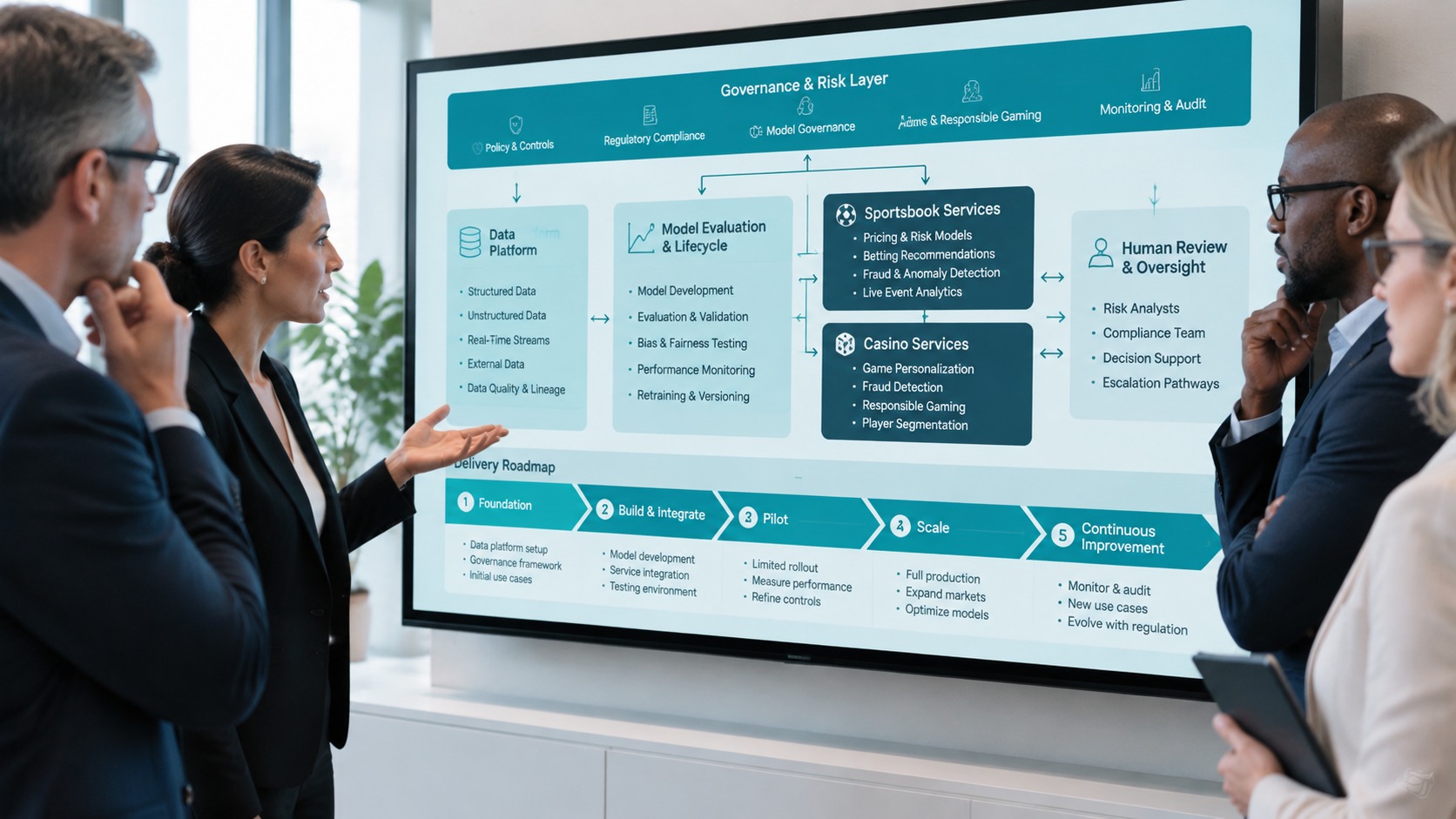
Player protection is the area of iGaming where artificial intelligence carries the highest stakes and the least tolerance for error. A recommendation that misfires costs a click. A protection system that misfires costs a customer their money, or an operator its licence.
Regulators have made expectations explicit: operators are expected to intervene, and to intervene earlier. The industry has responded with increasing investment in machine learning to detect changes in behaviour that might indicate harm. The honest question is not whether that investment is worthwhile, but what it can and cannot deliver.
Detection is not the same as protection
A model that flags a customer as at risk has produced a signal, not an outcome. Between the flag and the intervention sits a human being, a policy, a queue and a set of priorities. If the flag arrives in a system nobody monitors, or arrives too late for anyone to act, the detection was worth little.
The operators making real progress are usually the ones who measure what happens after a flag, not how many flags were raised. A high detection count with no follow-through is a reporting success and a protection failure.
False positives and false negatives are not symmetrical
Every threshold is a trade-off. Tighten the model and more customers are interrupted who were not harmed; loosen it and genuine cases are missed. Neither error is abstract. The first can feel like an accusation to a customer who has done nothing wrong; the second can be the difference between a manageable loss and a serious one.
What matters is that the trade-off is chosen deliberately and reviewed regularly, rather than inherited from a default setting. It should also be visible: an operator should be able to explain, in plain terms, why a customer was challenged.
Explainability is an operational requirement
If a customer is restricted, the operator must be able to say why, and the customer must be able to respond. That is difficult with models whose reasoning is not transparent, and it is one of the strongest arguments for simpler, well-understood approaches in the places where decisions affect individuals directly.
There is also a fairness question. Behavioural signals are not neutral across populations. Patterns that indicate harm in one group may be ordinary recreation in another, and a model trained mainly on one kind of customer will not generalise well to the rest.
Where AI genuinely helps
The most convincing applications are less dramatic than the marketing suggests: consistency across channels, faster review of large volumes of cases, surfacing the cases most likely to need a human, and freeing protection teams from routine triage so they can spend time on the conversations that matter.
That framing - AI supporting human judgement rather than replacing it - is both more defensible and, in practice, more effective.
The evidence problem
The industry should be careful about claiming outcomes it has not measured. Detecting a pattern is not the same as reducing harm, and reducing harm in one customer group does not prove it across all of them. Where operators publish claims about the effectiveness of their protection tools, the useful question is always what was compared, over what period, and with what control.
Player protection deserves the same discipline as any other regulated process: clear objectives, documented methods, honest reporting and a willingness to say what is not yet known.
More from the AI & Innovation Hub: The unglamorous win of automation · Hassan Peymani on AI-native operators
CreateFuture is the AI Sector sponsor of iGaming News and its AI & Innovation Hub. iGaming News decides what it publishes; the sponsor does not choose stories or approve copy. More detail is in our Sponsored Content Policy.
Advertisement
Stay ahead of iGaming
Get the week's key stories, industry insight and exclusive interviews in your inbox.
One email a week. Unsubscribe any time. More about our newsletter