Has Slot Volatility Hit Its Ceiling? Roundtable - Part TWO
In the second part of our roundtable, we explore whether the industry has lost sight of everyday player preferences, how accurately volatility ratings communicate the real gaming experience, and where studios believe the next battleground for innovation will emerge.
As slot volatility continues to evolve, so too does the way players discover, experience and judge games. Streaming culture and the growing prominence of bonus buys have helped put extreme wins firmly in the spotlight, but the moments that generate the most attention do not necessarily reflect what the average player is looking for.
At the same time, traditional volatility labels are becoming harder to interpret as studios experiment with increasingly complex mechanics, different bonus structures and new ways to deliver excitement. With player expectations shifting and competition intensifying, standing out may require more than simply offering the biggest potential payout.
In the second part of our roundtable, we explore whether the industry has lost sight of everyday player preferences, how accurately volatility ratings communicate the real gaming experience, and where studios believe the next battleground for innovation will emerge.
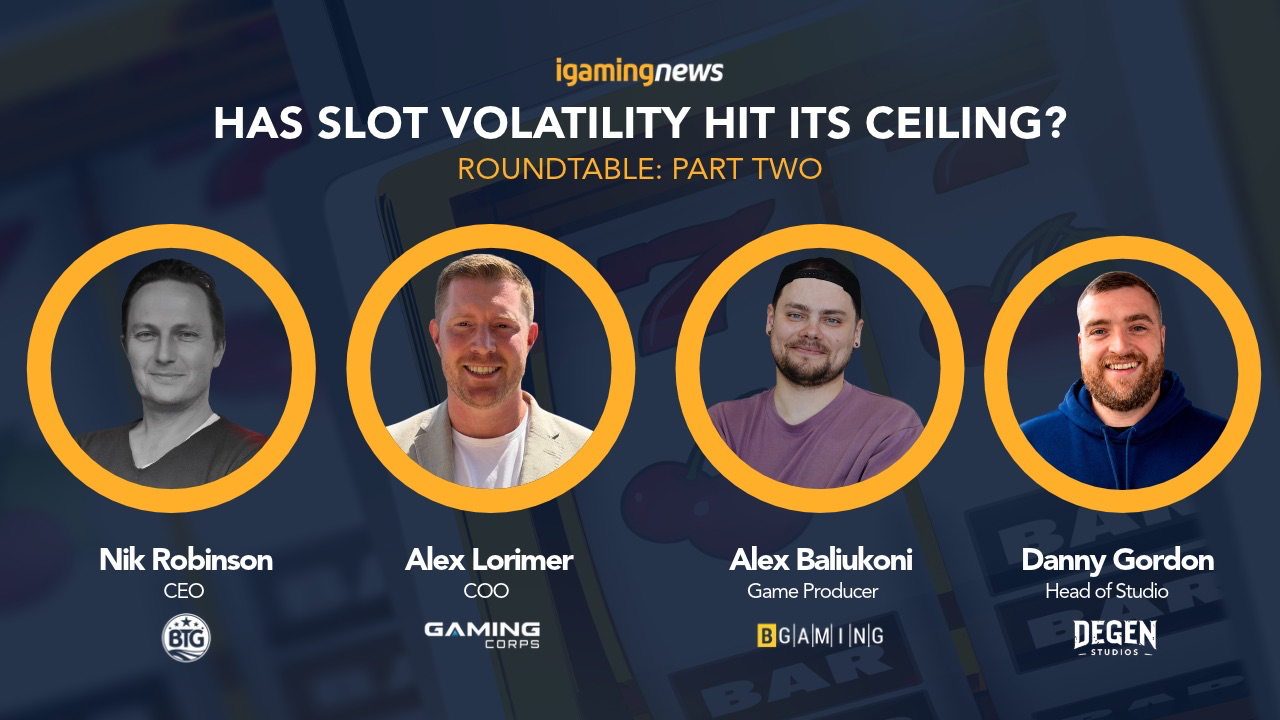
Contributors include:
Nik Robinson, CEO, Big Time Gaming
Alex Lorimer, CCO at Gaming Corps
Alex Baliukonis, Game Producer at BGaming
Danny Gordon, Head of Studio, DEGEN Studios
Has streaming and bonus-buy culture distorted the industry's idea of what the average slot player wants?
Nik Robinson: Streaming has, a bit. What gets clipped and shared is the very best of what a game can do, so it's easy for a studio to watch that content and decide everyone wants a slot built around one explosive bonus. Most people playing on a Tuesday night are on far smaller stakes and want the session itself to be fun.
I'd keep bonus buy separate from that. Giving players a say in how they play is a good thing. Our Power Play option lets people boost their spins, and Bonus Buy takes them straight into the feature in markets where it's offered, so different players can set the volatility to suit themselves. Where it goes wrong is a game designed entirely around the buy, with a base game nobody would choose to play.
Alex Lorimer: To a degree, yes. Streaming makes the biggest bonus buys and most extreme wins highly visible, but I don’t think they represent how most players want to spend a session. There is a large audience for familiar, engaging games that bring something new to an experience they already enjoy.
We also have to think about what operators want, particularly in regulated markets. With pressure on margins and so many games competing for lobby space, they are looking closely at consistency as well as quality. That does not mean innovation stops. It means innovation can be in how a game feels and entertains across the whole session, rather than always pushing the volatility further. Streaming matters, but it is only one view of a much broader market.
Alex Baliukonis: Streaming and bonus-buy culture have not necessarily distorted player demand; they have created and amplified a distinct new segment. Strong providers understand that regular players and streamer audiences often want very different experiences, and they develop content for both rather than treating one group as representative of the whole market.
Streamer-oriented games can legitimately prioritize extreme bonus rounds, high multipliers and moments that are exciting to watch and share. The challenge is that these moments dominate public visibility. Viral clips show extraordinary wins and highly dramatic features, while the far more typical experience of an average player receives little attention. As a result, someone looking at the industry from the outside may assume that these rare events define normal slot play. The distortion therefore, lies less in game development itself and more in how slot play is represented and perceived.
Danny Gordon: I think it has definitely amplified one particular type of player. The most visible slot content online tends to be the biggest bonus buys, the highest multipliers and the craziest max-win chases because, naturally, those are the moments people clip, share and react to.
But visibility does not necessarily mean that is how every player wants to play. There is still a huge audience that enjoys the base game, smaller stakes, longer sessions and seeing a game develop rather than jumping straight to the most extreme feature.
Studios need to understand both. Streaming culture is incredibly important and it has changed what players recognise and talk about, but we should not design every product as though the streamer is the average player. There probably is no average player anymore, and that is the more interesting challenge.
Does "low, medium or high volatility" still tell players enough about how a game will actually feel?
Nik Robinson: Not really. Two games labelled high volatility can feel completely different to play. One hands you small wins and visible progress all the way through, the other is silent until the feature lands, and the label puts them in the same box. I'd like more games to show players how they behave instead of relying on a one-word rating.
That was a big part of why MegawaysTM worked. The reels change shape in front of you and the ways count updates on screen, so you can see how much a spin is carrying before it resolves. Players understood it straight away without spending money just to learn how it worked.
Alex Lorimer: Partly. A volatility label gives players a starting point, and the theme can shape their expectations too. But neither tells them quite how the game will feel once they start playing.
That feeling takes a lot of work to get right. The way wins and features are paced can make a game with substantial top-end potential feel more approachable than its label suggests. For me, that is where the skill of the mathematician really comes through: making sure every spin contributes to an experience players want to stay with.
Alex Baliukonis: No. “Low, medium, or high volatility” is too broad to explain how a game will feel during an actual session. Two titles carrying the same label can deliver completely different experiences: one may produce frequent small wins and a very rare bonus, while another may have longer losing sequences but more meaningful feature payouts.
Players need a clearer combination of metrics, including hit frequency, payout distribution or variance, bonus frequency, RTP, typical win size, and the expected length of play needed to encounter the game’s main mechanics. Bet size and session format also matter, because the same mathematical model can feel very different across short and extended play. A single volatility label can remain a useful starting point, but it should be supported by more transparent information that helps players understand both the risk and the likely rhythm of the experience.
Danny Gordon: Not really. Those labels are useful as a starting point, but they are very blunt. You can put two games in the same high-volatility category and one might have a fairly active base game with regular feature teases, while the other is much harsher and puts far more weight behind a small number of outcomes.
Players are increasingly good at spotting those differences. They look at bonus behaviour, hit frequency, multipliers, feature structure and how quickly a game shows its intent. That tells them far more about the experience than a single volatility label.
I think there is an opportunity for the industry to talk about volatility with more nuance. Not necessarily by inventing another complicated rating system, but by being clearer volatility about what kind of ride the player is signing up for.
What do you think becomes the next battleground for studios?
Nik Robinson: Progression, and in particular what a game remembers. When multipliers and positions carry through the Free Spins, the player is watching something grow over the whole feature instead of hoping for one lucky hit. That feeling of building towards something is where I think studios will compete hardest over the next few years.
The other area with real potential is looking at the wider gaming landscape for inspiration. Merge mechanics have been hugely popular in casual mobile games for years and bringing that familiar style of interaction into Fruit Merge Megapots™ gave players something they could understand almost instinctively. I expect we’ll see more studios exploring ideas beyond traditional slot mechanics, because creating mechanics that feel intuitive from the very first spin is a real advantage when players have so many new games competing for their attention.
Alex Lorimer: Consistency, particularly when operators have so many new games to choose from each week. A studio might have one standout release, but can it deliver three or four games a month at the same standard? That is how you build momentum and earn an operator’s confidence.
That does not mean making the same game repeatedly. Classic slots still perform well, and it is interesting to see studios revisit those formats with the level of polish and production players expect today. The fundamentals that made those games popular still matter. For me, the challenge is to keep exploring what you can do with them while delivering quality across every release.
Alex Baliukonis: The next battleground will be the quality of the player experience rather than another race towards a larger maximum win. Studios will increasingly compete on how well they support psychological well-being, communicate risk, and create engagement without relying on manipulative mechanics.
Personalization and adaptive design will also become more important, provided they are implemented responsibly and within regulatory boundaries. We are likely to see more games designed around specific playing occasions: short, high-impact sessions for some audiences and longer, progression-led experiences for others. Transparency will be another differentiator, especially in how studios explain mathematical models, bonus frequency, and realistic game behavior. The strongest products will still be capable of delivering memorable moments, but they will build anticipation through clearer progression, stronger base-game engagement, and a better-balanced overall journey. High impact will remain important; it will simply be measured by more than extremity alone.
Danny Gordon: I think it comes back to product. Not just one mechanic or one feature, but how all the parts of a game work together and whether the player feels there is a reason to keep going.
Studios will still push maths and max-win potential, but the bigger opportunity is in making games feel more distinctive, readable and rewarding across the whole session. That could come through stronger progression, better use of feature states, more meaningful player choices or simply a base game that does more work.