CasinoReviews Research Shows Banning Prediction Markets Drives Interest Rather Than Deters It
CasinoReviews research suggests prediction market restrictions coincide with elevated search interest, particularly around elections, across the 51 countries studied.
CasinoReviews.net, the independent online casino reviewer, has released a report showing that regulatory bans on prediction market platforms Kalshi and Polymarket drive higher public search interest, rather than lower.
Global attention to these platforms is fuelled far more by contested political elections than by the regulatory fights that dominate their press coverage.
The research, derived from a full year of primary Google Trends data from September 2025 to September 2026, cross-referenced against the IFES ElectionGuide.org global election calendar and dated regulatory reporting, analysed search behaviour for Kalshi and Polymarket across 51 countries.
Bans Correlate With Search Interest
Among the key findings, the standout was that bans correlate with, rather than suppress, search interest.
Eight of the top 15 countries by Polymarket search share, and four of the top 15 for Kalshi, are jurisdictions that currently restrict or have formally banned prediction markets.
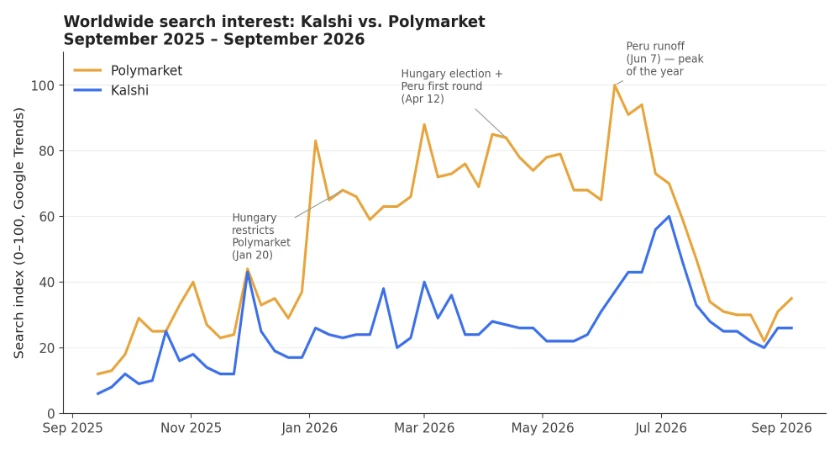
Search interest also regularly peaks in line with political elections, particularly in closely contested races.
The single highest point in worldwide Polymarket search interest across the year was during Peru's presidential runoff on 7 June 2026. The second-largest sustained peak occurred during Hungary's parliamentary election and Peru's initial presidential voting, both held on 12 April 2026.
Kalshi And Polymarket Show Different Search Patterns
The research found that Kalshi trades more money than Polymarket but loses the search-attention race almost everywhere.
Kalshi narrowly leads Polymarket in its home market, with a 21% share compared with 19% for Polymarket in the United States, but falls to single digits across nearly every other country studied.
The findings point to Polymarket having broader global awareness, while Kalshi is much more US-centric.
CasinoReviews also highlighted that at least one major platform is deliberately marketing into a country where it is banned.
Polymarket is hiring Mandarin-speaking staff and building Lunar New Year-specific betting markets despite being blocked by China's Great Firewall.
Restrictions And Public Exposure
The findings suggest that geo-blocking may be a weak tool for reducing public exposure to prediction markets.
Hungary's restriction is IP-based and openly acknowledged as bypassable by VPN in the regulator's own statement, while China's Great Firewall method routes hundreds of millions of dollars of contracts per month through VPN regs.
The research also points to a clear problem for the sector: platforms are being pulled into the news cycle by contested elections and geopolitical crises far more than by their own regulatory battles.
The countries most engaged with them are disproportionately the ones trying hardest to keep them out.
CasinoReviews On The Findings
Nikoleta Kuncheva, Lead Researcher and Project Manager for CasinoReviews.net, said:
“Looking at the last 12 months of prediction markets, and the sheer media noise generated around them, it’s clear that trying to combat their rise has seen a similar spike in publicity. Rather than bans quietening the noise around the platforms, we’re seeing the opposite occur, highlighting that the current approach isn’t working for regulators.
“From gaining cut-through in restricted markets to huge interest around major political events, it’s clear that prediction markets have a place in the public conscience, and this will seemingly only grow as we head into the key midterm votes in the United States, as well as numerous elections throughout Europe.”