Culture Starts at the Top, Execution Makes It Real
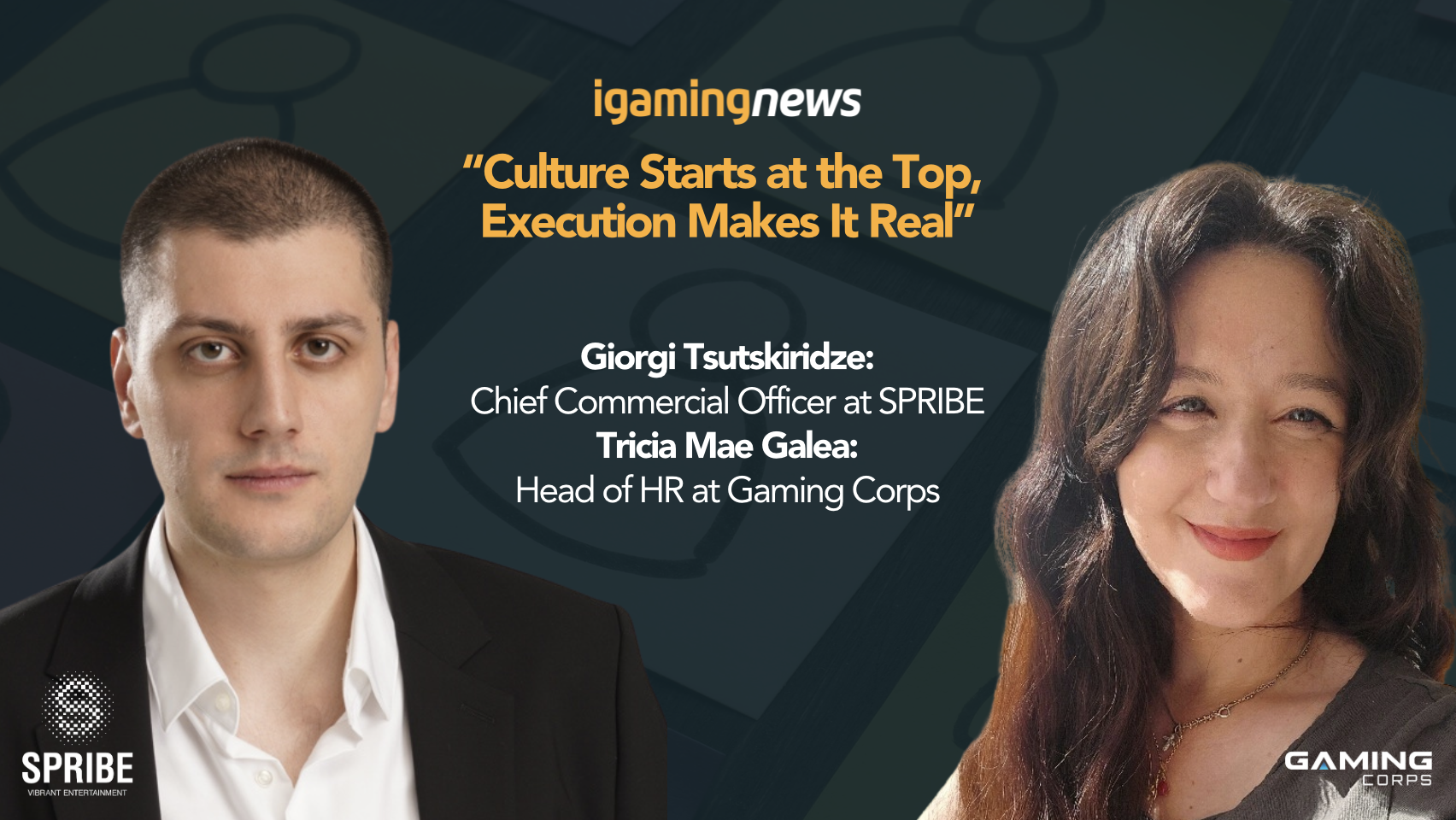
In this exclusive Q&A, Giorgi Tsutskiridze, Chief Commercial Officer at SPRIBE, and Tricia Mae Galea, Head of HR at Gaming Corps, discuss the role leadership plays in shaping culture from the top down
As iGaming businesses continue to grow at pace, culture has become far more than an internal talking point. It's a commercial asset that influences how companies attract talent, build partnerships, develop brands, and navigate international expansion. The challenge is not just creating a strong culture, but preserving it as organisations scale across markets, teams, and time zones.
In this exclusive Q&A, Giorgi Tsutskiridze, Chief Commercial Officer at SPRIBE, and Tricia Mae Galea, Head of HR at Gaming Corps, discuss the role leadership plays in shaping culture from the top down, how founder-led businesses can protect their identity through periods of rapid growth, and why aligning culture with brand strategy has never been more important. From global collaboration and local market nuance to the growing value of senior marketing leadership and fractional CMO support, they share their insights into why culture is increasingly becoming a defining factor in long-term commercial success.
1) How does leadership shape culture in your organisation, and what does strong alignment look like in practice?
Giorgi Tsutskiridze: SPRIBE believes that a company’s culture is shaped by having the leadership team set the standards for success.
This means creating the best possible conditions for how decisions are made, how people collaborate, and how quickly the business adapts.
We don’t treat culture as an internal slogan. Instead, it’s reflected in how we carry out our processes, how we ensure accountability, allow creativity, and the pace at which teams operate globally.
Any global company, which is what we are, must be aligned across crucial areas of its business. What this means in practice is that our product, marketing, commercial, and operational teams must understand and follow the same long-term vision.
We achieve this by having direct communication between leadership and our global teams, encouraging fast decision-making, and ensuring that innovation is supported by operational discipline.
It’s also important that this alignment is visible not just to those working within the company, but also to those outside it, too.
When dealing with SPRIBE, our partners and operators should experience the same values that we’ve worked so hard to create internally – speed, transparency, ambition, and consistency.
Tricia Mae Galea: Gaming Corps builds its culture in many different ways.
We do it through our people, through respect, relationships, and the understanding that we’re a company made up of different backgrounds, cultures, and personalities.
These important factors are shaped by our leadership team every day, who don’t simply talk about culture, but also live it.
Our leaders show up consistently. They listen, they adapt, they respect the differences in how people communicate, and they create an environment where everyone feels safe, valued, and understood. It’s the balance of being human and being accountable.
When leadership is aligned, you feel it. There’s clarity, collaboration instead of silos, and a shared sense of direction. People know what we stand for because they can see it in how leaders behave, not just in what they say
2) Founder-led businesses often establish a clear identity early on, but how can that be maintained as companies scale?
Giorgi Tsutskiridze: Founder-led companies often grow quickly because they begin with a very clear vision and a strong decision-making culture.
The challenge comes later, when growth introduces more layers, markets, and teams.
Being able to maintain your identity at scale requires taking that strong, passionate founder mentality and injecting it into the company’s systems, its leadership behaviours, and its everyday operational standards, rather than just relying on personalities.
At SPRIBE, preserving our identity means protecting the qualities that drove our early success, such as agility, creativity, speed, and willingness to challenge industry conventions.
As our teams expanded globally, we found it became important to hire leaders who genuinely understand and reinforce those principles.
Culture also has to be documented and embedded into onboarding, communication, hiring, and performance expectations, which is exactly what we’ve done.
The companies that maintain their identity successfully are usually the ones that avoid becoming overly corporate or slow as they grow.
Scaling should strengthen culture, not dilute it. That balance is critical in fast-moving sectors like iGaming.
Tricia Mae Galea: Gaming Corps has seen firsthand how quickly a founder-led identity can be tested as a company grows.
The last 18 months have been a perfect example - new teams, new structures, new markets, new personalities, and a pace that hasn’t slowed down for a second.
Growth is exciting, but it also stretches culture, exposes gaps, and forces you to decide what you’re actually keeping and what no longer serves you.
We believe maintaining your original identity isn’t about holding on to the past, but about protecting the essence of what made the company special in the first place.
That only works when leadership is aligned, present, and genuinely committed to living it. Here at GC, that’s exactly the work we’re doing, taking the best of where we came from and making sure it still exists as we scale into what comes next.
3) What role does senior marketing leadership, including fractional CMO support, play in translating culture into brand and messaging?
Giorgi Tsutskiridze: In highly competitive industries such as iGaming, brand positioning is shaped not only by products but also by how consistently a company communicates its identity, values, and long-term vision.
It’s a critical part of the senior marketing leadership’s role to make sure their healthy company culture is apparent to those outside the company as well, acting as a bridge between executive strategy and market perception.
This ensures any messaging reflects the company’s real culture, rather than becoming another generic corporate communication.
Whether it’s through internal leadership or by fractional CMO support, having access to experienced strategic marketers can help companies maintain clarity, consistency, and achieve differentiation while their business is scaling internationally.
This becomes especially valuable during periods of rapid growth, market expansion, or product diversification.
Ultimately, effective marketing leadership must ensure that brand reputation evolves alongside the business, without losing its authentic voice and the exciting elements that made it an attractive product in the first place.
Tricia Mae Galea: Senior marketing leadership plays a huge role in turning Gaming Corps’ culture into something the outside world can actually feel.
Internally, we know who we are - diverse, fast-moving, human, a little chaotic, and very driven. But translating that into a brand and a voice takes intention. That’s where strong marketing leadership becomes essential.
When it comes to our fractional CMO support, I’ll be honest – it’s been one of the most important pieces of that puzzle. Having access to someone with that level of experience and clarity has helped us articulate our identity in a way that feels grown-up without losing the personality that makes us who we are as a company.
Marketing takes the reality of our culture and shapes it into messaging that’s consistent, confident, and true.
In practice, it bridges who we are on the inside with how we show up on the outside. It elevates the brand and makes sure our voice reflects the culture we’re building every day.
4) How do you ensure cultural consistency across global teams while still allowing for local market nuance?
Giorgi Tsutskiridze: To begin with, you must have a very clear core identity.
Teams should understand what the company stands for, how decisions are made, and what behaviours are expected, regardless of geography.
At the same time, global consistency should never mean you lose the ability to be flexible, nor your understanding of local markets.
The most effective approach is to establish universal principles while empowering regional teams to adapt communication, partnerships, and market strategies according to local tastes.
Different markets have different player behaviours, business cultures, and regulatory environments, especially within iGaming. This means local expertise is essential for any product to become a success.
The SPRIBE team is fully aware of this, so that’s why we work hard to have clear communication between headquarters and regional teams. We make sure everyone understands the shared objectives and that the decision-making processes are fully collaborative between our head office and those on the ground around the world.
The goal is not to make every market operate identically, but to ensure that every market reflects the same overall standards, ambition, and brand philosophy while remaining locally relevant.
Tricia Mae Galea: Cultural consistency isn’t about making everyone work or communicate in the same way, especially in a fully remote, global setup like ours.
It’s about having a shared heartbeat involving respect, clarity, trust, and treating each other like humans first.
That’s the part which stays consistent, no matter where we log in from. We’ve grown fast in the last 18 months, and with that growth comes different cultures, different expectations, and different communication styles.
Instead of trying to smooth out those differences, we anchor everyone to the same core values. The expression can change, but the foundation doesn’t.
Local nuance matters. What feels natural in one country or culture won’t feel the same in another, and that’s exactly why we don’t force uniformity.
We give people the space to adapt to their own context, as long as the way they collaborate, communicate, and represent Gaming Corps stays aligned with who we are. The real consistency comes from leadership being present, connected, and genuinely curious about the people behind the screens.
When leaders model the Gaming Corps way, and by that I mean in respectful, human, accountable, relationship-driven ways, these attributes naturally carry across borders
5) Where have you seen culture deliver the greatest commercial impact, whether through hiring, partnerships, or brand positioning?
Giorgi Tsutskiridze: Culture delivers when it creates consistency and trust across every area of the business.
Having a strong culture in an iGaming company becomes a competitive advantage because it directly influences speed of execution, talent retention, partnership quality, and long-term reputation, which ultimately result in improved commercial results.
One of the clearest examples is with recruitment. High-performing professionals are increasingly selective about where they work, particularly in global technology businesses. Companies with a strong culture tend to attract ambitious talent more naturally and retain teams more effectively.
Culture also plays a major role in partnerships and brand positioning. Operators, media partners, and global brands want to work with companies that demonstrate professionalism, innovation, reliability, and long-term vision.
Partnerships are often built as much on reputation and operational culture as they are on commercial terms.
Over time, that trust compounds into stronger market positioning and sustainable growth – and the first seeds are planted by having a fruitful company culture that nourishes and supports everyone working within it.
Tricia Mae Galea: The greatest commercial impact comes from culture being lived in conversations, in behaviour and in how we treat people. That’s what others respond to, that’s what they buy into, and it is what moves the business forward.
For me, the biggest commercial impact always comes from the moments where people genuinely feel our culture, long before contracts, branding, or strategy come into play.
In hiring, culture is often the deciding factor. The way we communicate, the respect we show, the honesty and humanity in our process, that’s what attracts the right people.
When candidates feel that Gaming Corps is a place where they’ll be treated well and trusted, they choose us, and the right hires directly shape product, delivery, and commercial outcomes.
When it comes to partnerships, culture shows up in how we build relationships. People work with Gaming Corps because they trust the humans behind the brand. They feel the consistency, the transparency, the lack of ego.
That trust becomes commercial value, which means partners stay, expand, and advocate for us because of how we show up.
With brand positioning, culture is the backbone. When your internal culture is strong, your external voice becomes clearer, more confident, and more authentic.
It stops feeling like marketing and starts feeling like identity, a real one that actually represents what your company is and who the people are that work for it.