UK iGaming Market Overview: Europe's Largest Market Faces its Biggest Tax Shock
This overview breaks down the UK's regulatory trajectory, market dynamics, competitive landscape, and seasonal patterns using Blask data.
Few iGaming markets combine the UK's scale, regulatory intensity, and competitive density. Hundreds of licensed operators compete inside one of the strictest frameworks in the industry — and starting April 2026, the tax burden is about to get significantly heavier. Yet demand keeps growing, the competitive hierarchy is slowly shifting, and the market continues to set the global benchmark for what top-tier regulated iGaming looks like.
This overview breaks down the UK's regulatory trajectory, market dynamics, competitive landscape, and seasonal patterns using Blask data.
Blask metrics overview
- Blask Index — real-time measure of market demand volume for iGaming brands in a given country, based on normalised search data.
- BAP (Brand's Accumulated Power) — a brand's percentage share of total market demand in a specific country and period.
- CEB (Competitive Earning Baseline) — projected revenue a brand should realistically capture given its market presence, expressed in USD.
Macro snapshot
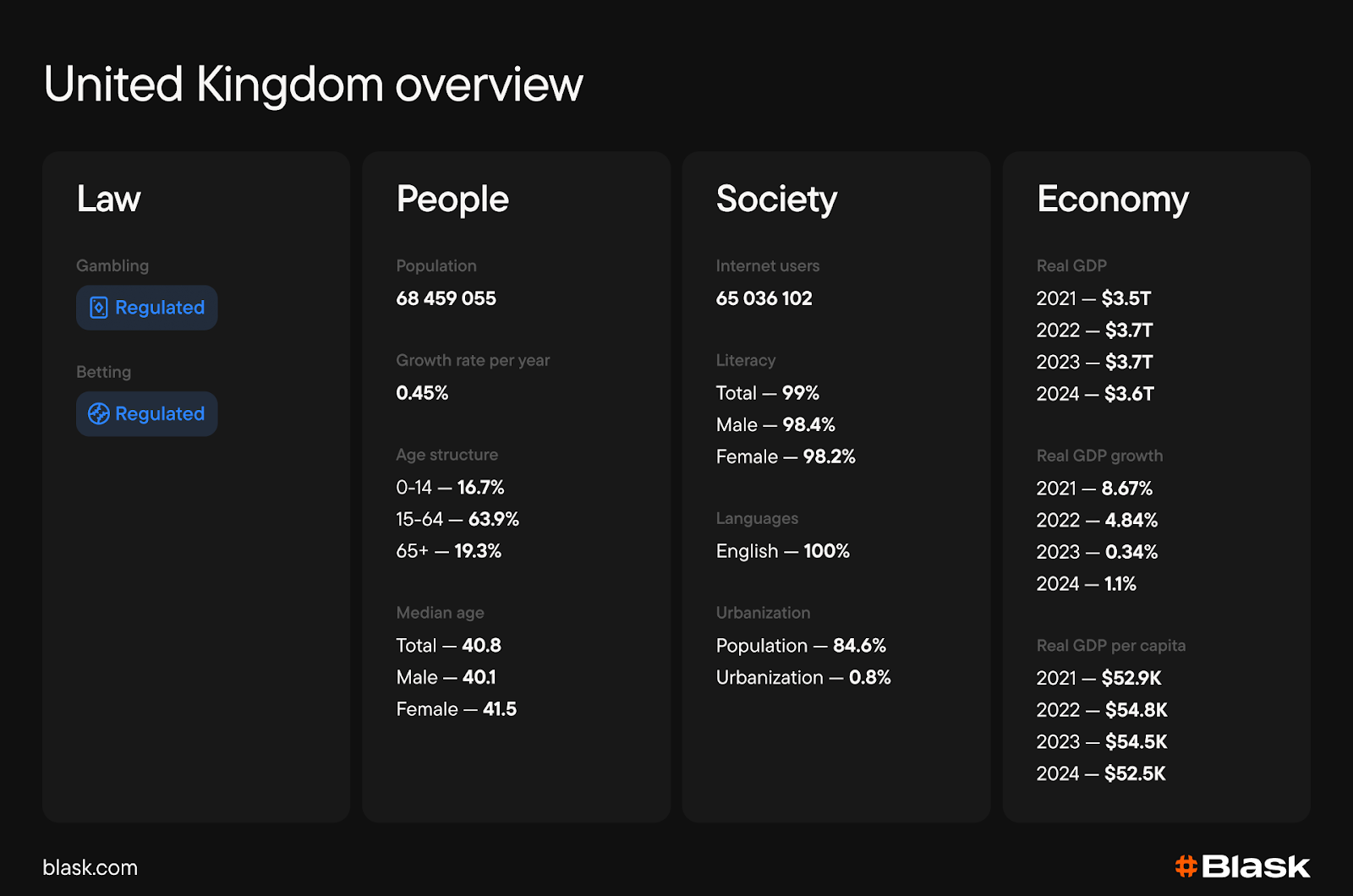
The UK is home to nearly 68.5 million people, with internet penetration approaching 95%. Urbanisation sits above 84%, and the median age is 40.8 — placing the core player base firmly in the digitally literate, urban-concentrated demographic that drives online gambling engagement.
Regulation: the squeeze tightens
The UK's iGaming market operates under the Gambling Act 2005, administered by the UKGC. The market is open to operators worldwide, but compliance costs are high, enforcement is active, and the regulatory trajectory since 2023 has moved unambiguously toward tighter player protections and a heavier tax burden.
Key timeline:
- 2005 — Gambling Act enacted; UKGC established as the primary regulator for online betting, casinos, bingo, and lotteries.
- 2014 — UKGC licence made mandatory for all operators serving UK residents, regardless of where they are based.
- April 2023 — Government White Paper High Stakes: Gambling Reform for the Digital Age published, triggering a multi-year wave of LCCP amendments across six reform themes.
- August 2024 – February 2025 — White Paper reforms rolled out in four stages, with financial vulnerability check thresholds tightening from £500/month down to £150/month, alongside enhanced age verification and new direct marketing opt-in requirements.
- April 2026 — Remote Gaming Duty rises from 21% to 40%, the most significant tax event in the market's recent history.
- April 2027 — A new remote betting rate of 25% introduced within General Betting Duty.
Tax stack for operators
The April 2026 Remote Gaming Duty increase is the single most consequential cost event for online casino operators in a decade. Remote betting duty follows suit, climbing to 25% by April 2027.
Player winnings remain untaxed at the individual level, but the operator-side burden is projected to generate over £800 million for the Treasury in the 2026/27 fiscal year alone. Post-April 2026, the UK joins the upper tier of the most heavily taxed regulated iGaming markets in the Western world.
Licensing structure
The UKGC issues operating, personal, and premises licences. All operators serving UK residents must hold a remote licence regardless of where they are headquartered, and the application process takes approximately 16 weeks. The licensing base is deep — but the incoming tax regime will pressure marginal operators, making further consolidation the most likely structural outcome.
Europe's largest iGaming market
The UK ranks second globally by CEB, behind only the United States — but while the US market has stalled, the UK continues to grow at a double-digit annual rate.
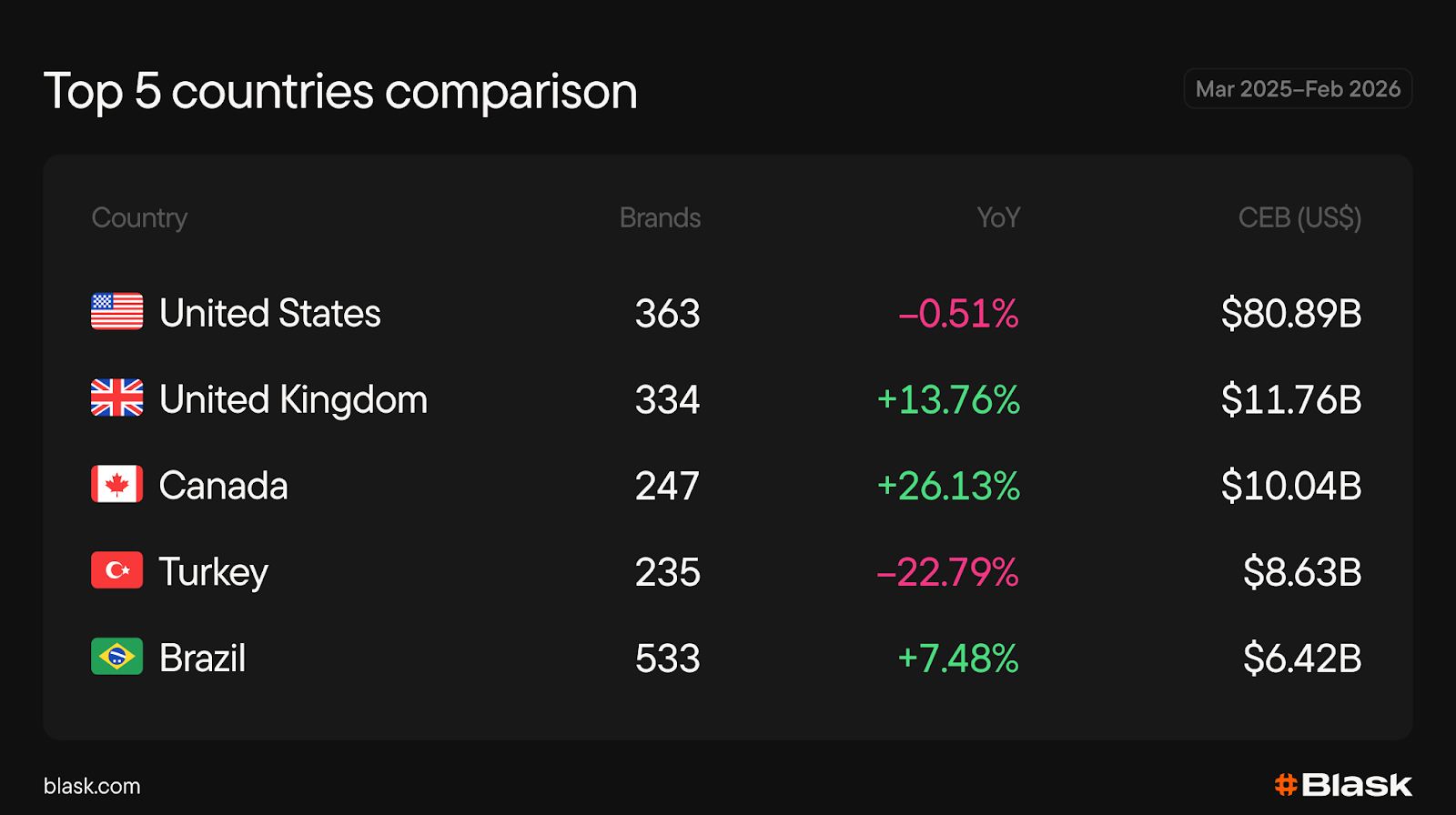
Canada is closing the gap, though the UK's regulatory depth and brand infrastructure remain a structural moat. Within Europe, the nearest challenger — Italy — trails by nearly half in CEB terms.
Market dynamics: two peaks, one squeeze
The twelve-month Blask Index trajectory reveals a market shaped by two forces: the football calendar and regulatory pressure.
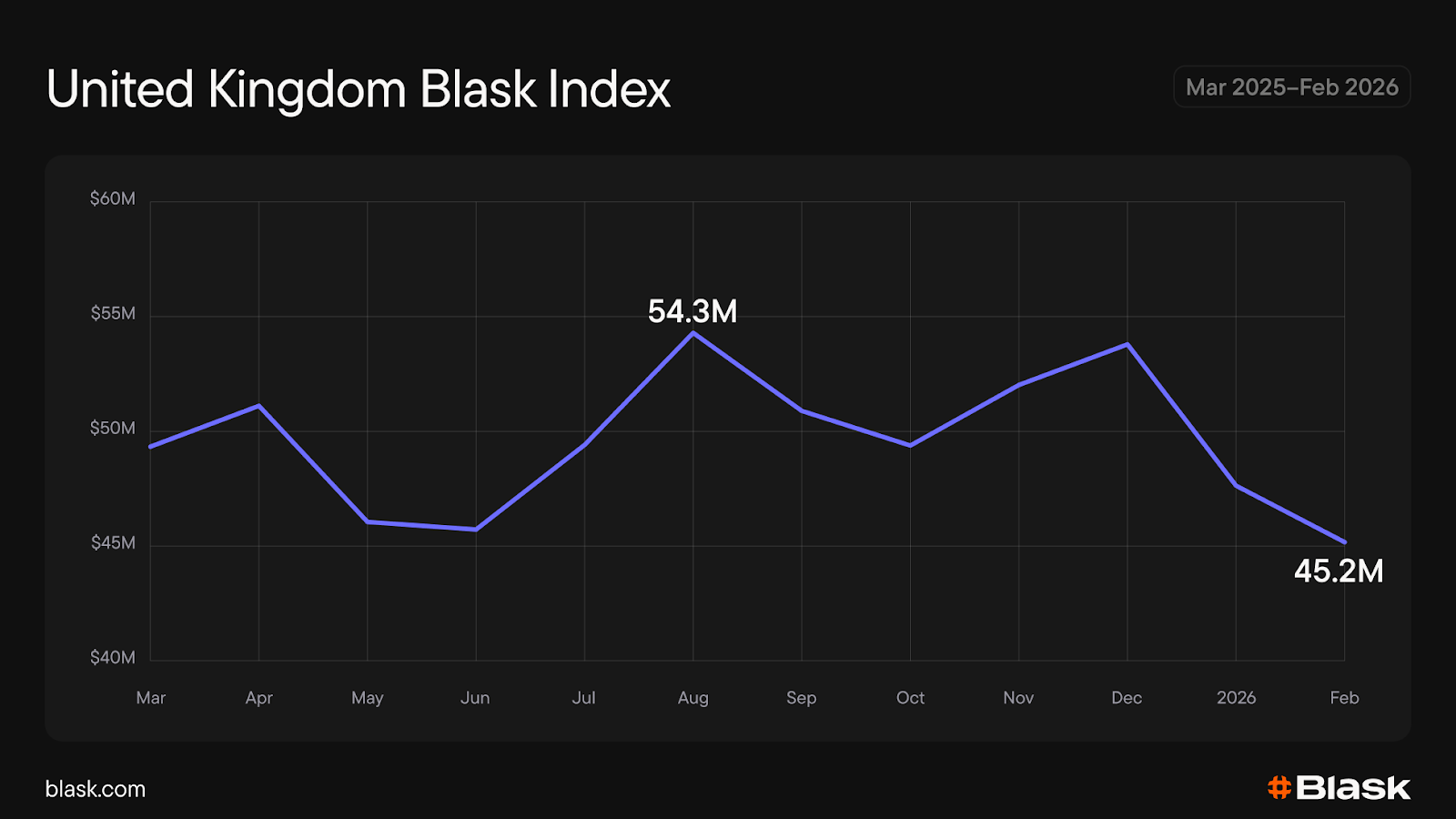
April–June trough. Blask Index opened the period at a moderate level before dipping to its lowest reading in the twelve-month window. This is counterintuitive given the UK's richest betting calendar — Cheltenham Festival, Grand National, and the World Snooker Championship all fall in this window. The cause is structural: the first wave of UKGC White Paper reforms landed here, with enhanced affordability checks and direct marketing restrictions disrupting operator acquisition at precisely the wrong moment.
Summer surge. The market recovered forcefully, peaking in August as the Premier League 2025/26 season kicked off. Operators had adapted to the new compliance environment, and the combination of football demand and stabilised acquisition channels drove the strongest sustained rise in the dataset.
Winter peak and post-holiday correction. A second peak formed around November–December, driven by the congested Premier League festive schedule and Christmas activity. The sharp pullback into February reflects both a standard post-holiday correction and the impact of the tightened £150/month financial vulnerability threshold.
Competitive landscape: contested, stable, and hard to crack
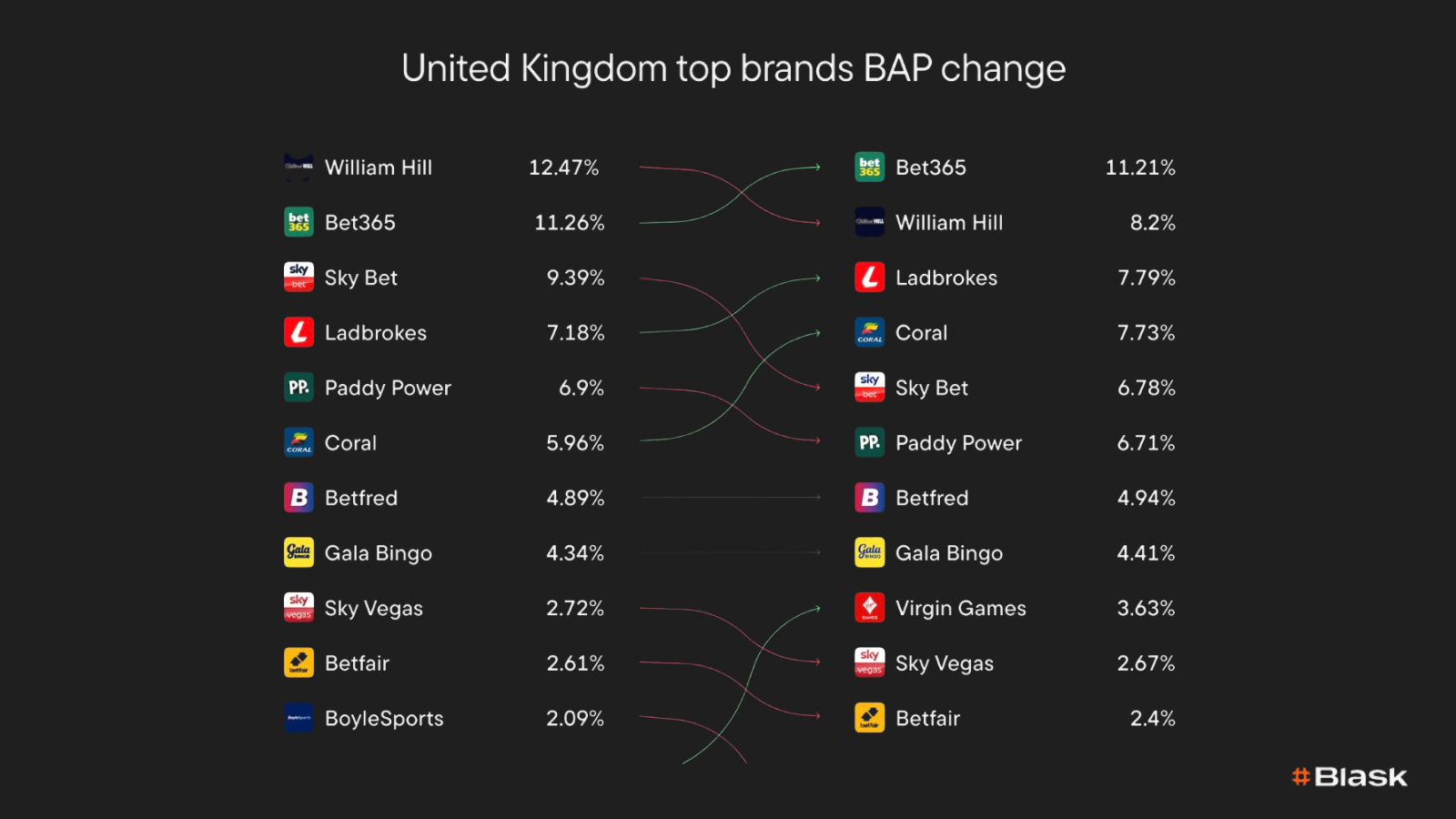
The UK's competitive landscape is tightly contested — no single brand holds more than mid-teen BAP, and the spread across the top ten is narrow.
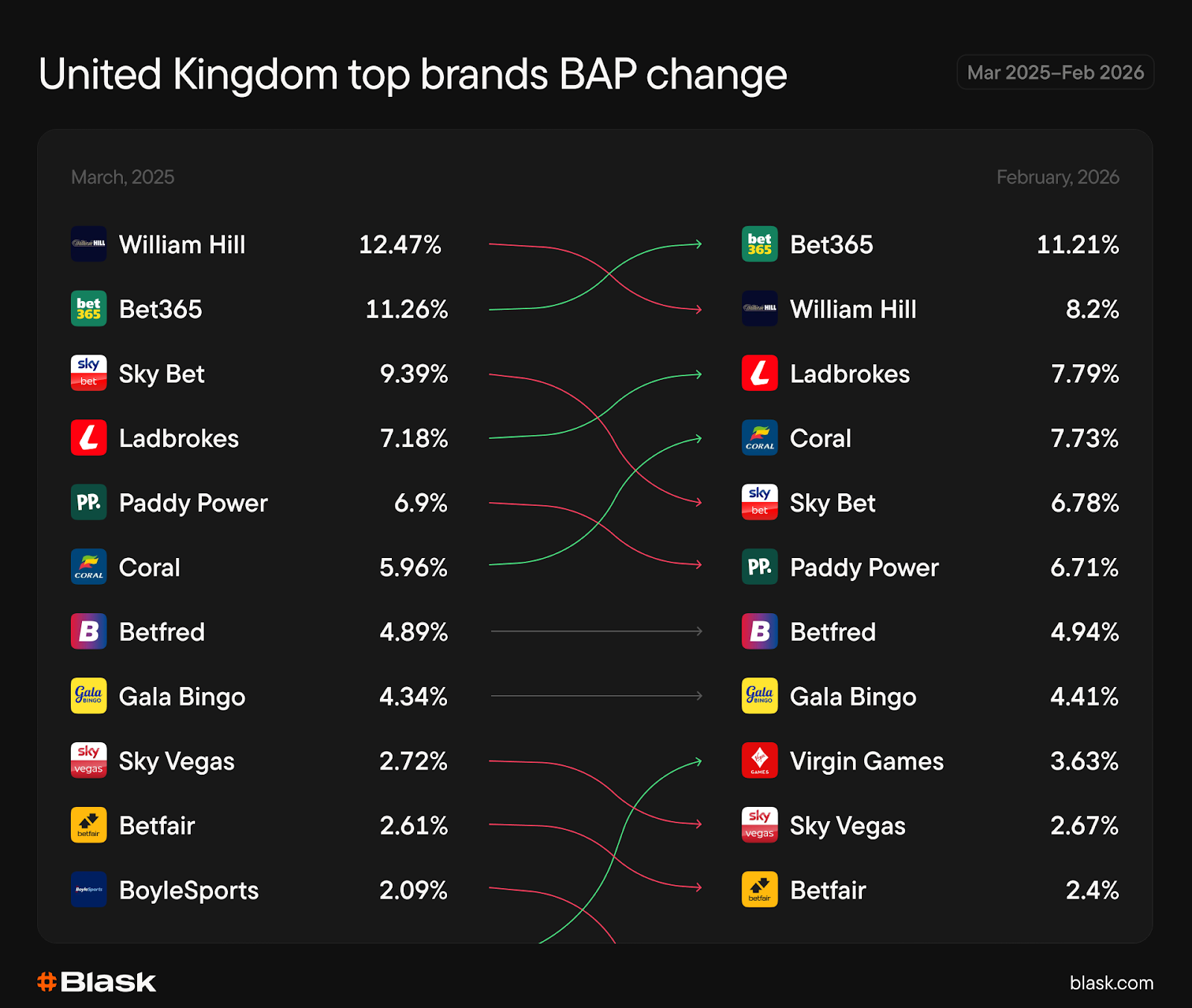
The composition is remarkably stable. Between March 2025 and February 2026, the same core names — Bet365, William Hill, Ladbrokes, Coral, Sky Bet, Paddy Power, Betfred, Gala Bingo — held their positions with only minor reshuffling. The main change at the top: Bet365 overtook William Hill for the number-one spot, while William Hill dropped to second after a notable BAP decline over the period.
The only real roster change came at the edges. BoyleSports fell out of the top ten, replaced by Virgin Games — a newcomer to the rankings that signals growing challenger momentum in the casino-focused segment. Beyond that, the hierarchy remained intact: entrenched brands trading small positional gains rather than any dramatic reshuffling of market share. Notably, every brand in the top ten holds a UKGC remote operating licence — there are no offshore operators in the rankings.
Seasonality: follow the racing and football calendar
The UK market peaks twice a year: once in spring, aligned with the major racing festivals (Cheltenham in March, Grand National in April), and again in December around the Premier League's congested festive fixture schedule and holiday season. The structural low falls in June–July, when no major racing festivals run and top-flight football is in off-season.
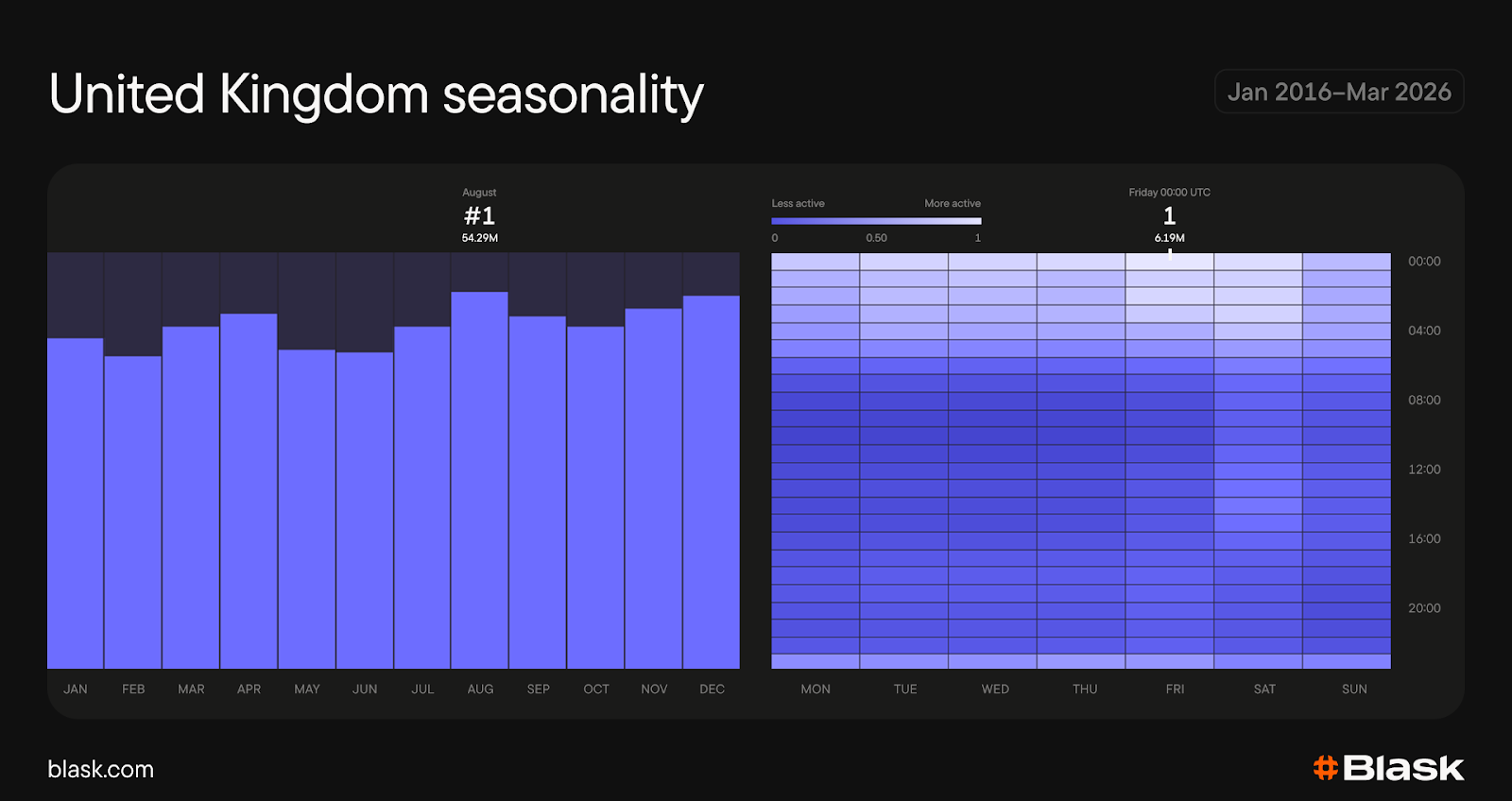
The daily heatmap shows peak activity on Friday and Saturday nights. Weekday evenings also show consistent engagement in the early night hours — likely driven by in-play betting on Premier League and Champions League midweek fixtures. Activity tapers off in the early morning hours across all days.
Conclusion
The UK is the world's second-largest iGaming market by CEB, growing at a double-digit annual rate inside a fully regulated, high-enforcement framework. With Remote Gaming Duty rising to 40% in April 2026, consolidation is the market's structural destination.
This is a market that rewards operators with the scale to absorb regulatory cost, the brand equity to retain players through compliance friction, and the efficiency to compete as margins compress. April 2026 will make that more true than ever.