Crypto: A Thing for Tier-1 Markets?
by GR8 Tech's CRO, Sergey Ghazaryan
There’s an assumption floating around our industry that goes something like this: crypto is primarily relevant for high-GDP markets with sophisticated players. It’s for operators targeting premium demographics in developed economies. Everyone else can wait.
I'm not convinced that assumption holds up when you look at the data. And if you're operating in Tier-2 or Tier-3 markets and you've been dismissing crypto as irrelevant to your business, you're almost certainly leaving money on the table.
The GDP Myth
The assumption that crypto adoption maps neatly onto GDP per capita sounds logical. Developed countries have the infrastructure, many are on the way to creating clear regulatory frameworks, and the citizens have disposable income to invest in crypto. It makes sense that adoption would follow wealth—but it's not that simple.
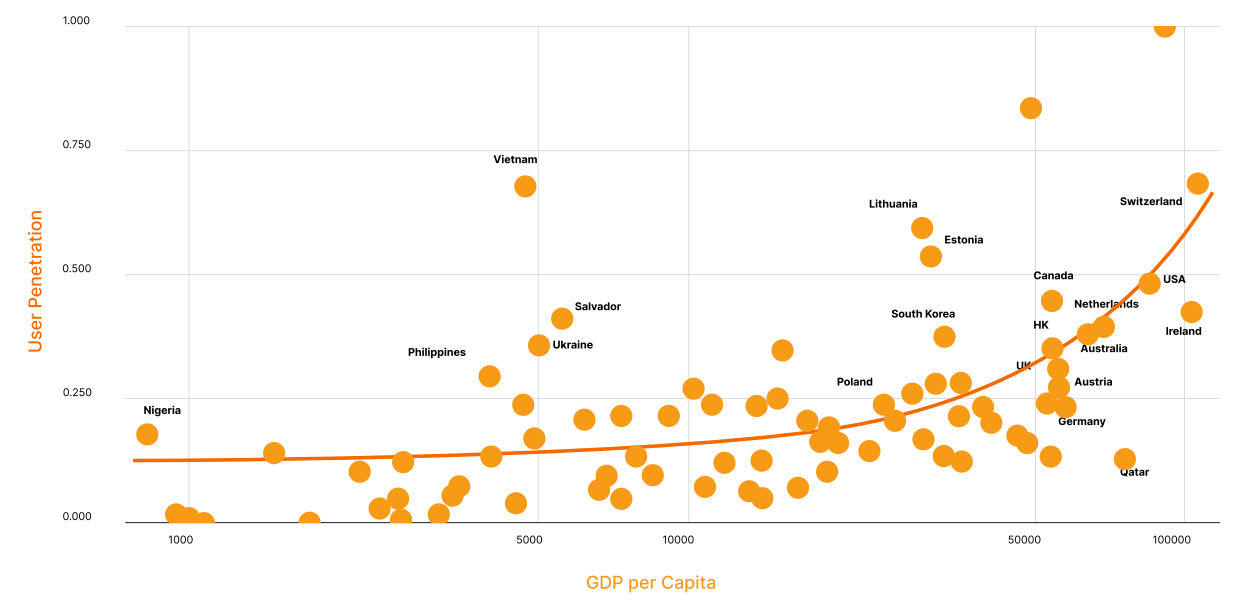
Bybit's recent report analyzing crypto usage across 79 countries found something interesting: yes, there's a positive relationship between GDP and overall crypto adoption, yet wealth is an enabler, not a guarantee. The top performers aren't defined by GDP alone. Look at user penetration rates from the report: Vietnam sits at 0.68—higher than the UK at 0.24, Germany at 0.31, or Austria at 0.26. Nigeria, Vietnam, and the Philippines, in particular, demonstrate that necessity and grassroots demand can be as powerful, if not more powerful, than financial capacity.
Necessity Beats Infrastructure Every Time
Transactional crypto use is also entirely decoupled from wealth. Instead of following the traditional tech adoption curve of innovation starting in high-GDP markets, then trickling down, crypto is booming in lower-GDP markets, proving the value proposition most convincingly because the pain points are most acute.
For example, Nigeria leads in transactional crypto use because crypto substitutes for weak or restricted financial systems. Vietnam's ownership rates are remarkably high because traditional banking hasn't kept pace with economic growth. The Philippines' crypto adoption is driven almost entirely by remittance flows—families receiving money from relatives abroad have learned that crypto delivers more value, faster, with lower fees.
These are massive, addressable markets where crypto is already solving real problems that traditional payment rails can't touch. And most importantly, in these markets, crypto isn't competing with seamless card checkouts and instant bank transfers. It's competing with 6% remittance fees, three-day settlement windows, and currency restrictions. That's why adoption happens faster and more organically and crypto increasingly becomes a commonly used norm, not something stand-out—maybe that’s why the potential is so often overlooked.
What This Means for Operators
If you're running operations in Tier-2 or 3 markets, or considering expansion, here's what matters most: your high-value players are already using crypto.
This insight drove the development of our Crypto Turnkey solution. The players generating the most revenue—your VIPs, your high rollers, the ones who actually move the needle on your P&L—they're disproportionately comfortable with crypto. They're already using it for investments, for moving money across borders, for protecting value.
For example, over 50% of Nigerians have used crypto. Twenty-two percent of Indians. These aren't niche populations—and within your target markets, your highest-value segments are even more likely to expect crypto as an option.
If you're not offering them a payment method they already trust and use, you're creating friction exactly where you can least afford it.
Let's Talk
We built Crypto Turnkey because we saw the potential that the market data was screaming about. If you've been operating under the assumption that crypto is primarily a high-GDP market play, I'd encourage you to look at the data. Better yet, reach out—I'd be happy to walk you through what we're seeing and how operators are already using this across different markets.
The opportunity is broader than most people think. And the time to grab it is now.