SolPoker Introduces Player-Run Tables With Dealer’s Choice And Stake Voting
The new feature allows players to create public or private cash games, select from five poker formats and adjust stakes through majority votes, with no rake charged.
Listen to this article
British female voice
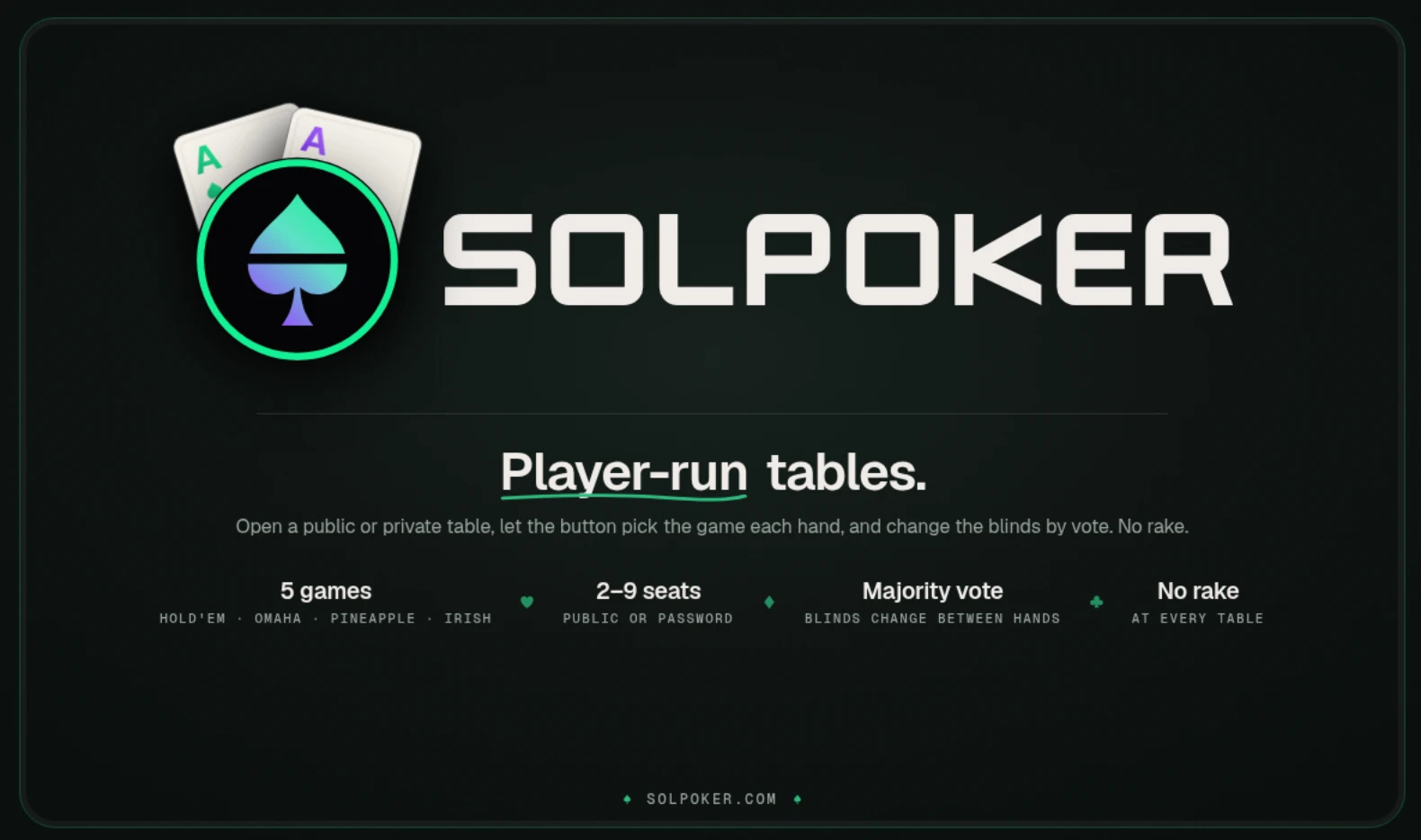
SolPoker has launched player-run tables, allowing all signed-in users to create and manage their own cash games on the platform.
Players can open a table from the lobby, choose a name, set the blinds, define the buy-in range and select between two and nine seats. Tables can be made public or protected with a password.
Game formats include Texas Hold’em, pot-limit Omaha, Pineapple and Irish, alongside a Dealer’s Choice option that allows the player on the button to select the game before each hand.
Once a game is under way, any seated player can propose a change to the stakes. Proposals are decided by a majority vote and, if approved, take effect between hands.
Dealer’s Choice Offers Five Game Formats
At Dealer’s Choice tables, the player on the button selects from five options before each hand: Texas Hold’em, four-card pot-limit Omaha, five-card pot-limit Omaha, Pineapple and Irish.
In Pineapple, players receive three cards and discard one before the flop. In Irish, players receive four cards, play the flop with all four and then discard two.
Players have a short window to make their selection before each deal.
Stake Changes Governed By Voting Rules
Stake proposals must follow set parameters. The big blind must remain within four times the table’s original blind in either direction, while the small blind must be between one-third and half of the big blind.
The minimum buy-in cannot fall below 20 big blinds, and the maximum must be at least 40 big blinds.
Each seated player receives one vote, which cannot be changed once submitted. At a six-handed table, four votes are required for a proposal to pass, while both players must agree at a heads-up table.
Approved changes are applied after a 15-second pause between hands and cannot take effect during a hand. Stakes can be changed no more than once an hour. The same voting system also applies to SolPoker’s regular cash tables.
Players must have enough bankroll to cover the table’s minimum buy-in, which starts at $5. Each player can operate one table at a time.
Player-run tables do not charge rake, meaning private games among friends carry no additional table fees beyond the chips wagered.
SolPoker Highlights Player Control
Shurdha Klea, head of product at SolPoker, said:
“A home game decides two things for itself that online rooms took away: what it plays and what it plays for. SolPoker can hand both back because it takes no rake, so it has no reason to steer players towards its own tables.“A password-protected Dealer’s Choice table with four friends is the game this format was built for, and it now takes a minute to set up.”
On-Chain Verification Supports Fair Play
Hands at player-run tables use the same verifiable shuffle system as the rest of the SolPoker platform.
Before each hand, the server publishes a SHA-256 commitment that fixes its secret seed, each seated player’s individual seed and a future round of drand, the public randomness beacon operated by the League of Entropy.
The commitment is anchored in a transaction on Base before the relevant drand round takes place. Completed hands can then be checked through the platform’s verification page at solpoker.com/verify.
Players can sign in using a Solana or Ethereum wallet or a Google account. Games run directly in a browser on desktop or mobile devices, without requiring a download.
Further information is available at SolPoker.
Stay ahead of iGaming
Get the week's key stories, industry insight and exclusive interviews in your inbox.
One email a week. Unsubscribe any time. More about our newsletter