How Video Pre-Roll Turned India Into A Growth Market For An iGaming Operator
A scalable 40% ROI on video — up from a 10–15% popunder start.
Listen to this article
British female voice

An iGaming operator entering the Indian market was looking for a reliable traffic source with room to scale. Initial Popunder campaigns delivered a positive ROI of 10–15%, but growth was limited.
To explore new opportunities, the operator worked with the TrafficStars team to develop video creatives and test different formats and placements across xHamster and other premium sites.
By focusing on the best-performing campaigns, the operator achieved a $60 cost per first-time deposit and 40% ROI within the first 30 days. Over the following months, continued scaling was also accompanied by an 18% increase in branded search impressions.
40% | $60 | 200+ | +18% |
|---|---|---|---|
ROI in 30 days | Cost per FTD | First-time deposits | Branded search (3 mo) |
The Campaign At A Glance
Vertical | iGaming (casino + sportsbook) |
Market | India |
Format | Video Pre-Roll (from a full-mix test) |
Buying model | CPM / SmartCPM → FTD postback |
Expert tools used | Campaign Optimizer · S2S postbacks |
Devices | Mobile-first |
Duration | 30 days, then scaled continuously |
Media spend | ~$3K test → ~$12K in 30 days → ~$78K over the next 3 months |
Cost per FTD | $60 |
Result | 40% ROI (up from 10–15% on popunder) |
Here's a result most performance buyers would happily sit on: a profitable popunder campaign. Here's why this operator didn't — and how walking away from “good enough” turned India into a channel he could actually scale.
Chapter 1 — A New Market, And A Search For Stable Traffic
The advertiser, an iGaming operator running casino and sportsbook offers, was opening a market that was new to them: India.
Entering a fresh GEO, the priority wasn't a quick spike — it was finding a stable, reliable traffic source with clean, properly attributed traffic they could build on.
Growth you can trust starts with numbers you can trust, so the KPI was set hard from day one: profitable first-time deposits, tracked by S2S postback — not clicks, not sign-ups.
Chapter 2 — Popunder Tested: Clean, But Low
The first source they tested was popunder. It behaved well — real volume, clean tracking, and a positive return.
But the numbers were low: a soft rotation of the best landing pages settled around 10–15% ROI. Fine return. But the numbers were low: a soft rotation of the best landing pages settled around 10–15% ROI. Fine for a test, not the reliable engine they came to India to build.
The audience that could really move the needle was one popunder reaches only indirectly — users already inside the content, watching video with intent.
The open question was the usual one: would a video creative fit these sites, and who would produce it at the pace performance buying demands?
Chapter 3 — The Turn: Cooperation With The Manager
That question is where the TrafficStars account manager stepped in.
Rather than hand over a rate card, the manager got into the campaign — reading the popunder data with the operator's media-buying team and mapping what a serious video play would look like.
Video wasn't pitched as a brand exercise; it was planned as a performance channel, with the deposit postback wired in from the start so every decision could be judged on cost-per-FTD.
“The operator came to India for a stable, cleanly-attributed source he could scale. Popunder was profitable but stuck around 10–15% ROI. Once we planned and produced the right video creative and split the buy down to spot and creative on xHamster and other premium sites, it moved to a 40% ROI at a $60 deposit — the number that let him keep scaling. A few months in, we even saw his branded search climb. We don't push video for its own sake; we find where it's genuinely more efficient and help clients produce the creative to get there.”
Ksenia — Head of Partnership Success, TrafficStars
Chapter 4 — Planning And Producing The Creative
The biggest unknown — the creative — TrafficStars took on directly, planning and producing a video set built for the two highest-intent iGaming audiences: Slots and Crash players.
The craft was in the fit: the creatives spoke the native look and rhythm of premium video sites like xHamster while carrying the dynamics of iGaming — the spin, the multiplier, the near-win — and each led into a precise post-click funnel.
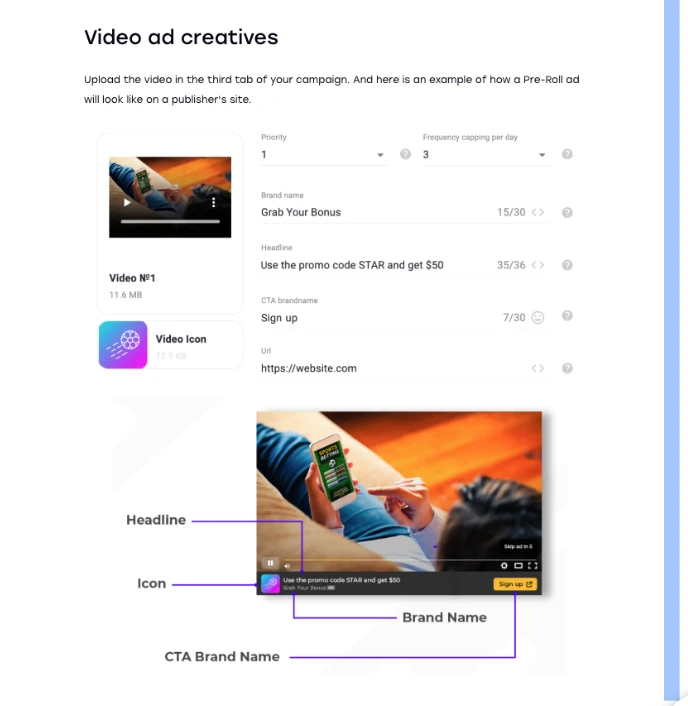
Offer-first hook, promo-code headline, one Sign-up CTA. From the very first tests, CTR came in high — the signal that the audience–creative–placement fit was real.


Chapter 5 — One Global Campaign, Then Split To The Spot
The buy launched as a single global video campaign across the full mix — Pre-Roll, Video IM Slider, Video Outstream and vertical Shorts — to let cost-per-FTD, not opinion, find the winners.
After ten days and roughly $3,000 of test budget, it was split into narrow, dedicated campaigns per spot and per creative: bid, budget, whitelist and rules all live at the campaign level on TrafficStars, so the only clean way to scale a winner is to give it its own campaign.
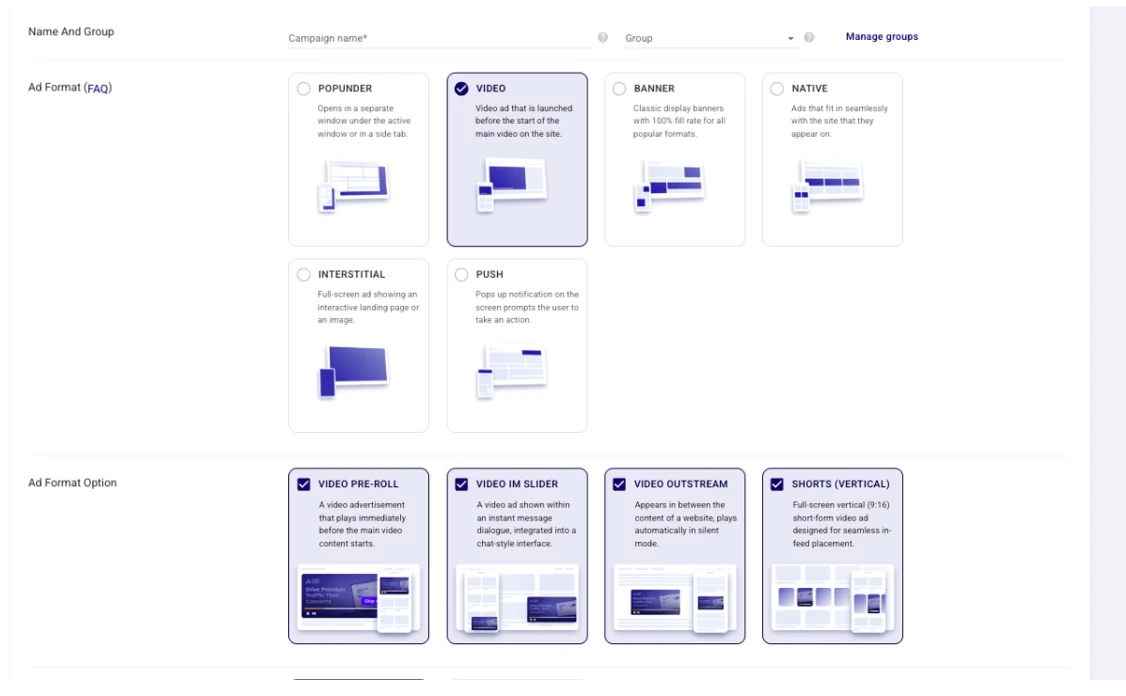
Targeting stayed tight — mobile, non-proxy traffic — bought on CPM/SmartCPM but always optimised against the FTD postback, so the algorithm and the buyers were reading cost-per-deposit from the first hour.
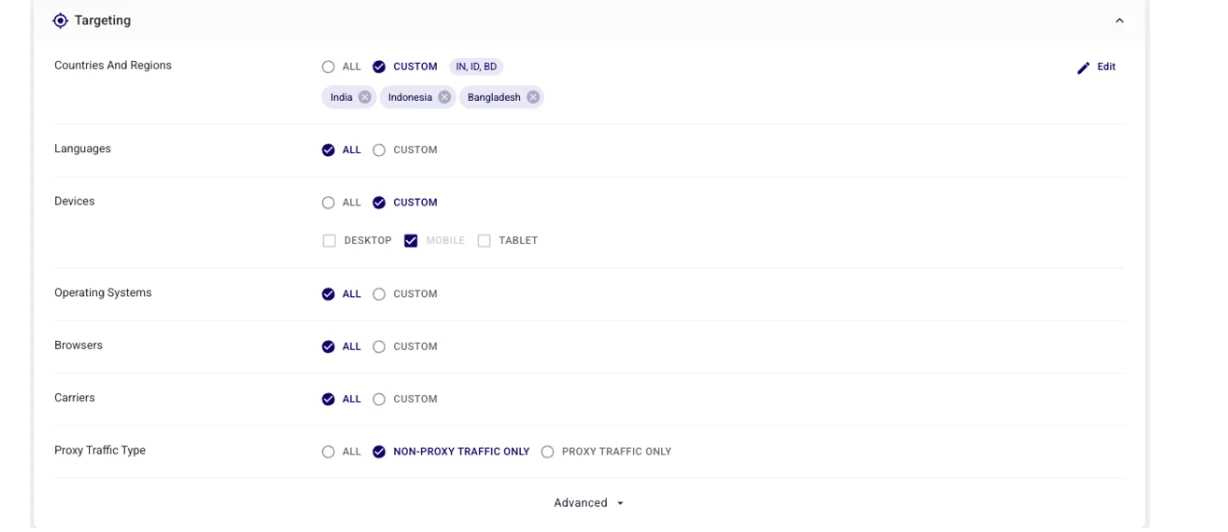
The targeting panel on TrafficStars — mobile-first, non-proxy. (The operator ran across the region; this case zooms into the India results.)
Chapter 6 — Optimisation: Down To The Format And The Spot
The enabler: S2S postbacks — planned, not bolted on. None of what follows would have been possible without the deposit signal.
From day one the team wired a server-to-server (S2S) postback that fired on every real first-time deposit, straight from the operator's platform into TrafficStars.
That turned the reporting view's FTD conversions and eCPA columns — matched daily against the operator's own revenue data — into actual deposit economics — so SmartCPM, the Campaign Optimiser and the buying team were all steering on cost-per-deposit in real time, never on clicks.
On that foundation, two Campaign Optimiser rules did the heavy lifting.
The first automatically blocked any site that burned past 10,000 impressions with a CTR under 1% — sweeping dead zones out of the buy every two days, with no manual babysitting.
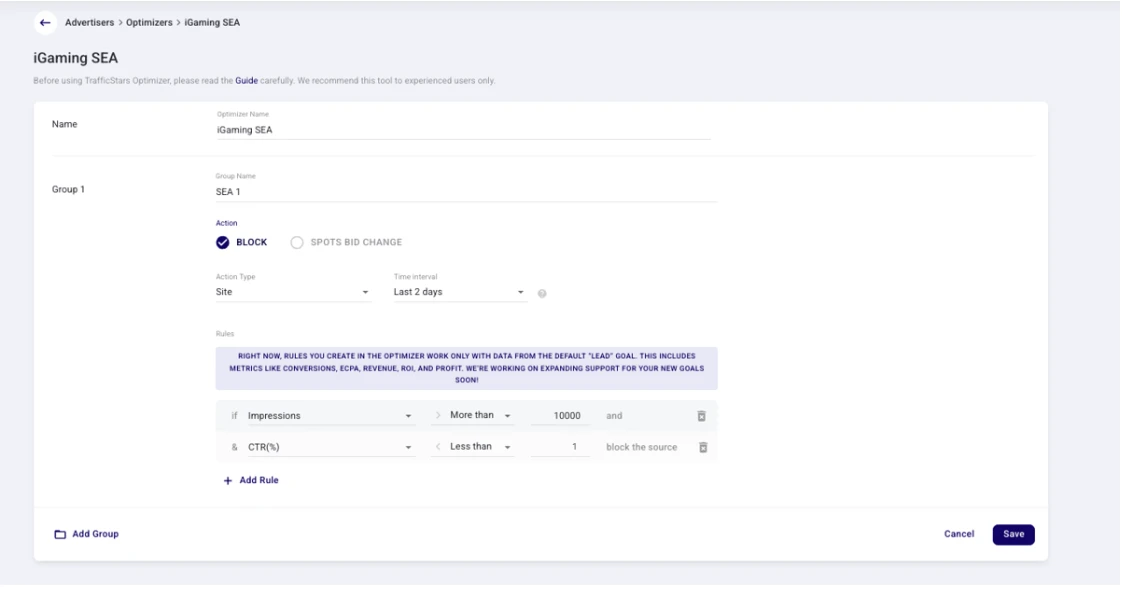
Optimiser rule #1 — automatic site blocking on dead zones: 10,000+ impressions with CTR under 1%.
The second stepped bids up on the spots that were actually converting.
The Optimizer reads the default Lead goal (registration), so the rule rewarded spots with more than three sign-ups at an eCPA under $10 — a leading indicator the buying team then checked against FTDs before moving budget.
Frequency was capped at three impressions per user per day.
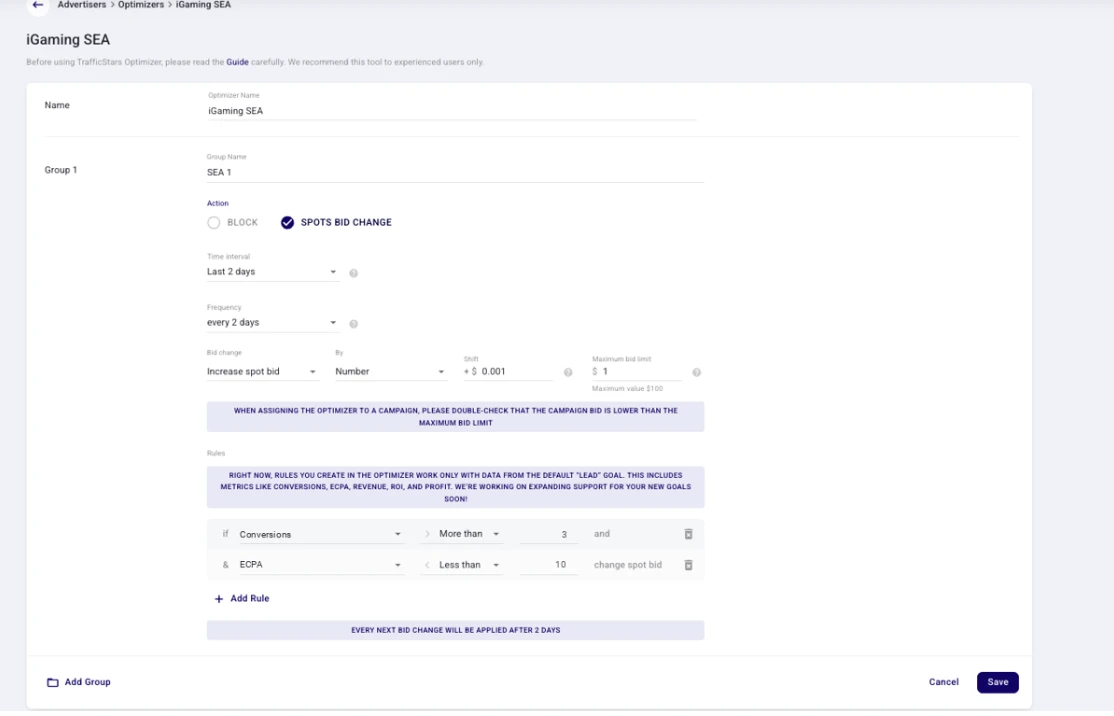
Optimiser rule #2 — automatic spot-bid increases on spots with cheap registrations (Lead goal).
Format By Format — Two Winners Emerge
Within the ten-day discovery test (~$3,000), a clear hierarchy emerged — and it wasn't one winner but two.
On TrafficStars, bid, budget, whitelist and Optimizer rules all live at the campaign level, so each winner was split into its own dedicated campaign.
Pre-Roll led and took the primary budget. The pleasant surprise was vertical Shorts: short-form video came in as the second winner — cheap, high-converting and a natural fit for mobile — and earned its own scaled campaign.
Outstream was narrowed to a handful of select spots; IM Slider couldn't match the FTD economics and was paused.
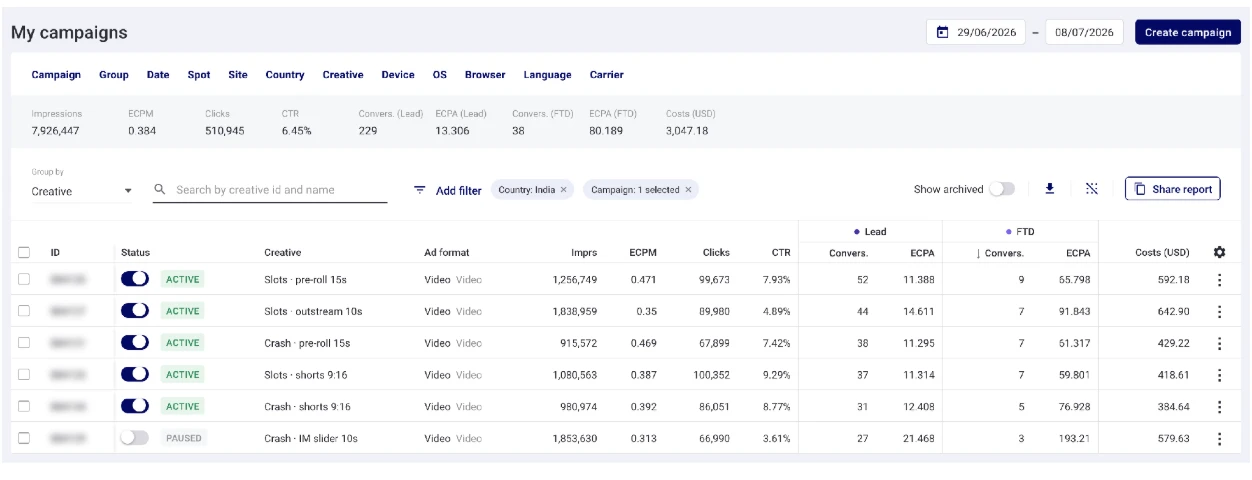
Discovery test only (29/06–08/07), grouped by creative: Pre-Roll and Shorts creatives convert at $60–77 per FTD; Outstream runs at $92, and the IM Slider creative was paused at $193.
Then the budget moved.
From 09/07 the discovery campaign was paused and the budget went into three dedicated campaigns — Pre-Roll, Shorts, and Outstream on two select spots.
Daily spend climbed from about $300 in the test to over $550 by the end of the month, while cost per FTD fell from $80 to $55.
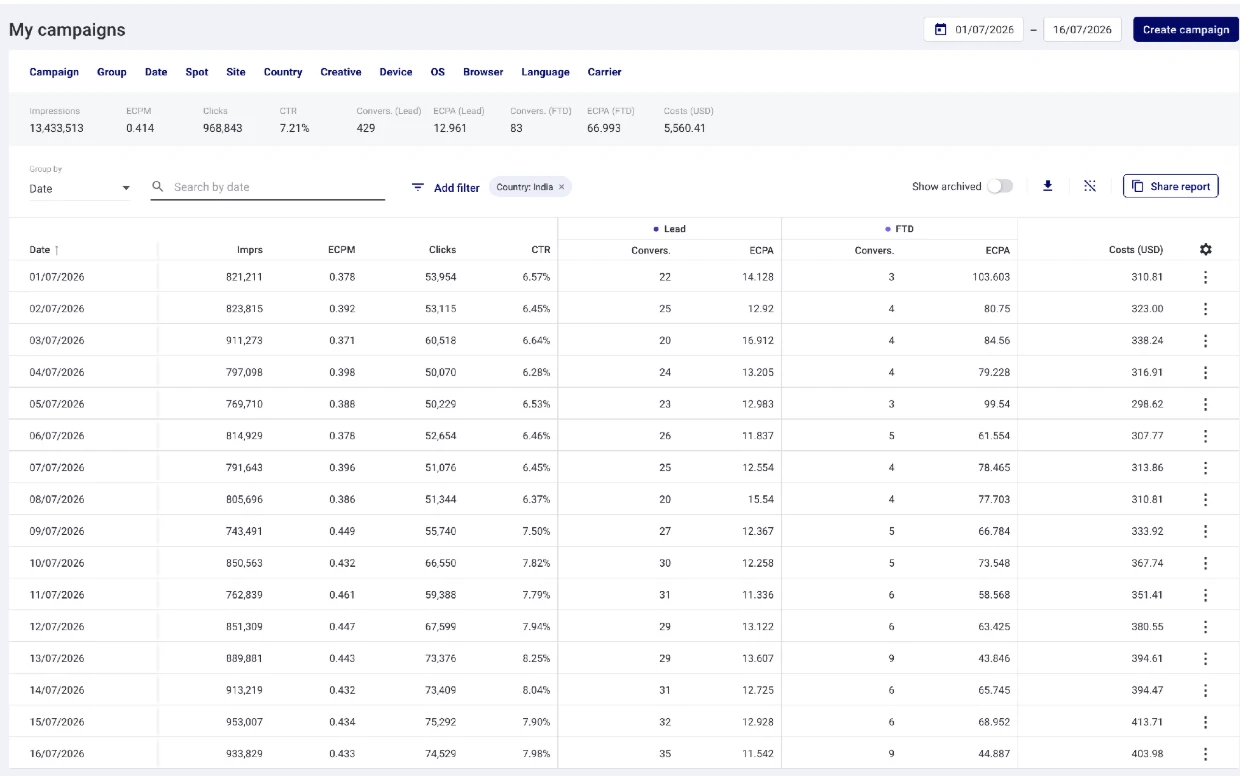
Grouped by date, 01/07–16/07: the last test days at ~$300/day and ~$81 per FTD, then the split on 09/07 — spend steps up toward $400/day and cost per FTD drops to ~$58.
Spot By Spot — Where The Deposits Came From
Zooming into the whitelist, xHamster pre-roll on mobile was the single strongest spot — but the winning format changed by site.
Pre-roll led on the premium video sites; vertical Shorts converted strongly on others; and two spots stayed on outstream, in their own small campaign.
After the split (09/07–28/07, the three dedicated campaigns), grouped by spot: xHamster mobile pre-roll leads at $51 per FTD; Shorts wins on other premium sites (site names masked).
The Results
The funnel stayed efficient from impression to deposit — a signature of video's engaged, in-view exposure versus interruptive formats:
28.1M | 2.1M | 1,018 | 201 |
|---|---|---|---|
Impressions | Clicks | Registrations | First-time deposits |
The full first 30 days by campaign, in the TrafficStars reporting view. The discovery campaign roughly breaks even finding the winners; the dedicated Pre-Roll campaign carries the return:
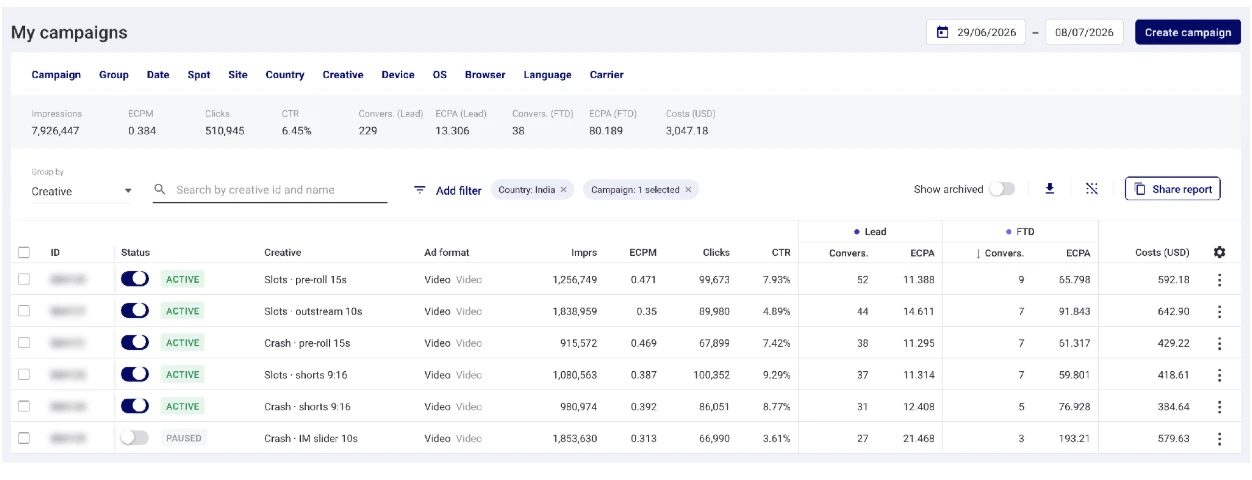
First 30 days (29/06–28/07), grouped by campaign (Lead = registration, FTD = first-time deposit): the discovery test is paused; three dedicated campaigns carry on.
Campaign | Imprs | eCPM | Clicks | CTR | FTD | eCPA | Revenue* | ROI |
|---|---|---|---|---|---|---|---|---|
Discovery — all formats (test) | 7.93M | $0.384 | 511K | 6.45% | 38 | $80.19 | $3,152 | 3% |
Video Pre-Roll — India | 10.70M | $0.487 | 825K | 7.71% | 98 | $53.19 | $8,623 | 65% |
Video Shorts — India | 7.01M | $0.413 | 637K | 9.09% | 51 | $56.73 | $4,138 | 43% |
Video Outstream — select spots | 2.46M | $0.359 | 127K | 5.17% | 14 | $63.15 | $939 | 6% |
Total · 30 days | 28.10M | $0.428 | 2.10M | 7.48% | 201 | $59.89 | $16,852 | 40% |
Revenue comes from the operator’s side, matched to the FTD postbacks — it isn’t shown in the TrafficStars interface. ROI = revenue ÷ media cost − 1.
At $60 per first-time deposit against roughly $84 in attributed revenue per depositor, the 30-day blended return landed at 40% ROI, with 38% of depositors re-depositing within 30 days.
On its own, 40% is a good month. What mattered more: it was a return the operator could stand behind and scale — unlike the 10–15% popunder ceiling he'd been stuck at.
The Bonus Return, Three Months In: +18% Branded Search
The video effect didn't stop at deposits.
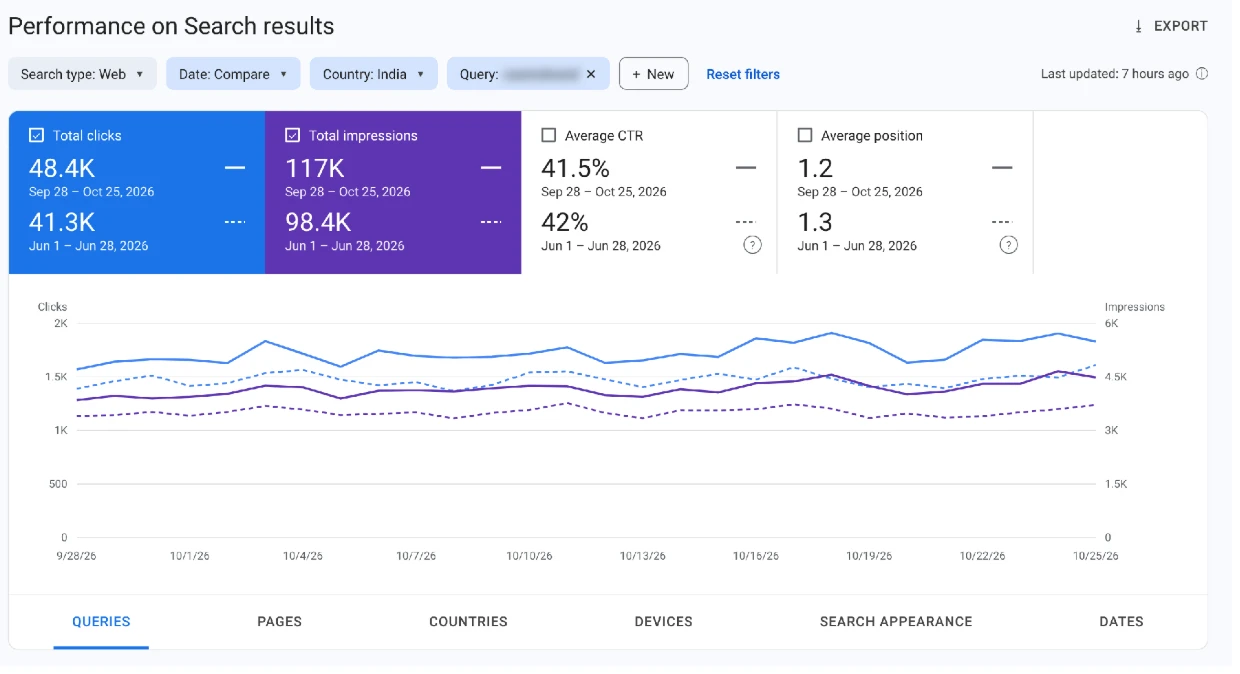
After three months of scaling the same strategy in India, the operator saw branded search for his brand climb roughly 18% versus his pre-video baseline — a halo that popunder and display simply don't produce.
Full-view, sound-on video builds recall, and recall makes every other channel — SEO, direct, affiliate — cheaper.
What You Can Steal From This
Don't confuse profitable with scalable. A 10–15% popunder ROI pays the bills but can't take budget. The goal is a return you can confidently pour into.
Buy on CPM, judge on FTD. Wire the S2S deposit postback before you spend a dollar, and let cost-per-FTD — not CTR or CPM — drive every call.
Let TrafficStars produce the creative. The format only works if the video fits the site and the audience — the in-house studio builds units for Slots, Crash and more.
Launch global, then split to the spot. One discovery campaign across the video mix, then dedicated campaigns per winning spot and creative.
Give it three months for the halo. The branded-search lift compounds as you scale — track it against a clean pre-video baseline.
By testing different video formats, analysing performance at the placement level, and gradually increasing investment in what worked, the operator was able to turn an initial test into a sustainable acquisition channel.
While results will vary depending on the offer, market, and campaign setup, a similar approach can be explored by advertisers looking to expand beyond their existing traffic sources.
Interested in testing video for your own campaigns? Get started on TrafficStars.
Stay ahead of iGaming
Get the week's key stories, industry insight and exclusive interviews in your inbox.
One email a week. Unsubscribe any time. More about our newsletter