What to Expect From a “Provably Fair” iGaming Product Pitch
On October 2, 2026, BGaming published an operator-focused guide explaining how its provably fair technology works and how verification applies to different game categories. The guide offers an example of how suppliers can explain their verification systems to potential business partners.

Provably fair technology has become a selling point for some iGaming suppliers, particularly those developing crypto casino games and other products where players expect greater transparency.
On October 2, 2026, BGaming published an operator-focused guide explaining how its provably fair technology works and how verification applies to different game categories. The guide offers an example of how suppliers can explain their verification systems to potential business partners.
However, a provably fair label is only one part of the equation. Documentation, integration, reporting, and customer support all affect whether the verification system works in practice.
When evaluating a new supplier, operators should focus on whether the supplier can demonstrate how the technology works and provide the infrastructure to support it. Gambling Nerd’s coverage of casino mathematics offers a useful distinction here: verifying a recorded outcome and assessing a game’s underlying probabilities are separate tasks.
Understanding Randomness Before Verification
“Random number generators (RNGs) sit at the heart of most online casino games. Whether you’re spinning a slot, playing roulette, or drawing a card, the RNG supplies the random values the game uses to determine the outcome.” — Shaun Stack
A properly implemented RNG should produce outcomes that follow the game's intended mathematical design without allowing operators or players to manipulate individual results.
Provably fair technology builds on randomness by letting players verify that an outcome matches previously committed information. However, verification and randomness testing aren’t the same.
What Does Provably Fair Actually Prove?
Most provably fair systems use cryptographic techniques that let players verify each game's outcome.
A common approach uses a server seed, a client seed, and a nonce, which is a value that distinguishes individual rounds.
Before gameplay, the supplier commits to information by publishing a cryptographic hash. Once the supplier reveals the necessary information, the player can reproduce the result using a verification program.
If the calculated outcome matches the recorded result, the player has evidence that the outcome matches the committed information.
BGaming's implementation illustrates how these mechanisms can vary between products. Its public documentation explains the use of SHA-256 hashing and game-specific calculations for different categories, including slots, roulette, and card games.
However, successfully verifying an outcome doesn't automatically establish that the underlying game is fair.
For example, a slot could have a theoretical return to player (RTP) of 90% while still using a correctly implemented provably fair verification system. The technology doesn't change the game's RTP or eliminate its house edge.
For further context, Gambling Nerd’s Nerd Nook Hub explores the mathematics behind casino games. Procurement teams can use that grounding to distinguish outcome verification from questions about RTP and house edge.
Similarly, a verification system might reproduce an outcome generated by flawed math.
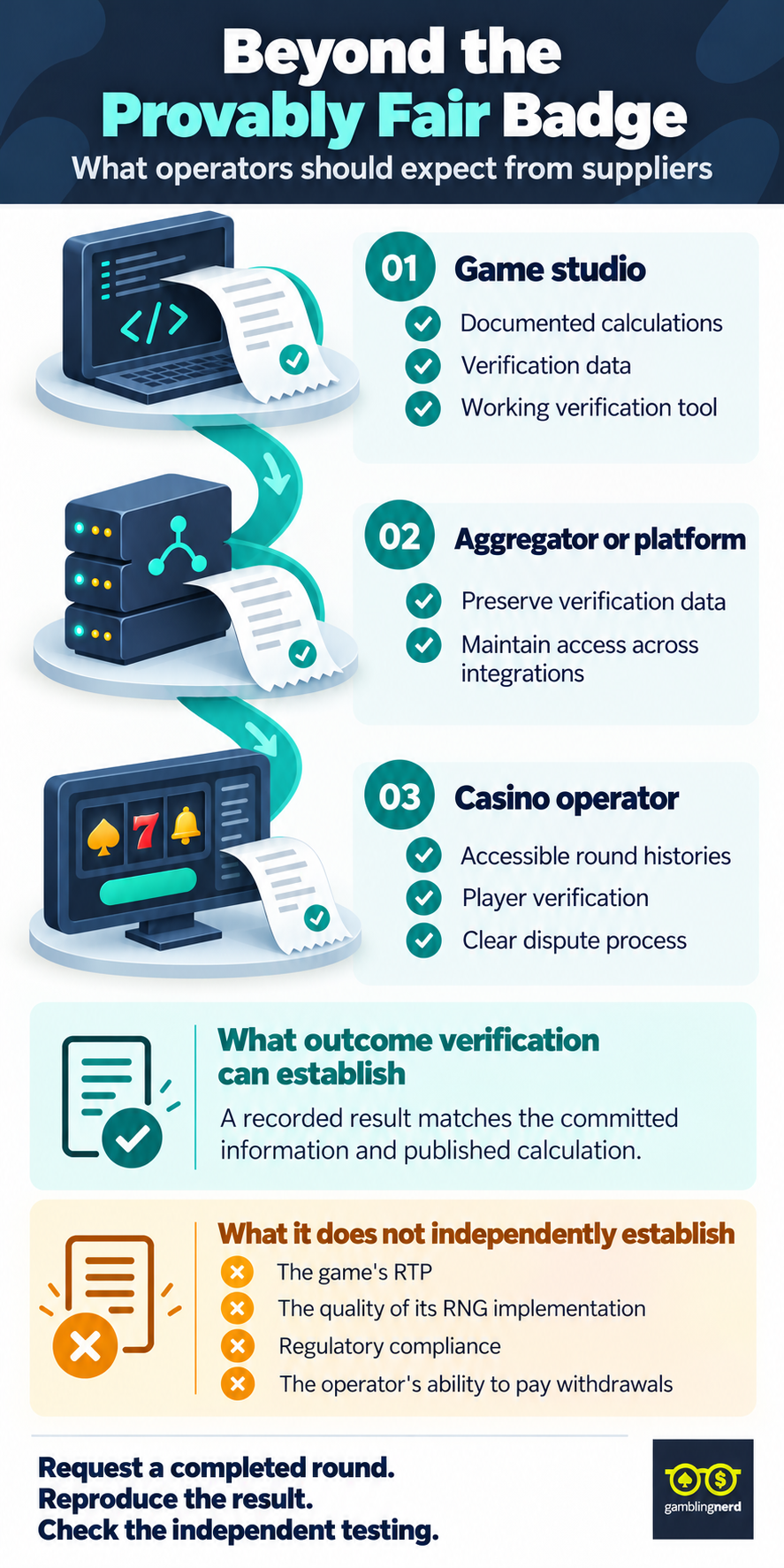
Provably fair technology can help show an outcome wasn't changed, but it doesn't independently certify the game's math, RNG implementation, or regulatory compliance.
That's why operators need to look beyond the verification badge.
What Should Studios Deliver Beyond the Badge?
A provably fair claim should come with the technical resources operators need to verify outcomes, integrate games, and investigate disputes. When evaluating suppliers, operators should focus on several key deliverables.
Verification Data and Documentation
Studios should provide access to the seeds, hashes, round identifiers, and outcomes necessary to verify individual games. Documentation must explain how these values are generated, when they're available, and how they translate into game results.
BGaming's public materials provide examples of these calculations across multiple game categories.
Verification Tools
Operators should expect a built-in or publicly accessible verification tool, along with instructions for reproducing outcomes independently.
Ideally, suppliers should demonstrate a completed round and provide enough information for operators to verify the result independently.
Integration Support
Studios should supply relevant API or SDK documentation explaining how verification data passes through aggregators and platforms to the operator's interface.
They should also document software updates and version changes that could affect verification, ensuring historical outcomes remain reproducible.
Round Histories and Data Retention
Operators need access to historical verification records when investigating player disputes.
Suppliers should set retention periods and retrieval procedures, and confirm whether verification information remains accessible after game updates.
Technical Support
Studios should clarify who handles verification-related inquiries, how disputes are escalated, and what response times operators can expect.
Operators should establish these arrangements before integration, rather than assuming a supplier's standard service agreement includes verification support.
Together, these deliverables help operators determine whether a supplier's provably fair technology can function reliably beyond a product demonstration.
Provably Fair Requires Cooperation Across the Supply Chain
Even a properly implemented verification system can become difficult to use if the necessary information doesn't reach the operator or player.
Studios, aggregators, and operators each have responsibilities.
Game studio | Develop the verification mechanism, provide technical documentation, and generate the necessary game-level data. |
|---|---|
Aggregator or platform provider | Preserve verification information during integration and ensure the relevant data remains accessible. |
Casino operator | Provide player access to verification tools and game histories, investigate disputes, and meet applicable regulatory obligations. |
Problems can arise when verification information doesn't move properly between the studio, aggregator, and operator.
One potential issue is lost or incomplete verification data. An aggregator might display game results without passing along the seeds, hashes, or other information players need to verify them. This can make a provably fair game difficult to verify.
Another concern is limited access to game histories. If players cannot easily retrieve previous rounds, they may be unable to verify disputed outcomes. Operators could also struggle to investigate complaints if historical records are difficult to access.
Finally, inconsistent technical support can complicate disputes. If the operator, aggregator, and studio haven't established who handles verification problems, players may experience delays while the businesses determine who is responsible.
Operators should test the full verification process before launching a game and set clear responsibilities for resolving issues.
Provably Fair Is Not a Substitute for Independent Testing
One of the biggest misconceptions surrounding provably fair technology is that it eliminates the need for independent testing. In reality, the two approaches serve different purposes.
Provably fair verification focuses on whether individual outcomes correspond to the information and calculations used to generate them.
Independent testing laboratories evaluate broader aspects of gaming software, including RNG implementation, statistical performance, game mathematics, and compliance with applicable technical standards.
For example, Gaming Laboratories International's GLI-19 standard addresses RNG functionality, outcome determination, and other technical requirements for interactive gaming systems. The UK Gambling Commission also requires appropriate independent testing of games and RNGs under its remote gambling technical standards and testing strategy.
Provably fair verification is often not enough to meet regulatory requirements. A game may offer cryptographic verification but still require independent certification or additional testing before it can be offered in a particular jurisdiction.
Operators should request applicable testing reports and confirm that certifications cover the relevant game versions, configurations, and markets. They should also establish whether integrating the game through a different platform creates additional testing obligations.
Ultimately, treat provably fair verification and independent certification as complementary safeguards, not alternatives.
Buyer Checklist: Questions to Ask Provably Fair Suppliers
Before signing an agreement with a studio or aggregator, operators should establish whether the supplier can support verification throughout the product's lifecycle.
The following questions provide a starting point for due diligence:
1. What verification data is available? Identify the seeds, hashes, round identifiers, and other information needed to reproduce outcomes. Confirm how long records are retained.
2. Can outcomes be verified independently? Request technical documentation and a working demonstration that allows the operator to reproduce a completed round.
3. Does verification survive platform aggregation or integration? Confirm that aggregators and platform providers preserve the necessary information and that verification tools remain functional.
4. Which games support provably fair verification? Establish whether the feature applies to the supplier's entire portfolio or only selected titles and categories.
5. What independent testing accompanies the product? Request relevant certification reports and confirm they meet the requirements of the operator's target jurisdictions.
6. Who handles verification disputes? Establish responsibilities for investigating player complaints, retrieving historical records, and providing technical support.
Operators should also consider incorporating verification requirements into supplier agreements, including data access, retention periods, and procedures for managing changes to the underlying technology.
The Badge Is Only the Beginning
Provably fair technology can provide additional transparency, but its value depends on how effectively suppliers and operators implement it.
BGaming's operator guide shows how studios can explain their verification mechanisms. However, operators evaluating these products must look beyond the cryptographic process itself.
Reliable documentation, accessible records, compatible platforms, independent testing, and technical support all contribute to a verification system that works in practice.
For iGaming businesses, a provably fair badge should start supplier due diligence, not end it.
About the Author
Shaun Stack is the Editor-in-Chief at GamblingNerd.com and a gambling analyst specializing in sports betting odds, online casino strategy, and betting market analysis. Shaun has published 450+ articles in the iGaming niche and oversees content quality, editorial standards, and betting analysis across Gambling Nerd.
Primary References
● BGaming: Provably Fair Technology in iGaming
● BGaming: Provably Fair Technical Documentation
● GLI-19: Interactive Gaming Systems
● UK Gambling Commission: Testing Strategy